Back to featured insights
13 Types of Website Builders: Which One Is The Best For Your Hong Kong Businesses
This guide explains the main types of website builders for Hong Kong businesses, from editing interfaces and specialized purposes to technical hosting models. Learn how each type impacts performance, scalability, multilingual support, and long-term growth so you can choose the right platform for your business needs.
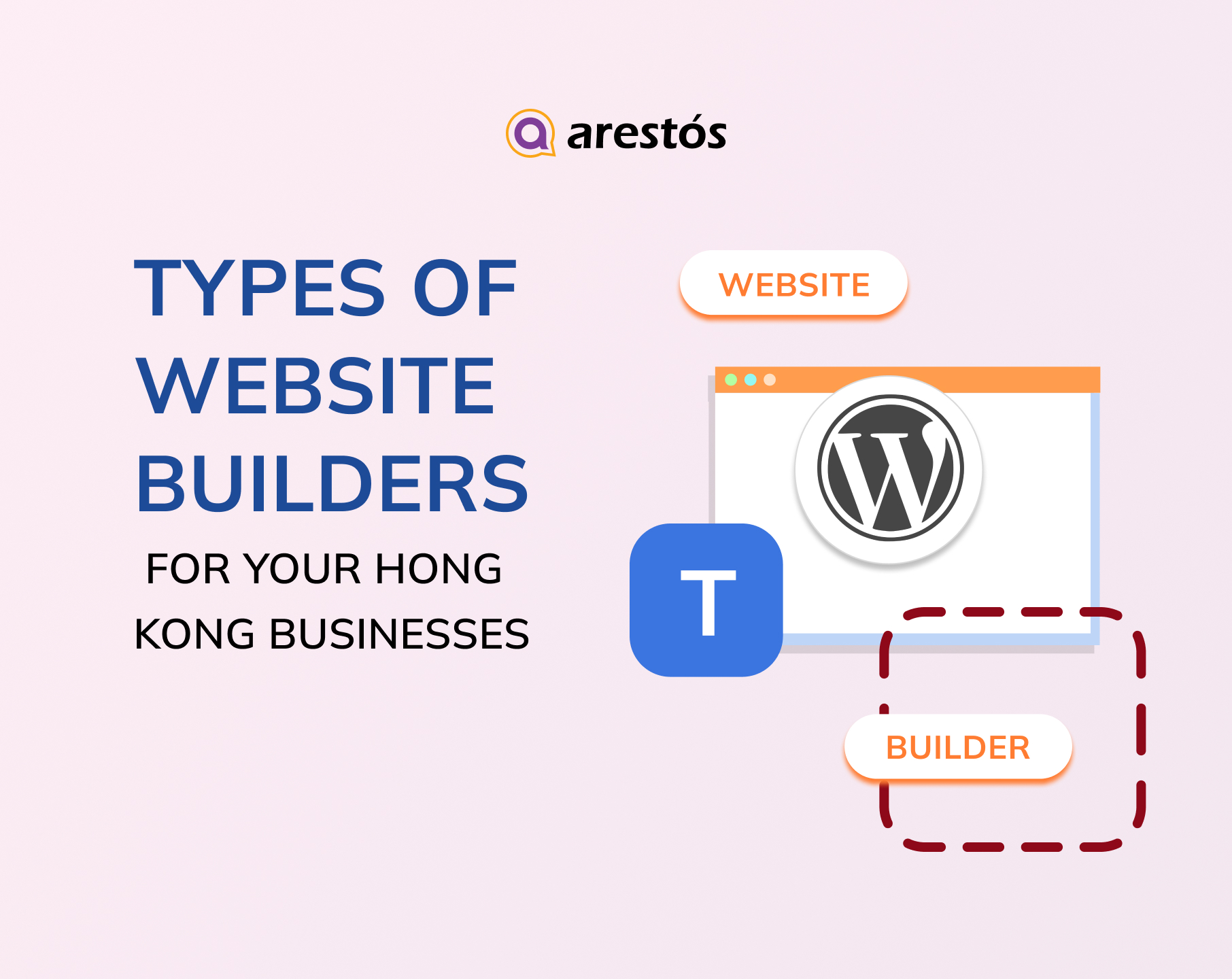

Table of Content
Share
Understanding the types of website builders is essential for Hong Kong businesses planning to build or scale their online presence. Choosing the right website builder helps improve launch speed, cost efficiency, scalability, and long-term performance.
This guide is designed for startups, SMEs, enterprises, and agencies operating in Hong Kong’s competitive and bilingual digital market. In this guide, we break down website builders by editing interface, specialized purpose, and technical hosting model to help you choose the right solution.
What Is A Website Builder?
A website builder is a software platform or tool designed to enable the creation of websites without the need to manually write code. It provides users with pre-built templates, visual editing interfaces, and structured components that abstract away much of the technical complexity involved in web development.
From a theoretical perspective, website builders function as abstraction layers between the user and the underlying web technologies such as HTML, CSS, JavaScript, and server infrastructure. By standardizing layouts, design elements, and workflows, website builders reduce the cognitive and technical barriers required to publish and maintain a website.
Types of Website Builders for Hong Kong Businesses
Website builders can be categorized in several ways depending on how they are built, used, and managed. For Hong Kong businesses, the most practical classification falls into three main groups:
- By Editing Interface
- By Specialized Purpose
- By Technical Hosting Model
Each group addresses different business needs, technical capabilities, and growth scenarios, which we will explore in detail below.
By Editing Interface
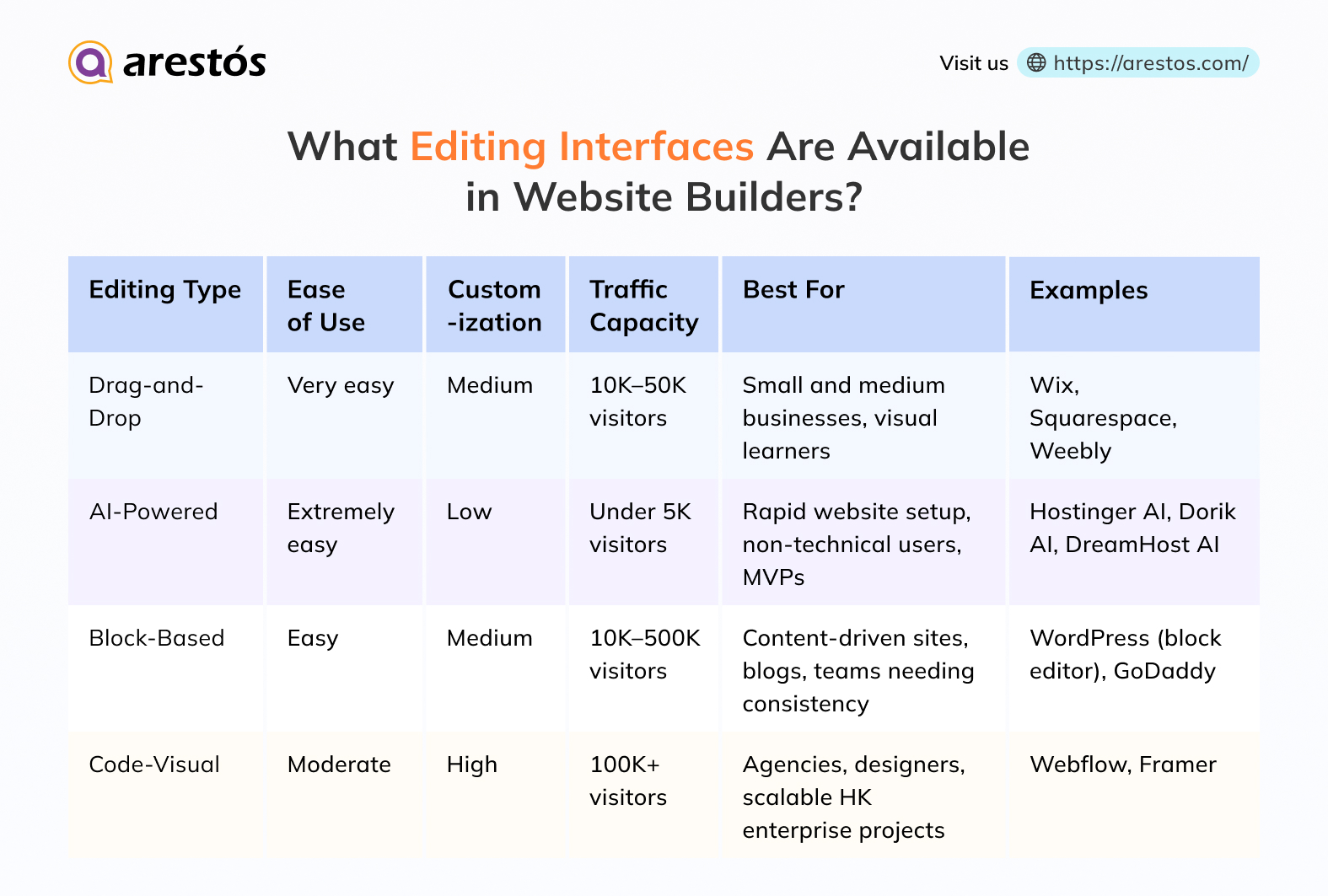
Website builders can be categorized based on how users interact with the design and editing environment. The editing interface determines how content is created, structured, and customized—ranging from fully visual drag-and-drop editors to hybrid interfaces that combine visual controls with code-level customization.
For Hong Kong businesses, this distinction is especially important because it directly affects development speed, design precision, internal skill requirements, and long-term scalability. Choosing the right editing interface helps ensure that the website can be maintained efficiently while still supporting brand consistency and future growth.
Benefits
- Faster or more controlled website creation depending on interface type
- Design flexibility aligned with business and branding needs
- Reduced technical barriers for non-technical teams
- Scalable options for both simple and complex websites
Website builders can be categorized by editing interface, which defines how users create and manage website content.
Drag-and-Drop
Drag-and-drop website builders allow users to create websites by visually placing elements such as text, images, and buttons directly onto the page. This editing style minimizes technical barriers and is widely used by small and medium-sized Hong Kong businesses that need fast deployment with minimal setup complexity.
Examples: Wix, Squarespace, Dorik
AI-Powered
AI-powered website builders use artificial intelligence to generate website layouts, content structures, and design elements automatically based on user inputs. This type of builder is increasingly popular among startups and solopreneurs in Hong Kong who prioritize speed, cost efficiency, and rapid market entry.
Examples: Hostinger AI, Wix ADI, Dorik AI
Block-Based
Block-based website builders construct pages using predefined content blocks or sections that can be rearranged and customized. This approach offers more structure and scalability than drag-and-drop builders while maintaining ease of use, making it suitable for content-driven websites and growing businesses in Hong Kong.
Examples: WordPress (Block Editor), GoDaddy Website Builder
Code-Visual Website Builders
Code-visual website builders combine visual design tools with access to underlying code, allowing advanced customization without abandoning a visual workflow. This type is commonly chosen by agencies, developers, and enterprises in Hong Kong that require high performance, scalability, and precise control.
Examples: Webflow, Framer
By Specialized Purpose
Some website builders are designed with a specific business purpose in mind rather than serving as general website creation tools. These platforms focus on solving particular problems such as online selling, brand presentation, lead generation, or content monetization.
For Hong Kong businesses operating in competitive and fast-moving markets, purpose-built website builders reduce setup time and complexity by offering pre-configured structures and workflows that match real business use cases. This allows companies to launch faster while minimizing the need for custom development.
Benefits
- Faster setup for clearly defined business objectives
- Built-in functionality tailored to specific use cases
- Reduced need for custom development or plugins
- Better alignment between website structure and business model
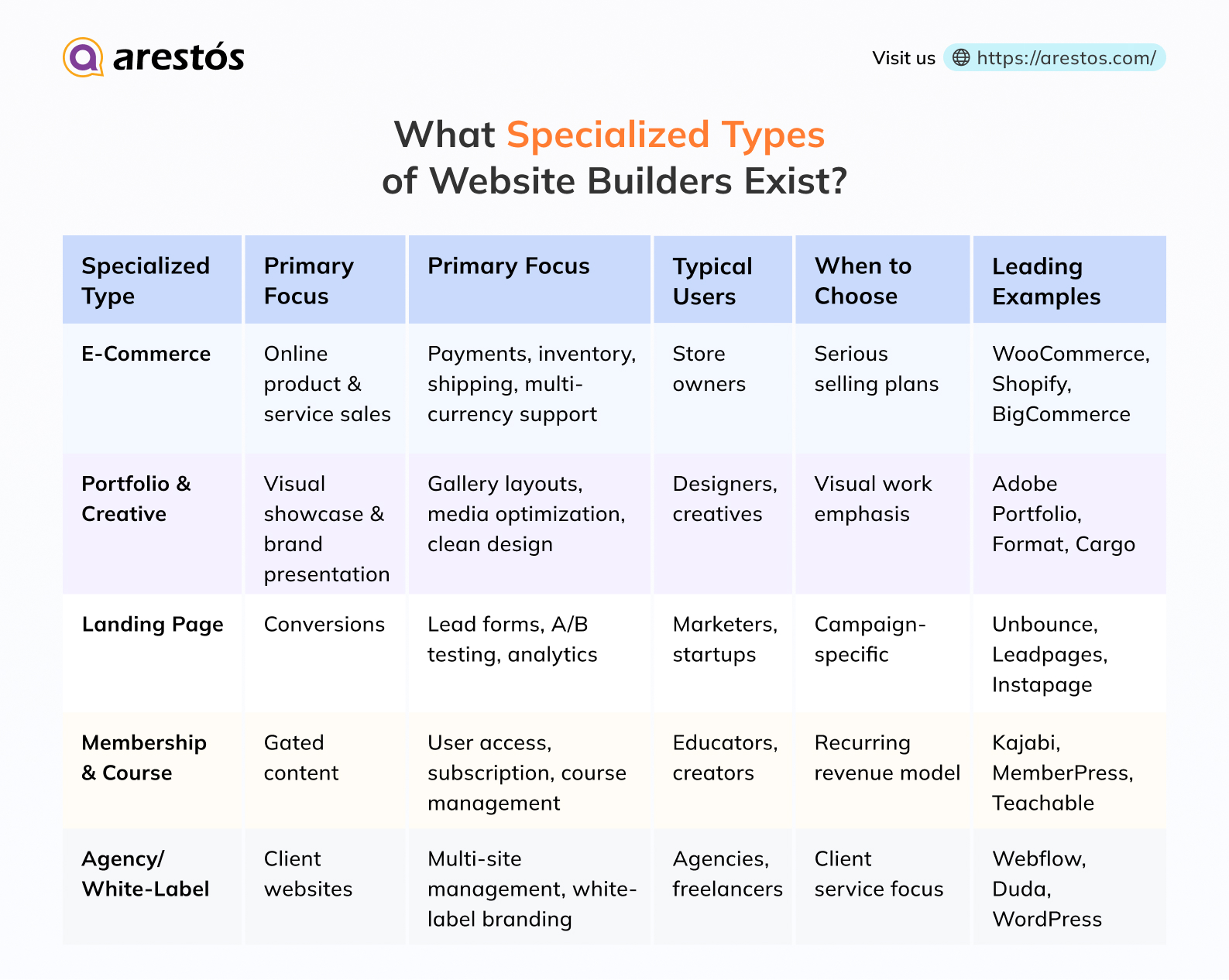
Based on business goals, specialized website builders can be further grouped into several common categories, each designed to support a specific use case.
E-Commerce
E-commerce website builders are designed specifically for selling products and services online, with built-in tools that support product management, payments, and order processing. For Hong Kong businesses operating in competitive retail and cross-border trade environments, this type of builder provides a scalable foundation for online sales without heavy custom development.
Examples: WooCommerce, Shopify, BigCommerce
To explore and compare leading e-commerce solutions in more detail, read Best E-Commerce Platforms in Hong Kong
Portfolio & Creative
Portfolio and creative website builders focus on presenting visual content, personal branding, and creative work in a clean and impactful way. These platforms are widely used by designers, photographers, artists, and creative agencies in Hong Kong where brand image and visual quality are critical.
Examples: Adobe Portfolio, Format, Cargo
Landing Page
Landing page website builders are optimized for creating single-purpose pages focused on conversions, such as lead generation, product launches, or marketing campaigns. This type of builder is commonly used by Hong Kong businesses running performance-driven digital marketing initiatives.
Examples: Unbounce, Leadpages, Instapage
Membership & Course
Membership and course website builders are designed for businesses that offer gated content, online courses, or subscription-based access. In Hong Kong, these platforms are often used by training providers, consultants, and digital product businesses that rely on recurring revenue models.
Examples: Kajabi, MemberPress, Teachable
Agency/ White-Label
Agency and white-label website builders are built for agencies and service providers that manage websites for multiple clients. These platforms allow Hong Kong agencies to deliver scalable website solutions while maintaining brand control, operational efficiency, and client separation.
Examples: Webflow, Duda, WordPress
By Technical Hosting Model
Website builders can also be differentiated by how hosting, infrastructure, and system ownership are managed. This technical classification influences performance, security responsibility, data ownership, and the ability to scale over time.
For Hong Kong businesses—especially those with regional traffic, compliance considerations, or complex integrations—the hosting model plays a critical role in long-term stability and operational control. Selecting the right technical hosting model ensures that the website can support future expansion without creating hidden technical constraints.
Benefits
- Clear understanding of technical control and ownership
- Options to reduce maintenance or retain full infrastructure control
- Better planning for performance, security, and scalability
- Flexibility to support complex or high-traffic websites
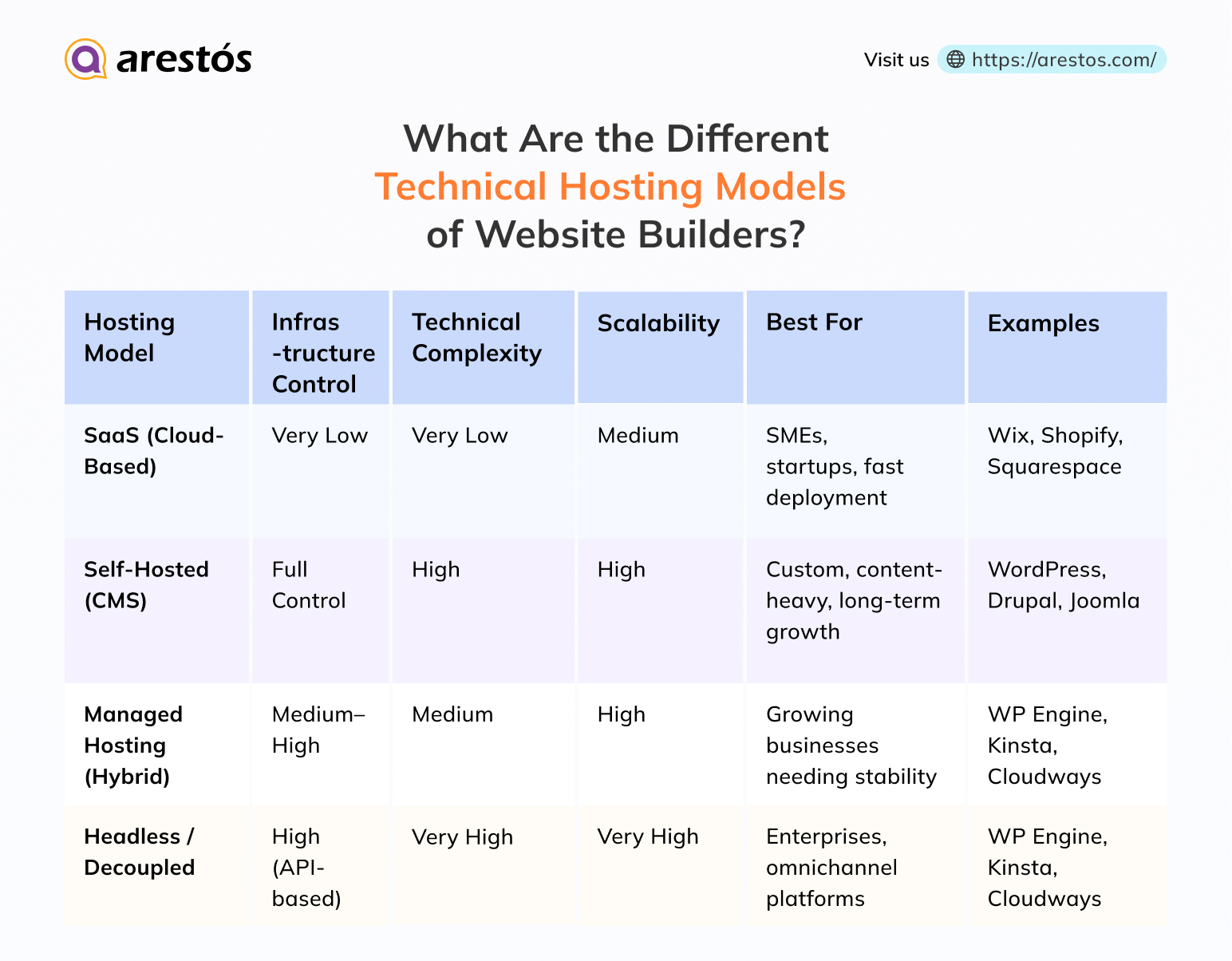
Based on technical requirements and ownership preferences, website builders can be grouped into several common hosting models, each offering a different balance of control, performance, and maintenance responsibility.
SaaS (Cloud-Based)
SaaS (cloud-based) website builders are fully hosted platforms where the provider manages infrastructure, security, updates, and system maintenance. Businesses subscribe to the service and build websites within a controlled environment without handling servers or technical setup. This model is widely used by Hong Kong businesses that prioritize simplicity, speed, and predictable costs.
Examples: Wix, Shopify, Squarespace
Self-Hosted (CMS)
Self-hosted website builders allow businesses to install and manage the CMS on their own hosting environment. This model provides maximum flexibility and data ownership but requires greater technical involvement. In Hong Kong, self-hosted CMS platforms are commonly chosen by businesses that need advanced customization, multilingual content control, and long-term scalability.
Examples: WordPress, Drupal, Joomla
For a deeper comparison of WordPress and other self-hosted CMS options for Hong Kong Businesses, see our guide CMS WordPress vs Other Platforms
Managed Hosting (Hybrid)
Managed hosting website builders combine the flexibility of self-hosted CMS platforms with the convenience of professionally managed infrastructure. In this model, the hosting provider handles server performance, security, and updates, while businesses retain control over content and customization. This approach is popular among Hong Kong businesses seeking scalability without heavy technical maintenance.
Examples: WP Engine, Kinsta, Cloudways
Headless / Decoupled
Headless or decoupled website builders separate the content management system from the front-end presentation layer. Content is delivered via APIs and can be reused across multiple platforms such as websites, mobile apps, and digital interfaces. This model is increasingly adopted by Hong Kong enterprises that require high performance, omnichannel delivery, and advanced customization.
Examples: Contentful, Strapi, Sanity, WordPress (Headless)
How To Choose The Right Type Of Website Builder For Hong Kong Businesses?
Before selecting the right type of website builder, it is essential to understand the unique characteristics of the Hong Kong market that directly influence website strategy and technology choices.
- Bilingual market expectations: Professional websites are expected to support both English and Traditional Chinese to build trust and credibility.
- Strong international orientation: Many businesses serve overseas clients and cross-border markets, requiring scalable and globally compatible website structures.
- High competition across industries: Website performance, SEO visibility, and conversion optimization play a critical role in standing out.
- Mobile-first user behavior: A large portion of traffic comes from mobile devices, especially for eCommerce and service-based websites.
- Demand for fast performance and stability: Users expect fast loading times and reliable uptime in a densely competitive digital environment.
- Complex integration requirements: Businesses often need to integrate payment gateways, CRM systems, logistics tools, and marketing platforms.
- Cost-sensitive but ROI-driven mindset: Companies seek predictable costs while prioritizing long-term scalability and efficiency.
- Rapid business growth potential: Websites must be flexible enough to evolve without requiring frequent platform changes.
A Guide to the Selection Process:
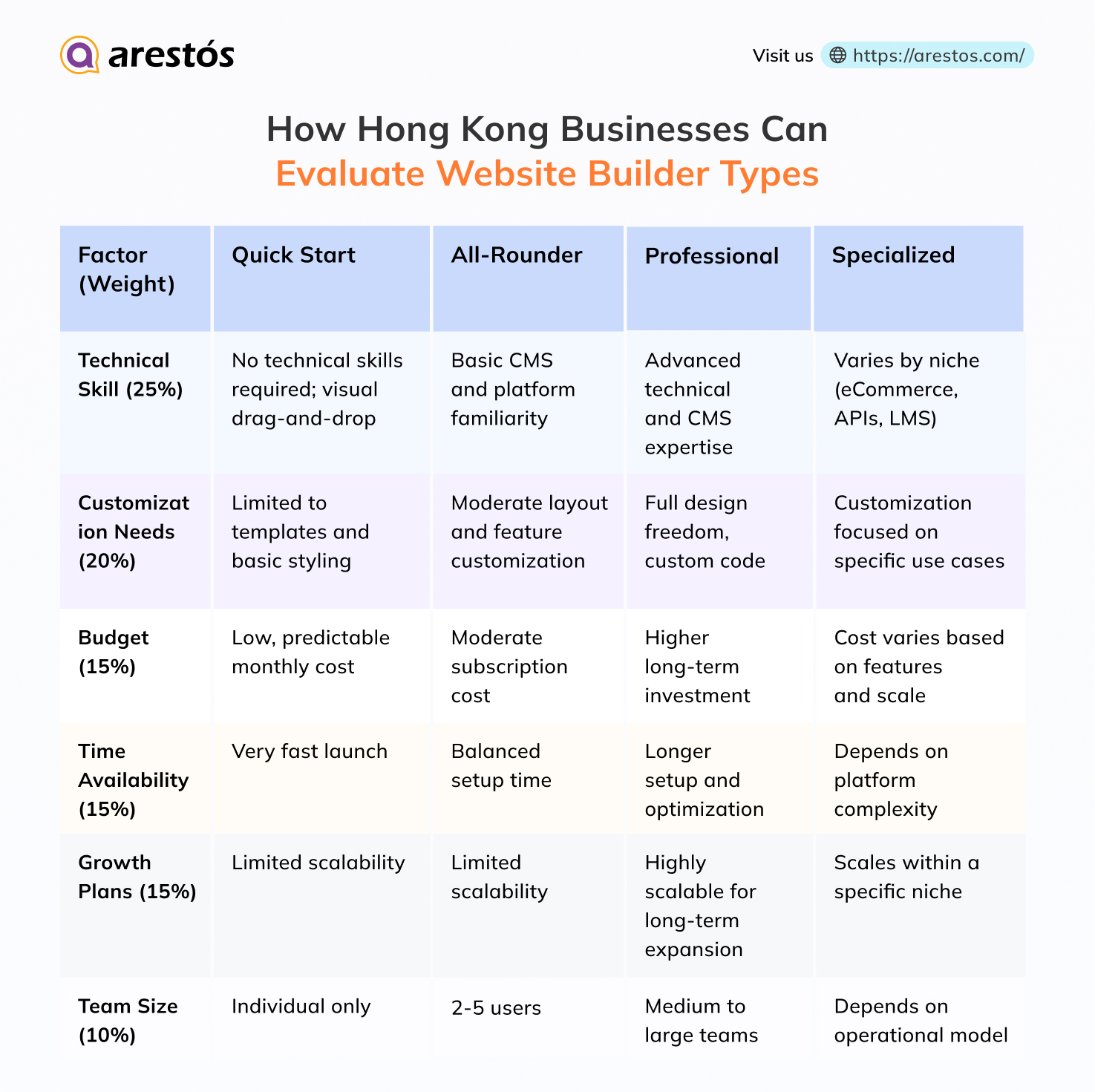
Below is a practical, step-by-step approach to choosing the right website builder for Hong Kong webs.
- current business needs and medium-term growth plans (1–3 years).
- Rate each website builder category on a scale of 1–5 for every factor, apply the assigned weighting, and calculate the overall score.
- Narrow down the highest-scoring options and explore their free trials, paying attention to usability, workflow speed, and feature availability.
- Assess long-term suitability by simulating real use cases such as building pages, managing content, and connecting required tools or integrations.
- Finalize your choice once the platform proves capable of supporting both short-term objectives and future expansion.
Note: Factor weightings should remain flexible. For example, non-technical teams may prioritize ease of use, while growth-focused businesses may assign greater importance to scalability.
How AI Will Influence the Evolution of Website Builders
AI is rapidly transforming website creation by significantly reducing development time and technical complexity. Today, AI-powered website builders can cut website setup time by 70–80%, making them an increasingly attractive alternative to traditional development workflows—especially for businesses that prioritize speed, efficiency, and cost control.
As adoption continues to grow, this shift is driving a new generation of website building defined by automation, adaptability, and data-driven decision-making.
- Automated layout generation tailored to user behavior and device context
- Real-time optimization of content structure and conversion flows
- Lower reliance on coding and advanced technical expertise
- Faster iteration cycles from concept to live deployment
- Improved multilingual content creation and localization accuracy
- Expanded accessibility for startups, SMEs, and lean digital teams
Frequently Asked Questions
1. What are the main types of website builders?
Website builders are commonly categorized by editing interface, specialized purpose, and technical hosting model, including drag-and-drop, AI-powered, e-commerce-focused, self-hosted CMS, and headless platforms.
2. Which type of website builder is best for Hong Kong businesses?
There is no single best option; the right type depends on business goals, budget, technical resources, scalability needs, and bilingual requirements in the Hong Kong market.
3. Are website builders suitable for large or high-traffic websites?
Yes, certain types such as self-hosted CMS, code-visual builders, and headless architectures are capable of supporting high traffic and complex business needs.
4. Can website builders support bilingual websites in Hong Kong?
Many modern website builders support multilingual content, but self-hosted CMS and advanced builders usually offer greater flexibility for managing English and Traditional Chinese content.
Conclusion
Choosing the right type of website builder is a strategic decision that directly affects performance, scalability, and long-term business growth. By understanding website builders through editing interfaces, specialized purposes, and technical hosting models, Hong Kong businesses can avoid common mistakes and select a solution aligned with their goals, budget, and technical capacity.
At Arestós, we help Hong Kong businesses evaluate, plan, and build websites using the most suitable website builder or CMS—whether it’s WordPress, eCommerce platforms, or custom solutions. Our approach focuses on business objectives, multilingual requirements, SEO performance, and future scalability, not just design or technology.
Need expert guidance? Contact us today for professional website consulting and development tailored to your business goals in Hong Kong.
Subscribe to our newsletter!
Get updated to
the lastest IT trends
Related Posts
Update the latest technology trends for your business