Back to featured insights
Hire AI Engineers in Hong Kong: In-House or Offshore?
Should you hire AI engineers in-house or offshore? For Hong Kong enterprises, choosing the right model can make a significant difference in cost and long-term growth. Discover which approach best supports your AI ambitions and business success.
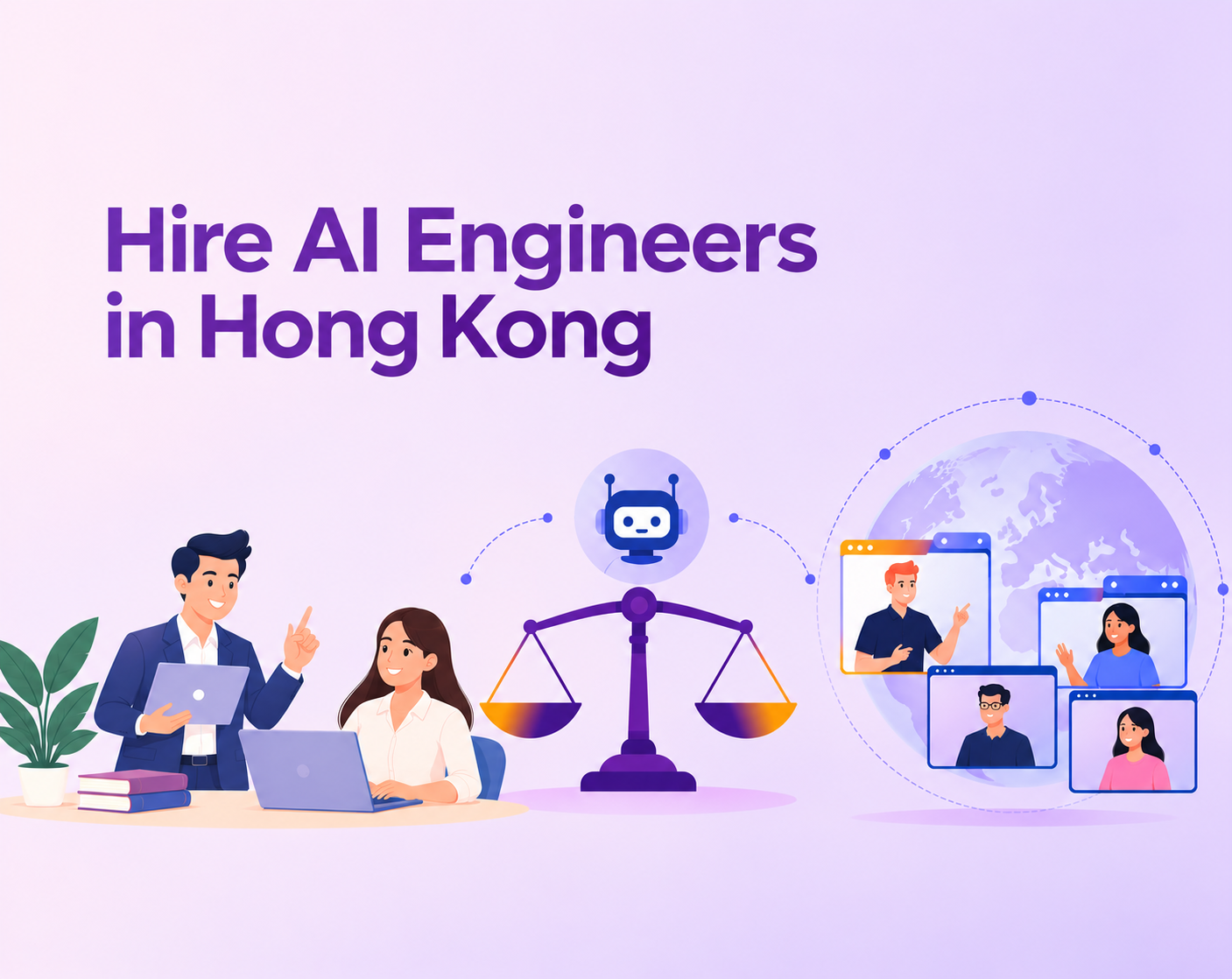
Table of Content
Share
Hiring AI engineers in Hong Kong can be costly and challenging, especially when specialized expertise and long-term commitments are required. Offshore AI staffing offers a more cost-efficient and flexible alternative.
But which hiring model is right for your business? This guide compares in-house vs offshore AI engineers, helping you make an informed hiring decision.
What Does It Mean to Hire AI Engineers In-House or Offshore?
Hiring AI engineers in-house or offshore offers different approaches to building AI capabilities, each with distinct advantages and limitations.
In-House AI Engineers
In-house AI engineers are professionals directly employed by an organization to develop, deploy, and maintain AI solutions. They work closely with internal teams, aligning AI development with business objectives, technical requirements, and long-term strategies.
This model provides greater technical control and stronger internal knowledge retention, making it suitable for enterprises building long-term AI capabilities.
Key Advantages:
- Direct control: Full oversight of AI development, technical decisions, and project priorities.
- Business alignment: Close collaboration with internal stakeholders and deeper understanding of business operations.
- Knowledge retention: AI expertise and technical knowledge remain within the organization.
Key Limitations:
- Higher costs: Competitive Hong Kong salaries, recruitment expenses, benefits, and operational overhead.
- Longer hiring cycles: Recruiting specialized AI engineers can be time-consuming.
- Limited flexibility: Permanent employment commitments make team scaling more difficult.
Best suited for: Enterprises developing proprietary AI solutions, handling sensitive systems, or requiring long-term internal AI expertise.
Offshore AI Engineers
Offshore AI engineers are professionals working remotely from another country, typically hired through an offshore staffing provider. They support AI development, deployment, and maintenance while integrating with the client’s existing engineering team.
Unlike project-based outsourcing, where an external vendor manages specific deliverables, dedicated offshore staffing allows businesses to retain direct control over technical decisions, workflows, and project priorities. The staffing provider typically handles recruitment, payroll, and HR administration.
Arestós Offshore AI & ML Engineers helps Hong Kong enterprises access dedicated AI talent while maintaining technical oversight.
Key Advantages:
- Cost efficiency: Lower engineering labor costs compared with local hiring in Hong Kong.
- Broader talent access: Access specialized AI, ML, LLM, and MLOps expertise beyond the local market.
- Flexible scaling: Expand engineering capacity according to project requirements.
- Reduced HR burden: Staffing providers handle recruitment and employment administration.
Key Limitations:
- Remote collaboration: Requires clear communication, workflows, and coordination.
- Data security: Cross-border access requires appropriate security and compliance controls.
- Knowledge continuity: Documentation and knowledge transfer are essential to reduce dependency on external engineers.
Best suited for: Hong Kong enterprises seeking cost-efficient AI engineering capacity, specialized expertise, or flexible team expansion while retaining control over AI development.
Why Is Hiring AI Engineers Challenging for Hong Kong Enterprises?
Hiring AI engineers in Hong Kong presents several challenges, from high employment costs to finding specialized talent and meeting evolving AI project demands.
The Cost of Hiring Specialized AI Talent in Hong Kong
Hiring specialized AI engineers in Hong Kong requires substantial investment, particularly as enterprises compete for advanced technical expertise.
- High salary expectations: Specialized AI engineers command premium compensation, making traditional IT hiring budgets insufficient for building dedicated AI teams.
- 2026 salary benchmarks: According to Morgan McKinley’s 2026 Hong Kong Salary Guide, median monthly salaries reach HK$65,000 for ML Engineers and HK$55,000 for MLOps Engineers, excluding recruitment fees, benefits, and employment overhead.
- Multi-role hiring costs: Production-ready AI systems often require Data Engineers, ML Engineers, and MLOps specialists. Hiring multiple professionals significantly increases total staffing expenditure.
Matching AI Expertise to Business Requirements
Hiring the right AI engineers goes beyond technical qualifications, as different AI initiatives require distinct skills and practical experience.
- Specialized AI competencies: “AI Engineer” is a broad term covering different specializations, including data engineering, Generative AI development, LLM fine-tuning, Retrieval-Augmented Generation (RAG), and MLOps. Businesses must identify the specific expertise their AI projects require rather than hiring based on generic job titles.
- Limited production experience: Candidates may have strong theoretical AI knowledge but lack hands-on experience deploying, integrating, and maintaining AI systems in production. This makes it challenging to identify engineers capable of delivering reliable, scalable AI solutions.
Balancing Hiring Speed with Long-Term Commitments
Hiring AI engineers in Hong Kong requires enterprises to balance recruitment speed with long-term workforce costs, particularly as AI project requirements continue to evolve.
- Lengthy recruitment cycles: Traditional in-house hiring can take 60–90 days or longer for specialized AI roles, potentially delaying development and reducing time-to-market. This is an illustrative timeframe, not a verified Hong Kong market average.
- High fixed employment commitments: AI projects often require different expertise across development, deployment, and maintenance. Maintaining permanent specialists during periods of lower demand can increase staffing costs and reduce workforce flexibility.
In-House vs Offshore AI Engineers: How Do They Compare?
Comparing in-house and offshore AI engineers across key factors helps Hong Kong enterprises identify the most suitable hiring model for their business needs.
| Decision Factor | In-house AI Engineers | Offshore AI Engineers |
|---|---|---|
| ▣Hiring costs | Higher local salaries and recruitment agency fees | Lower labor costs with monthly provider fees |
| ◷Onboarding speed | Longer hiring cycles (30–90 days, depending on notice periods) | Potentially faster onboarding (2–4 weeks with pre-vetted candidates) |
| ♧Specialized talent access | Primarily limited to the Hong Kong talent market | Access to a broader pool of specialized AI engineers |
| ⚙Technical control | Direct supervision and internal code reviews | Client-led remote management with structured workflows |
| ↗Scalability | Less flexible due to permanent employment commitments | Easier to scale teams based on project requirements |
| ◇Data security | Governed by internal controls | Requires cross-border access and vendor controls |
| ▤Knowledge retention | Stronger internal knowledge continuity | Maintained through documentation and knowledge transfer |
Which Model Offers Better Technical Control and Quality?
Both hiring models can deliver high-quality AI solutions, but they differ in how technical oversight, collaboration, and engineering standards are managed.
- In-House AI Engineers: Offer direct technical supervision, closer collaboration with internal teams, and greater visibility into daily development. This facilitates architecture decisions, code reviews, and quality control.
- Offshore AI Engineers: Can maintain comparable engineering standards under client-led technical management. However, effective delivery requires structured code reviews, clear communication, comprehensive documentation, and consistent security and development practices.
Key takeaway: Engineering quality depends more on technical leadership and governance than physical location. With proper management, offshore AI engineers can deliver quality comparable to in-house teams.
Which Model Is More Flexible for Scaling AI Teams?
Scaling AI teams requires businesses to adjust engineering capacity as project demands evolve. In-house and offshore hiring offer different levels of workforce flexibility.
- In-House AI Engineers: Scaling requires additional recruitment, onboarding, and long-term employment commitments. This can increase fixed costs and make it harder to adjust team size when project requirements change.
- Offshore AI Engineers: Dedicated offshore staffing enables businesses to expand or reduce engineering capacity based on project needs, often with provider-supported recruitment and onboarding. However, scaling flexibility depends on contract terms, while vendor dependency and knowledge continuity require careful management.
Key takeaway: Offshore AI staffing generally offers greater flexibility for scaling AI teams, particularly for enterprises with fluctuating workloads or evolving technical requirements.
How Much Does It Cost to Hire AI Engineers In-House vs Offshore?
Comparing the total costs of in-house and offshore AI engineers reveals how Hong Kong enterprises can optimize hiring expenses and achieve potential cost savings.
The True Cost of Hiring In-House AI Engineers in Hong Kong
Hiring AI engineers in-house involves more than base salaries. Hong Kong enterprises must also account for recruitment, employee benefits, and operational expenses, which significantly increase the total cost of maintaining an internal AI team.
- Base salary: According to Morgan McKinley’s 2026 Hong Kong Salary Guide, ML Engineers earn a median HK$65,000 per month, equivalent to HK$780,000 annually.
- Recruitment costs: Agency placement fees, candidate screening, technical assessments, and onboarding expenses.
- Employment overhead: Mandatory Provident Fund (MPF) contributions, employee benefits, bonuses, and insurance.
- Operational costs: Workstations, software licenses, office facilities, and ongoing administrative support.
These additional expenses make in-house AI hiring a substantial long-term financial commitment, particularly when building teams with multiple specialized engineers.
Estimated Year-1 Local In-House Cost Matrix
Based on Morgan McKinley’s 2026 Salary Guide and MPFA data, the table below estimates first-year in-house ML Engineer hiring costs in Hong Kong, with recruitment fees included as an assumption.
| Cost Component | Details | Total Annual Footprint |
|---|---|---|
| Base Salary | Median monthly rate of HK$65,000 | HK$780,000 |
| Employer MPF Contribution | Statutory cap maximums | HK$18,000 |
| Recruitment Placement Fee | Industry standard tier (15%–25%) | HK$117,000–HK$195,000 |
| Hardware & Enterprise Tooling | Dedicated workstations, cloud IDE seats, onboarding | HK$30,000+ |
| Estimated Year-1 Local Capital Spend | Total Consolidated Outlay | HK$945,000–HK$1,023,000+ |
How Much Does Offshore AI Staffing Cost?
Offshore AI staffing offers Hong Kong enterprises a potentially more cost-efficient approach to building AI teams, with total expenses depending on the staffing model and project requirements.
| Cost Component | Monthly Equivalent | Total Annual Footprint |
|---|---|---|
| Base Resource Compensation | HK$13,184 / Month | HK$157,248 |
| Statutory Local Employer Contributions | Regional compliance overhead (22%) | HK$34,595 |
| Staffing Provider Admin & EOR Fees | Infrastructure, HR administration (25%) | HK$39,312 |
| Dedicated Workplace Overhead | Secure facility workspace, hardware provision | HK$18,720 |
| Estimated Annual Strategic Outlay | Total Consolidated Spend | HK$249,875 |
Estimated Annual Offshore Staffing Costs Key takeaway: Offshore AI staffing can offer substantial cost advantages by accessing lower-cost engineering talent markets and potentially reducing recruitment and administrative overhead.
For a more detailed cost breakdown, explore our guide on Hiring AI Engineers in Hong Kong: In-House vs Offshore Costs.
Why Offshore AI Staffing Is a Cost-Efficient Choice for Hong Kong Enterprises
Offshore AI staffing helps Hong Kong enterprises reduce engineering expenses while maintaining access to specialized AI talent and allocating resources more efficiently.
- Significant cost savings: Offshore staffing can substantially reduce engineering expenditure compared with local hiring. Illustrative cost models suggest potential savings of 60–75%, although actual savings depend on provider fees, technical requirements, and operating costs.
- Reduced administrative burden: Offshore staffing providers handle recruitment, payroll, employment compliance, and HR administration, reducing the operational workload for internal teams.
- Better AI budget allocation: Businesses can redirect potential staffing savings toward GPU computing, cloud infrastructure, model fine-tuning, and other critical AI development activities.
For Hong Kong enterprises seeking cost-efficient AI teams, Arestós Offshore AI & ML Engineers provide options for accessing dedicated technical talent while retaining control over AI development.
When Should You Hire AI Engineers In-House, Offshore or Hybrid?
Choosing the right AI hiring model is essential for Hong Kong enterprises to build an effective and sustainable AI engineering team.
Choose In-House AI Engineers When…
In-house hiring is best suited for enterprises that consider AI a core business capability and require long-term technical ownership.
- Long-term AI strategy: AI development is central to the company’s competitive advantage and requires continuous innovation.
- Close internal collaboration: AI engineers need frequent interaction with business teams to align development with operational requirements.
- Sensitive data and systems: Projects involve confidential information or critical infrastructure that benefits from tightly controlled internal environments.
- Sufficient resources: The organization has the financial capacity and technical leadership to recruit, manage, and retain a permanent AI team.
Choose Offshore AI Engineers When…
Offshore AI staffing is ideal for enterprises seeking specialized AI expertise, cost-efficient hiring, and greater flexibility without expanding permanent local headcount.
- Specialized AI expertise: Businesses need additional AI, ML, LLM, or MLOps capabilities that are difficult or costly to source locally.
- Cost optimization: High local salaries and employment overhead make offshore staffing a more cost-efficient alternative.
- Flexible scalability: AI workloads fluctuate, requiring businesses to expand or reduce engineering capacity as project needs change.
- Internal technical leadership: The organization has experienced technical managers who can supervise distributed AI engineers and maintain development standards.
- Security and IP protection: Appropriate data access controls, confidentiality agreements, and intellectual property safeguards can be established.
Consider a Hybrid AI Team When…
A hybrid AI team combines in-house technical leadership with offshore engineering expertise, allowing enterprises to maintain strategic control while expanding development capacity.
- Strategic ownership: In-house teams in Hong Kong oversee AI strategy, system architecture, critical decisions, and project priorities.
- Specialized execution: Offshore engineers support model development, AI application development, testing, and MLOps under internal technical supervision.
- Balanced scalability: Businesses retain core AI knowledge internally while accessing flexible offshore resources to accelerate development and control staffing costs.
What Risks Should You Consider Before Hiring Offshore AI Engineers?
Before hiring offshore AI engineers, Hong Kong enterprises should understand the potential risks and how to manage them effectively.
Data Security, Intellectual Property and Compliance
Offshore AI development can introduce security and compliance challenges, particularly when external engineers access proprietary models, sensitive business information, or internal systems.
The key concern is not simply where engineers work, but how businesses control data access and intellectual property.
| Potential Risk | Recommended Safeguard |
|---|---|
| Unauthorized Data Access | Role-based permissions, encryption, and audit logs |
| IP Ownership Disputes | Clear contractual ownership and IP assignment clauses |
| Regulatory Non-Compliance | PDPO-aligned data handling and applicable industry controls |
| Cross-Border Data Exposure | Data minimization, anonymization, and secure remote environments |
Hong Kong enterprises should follow guidance from the Office of the Privacy Commissioner for Personal Data (PCPD). Offshore development does not necessarily require transferring raw personal data abroad when appropriate technical safeguards are implemented.
Communication, Quality and Talent Continuity
Beyond security, offshore AI teams may face challenges related to remote collaboration, inconsistent engineering practices, and employee turnover. These risks can be addressed through three management priorities:
| Management Priority | Recommended Approach |
|---|---|
| Clear Communication | Establish shared project requirements, overlapping working hours, and regular sprint reviews to keep distributed teams aligned. |
| Consistent Engineering Quality | Apply shared coding standards, peer reviews, automated testing, and technical documentation across internal and offshore teams. |
| Long-Term Talent Continuity | Maintain knowledge-transfer processes, backup ownership, and replacement plans to minimize disruptions when team members change. |
How to Hire the Right AI Engineers for Your Business
Hiring the right AI engineers requires a structured approach to ensure businesses find talent that aligns with their development needs and long-term goals.
Step 1 — Define Your AI Project and Required Skills
Before hiring AI engineers, clearly define your project’s objectives, development stage, and technical requirements to ensure you recruit the right expertise.
- Identify project goals: Determine the business problem your AI solution will address, its current development stage, and expected outcomes.
- Define technical requirements: Identify whether your project requires Machine Learning (ML), Large Language Models (LLMs), data engineering, AI application development, or MLOps expertise.
- Establish hiring criteria: Specify the required experience level, key deliverables, and technical responsibilities to ensure candidates match your project needs.
Step 2 — Evaluate the Hiring Model and Budget
Once your AI requirements are defined, the next step is to select a hiring model that balances cost, technical control, and project flexibility.
Start by comparing three hiring options: in-house hiring for long-term internal capabilities, offshore staffing for cost-efficient and flexible engineering capacity, or a hybrid model that combines both approaches.
Next, calculate the total hiring budget, including recruitment expenses, employment costs, operational overhead, and the expected project duration. Consider how quickly engineers need to be onboarded and whether staffing requirements may change.
Finally, assess your internal management capacity. Regardless of the hiring model, effective AI development requires technical leadership, clear responsibilities, and consistent quality oversight.
Step 3 — Assess Technical and Delivery Capabilities
Before hiring AI engineers, prioritize proven technical expertise and practical delivery experience over qualifications alone.
- Technical capabilities: Use hands-on assessments to evaluate AI model deployment, data engineering, testing, monitoring, and production troubleshooting.
- Collaboration and security: Assess communication skills, security awareness, and the ability to work effectively within established engineering workflows.
- Offshore provider reliability: For offshore hiring, verify the provider’s candidate screening standards, replacement policies, and knowledge continuity arrangements to minimize delivery risks.
Step 4 — Onboard, Measure and Scale
Once AI engineers are hired, a structured onboarding and performance management process is essential to ensure smooth integration and long-term productivity.
- Onboarding and ownership: Define project deliverables, technical responsibilities, repository access, and code ownership to establish clear accountability from the start.
- Performance measurement: Track engineering KPIs such as deployment reliability, delivery cycle time, model performance, and operational stability to evaluate development effectiveness.
- Continuous optimization: Review team performance and staffing requirements at key project milestones, adjusting engineering capacity as business needs evolve.
For businesses choosing offshore hiring, Arestós Offshore IT Staffing Services offers support with talent sourcing, onboarding, and staffing administration, helping enterprises scale their AI engineering teams while retaining technical control.
Hire Offshore AI & ML Engineers with Arestós
Building a skilled AI engineering team doesn’t have to mean higher recruitment costs or long-term employment commitments. Arestós, a Hong Kong-based IT solutions and offshore staffing provider, helps enterprises access dedicated AI and ML engineers while maintaining control over their development projects.
Through our Offshore AI & ML Engineers service, we support businesses with talent sourcing, candidate screening, onboarding, and ongoing HR administration. Our staffing approach enables offshore engineers to integrate with your existing teams, follow your technical direction, and adapt to evolving project requirements.
Whether you’re expanding AI capabilities or building a dedicated engineering team, Arestós offers a flexible, cost-conscious staffing approach designed to support your long-term development goals.
Frequently Asked Questions
1. Is it cheaper to hire AI engineers offshore than in-house in Hong Kong?
Yes. Offshore AI staffing can significantly reduce hiring costs through lower labor expenses and reduced HR overhead. Actual savings depend on provider fees and project requirements.
2. How long does it take to hire offshore AI engineers compared to in-house recruitment?
Offshore hiring may take 2–4 weeks with pre-vetted candidates, while specialized in-house recruitment can take 60–90 days or longer. Timelines vary by role and provider.
3. What AI engineering roles are suitable for offshore staffing?
Common roles include ML Engineers, LLM Engineers, Data Engineers, AI Application Developers, and MLOps Engineers.
4. How can Hong Kong companies maintain control over offshore AI engineers?
Through dedicated offshore staffing, businesses retain technical oversight by managing tasks, code reviews, project priorities, and performance directly.
5. How can businesses protect sensitive data and intellectual property when hiring offshore AI engineers?
Use NDAs, clear IP ownership agreements, role-based access controls, and secure development environments while meeting applicable PDPO requirements.
6. Should enterprises hire AI engineers in-house, offshore, or use a hybrid model?
Choose in-house for long-term AI ownership, offshore for cost efficiency and flexibility, or hybrid to combine internal control with scalable engineering capacity.
Conclusion
Choosing between in-house and offshore AI engineers depends on your business needs and long-term goals. While in-house hiring offers direct control and internal expertise, offshore staffing provides a more cost-efficient and flexible way to build AI capabilities.
For Hong Kong enterprises looking to optimize hiring costs without compromising technical oversight, offshore AI staffing is worth considering.
Contact us today to discuss your AI engineering needs and discover how Arestós can help you build a cost-efficient, scalable offshore AI team.
Subscribe to our newsletter!
Get updated to
the lastest IT trends
Related Posts
Update the latest technology trends for your business