Back to featured insights
WordPress vs Custom CMS for Hong Kong Companies
Choosing between WordPress and a Custom CMS is not about which platform is better, but which one fits your business. This guide helps Hong Kong companies understand the key differences and choose a website solution that supports their needs today and future growth.

Table of Content
Share
Choosing between WordPress vs Custom CMS can significantly affect a Hong Kong company’s development costs, scalability, security, and long-term maintenance. The right platform can help businesses launch efficiently while supporting future growth and evolving technical requirements.
This guide is designed for Hong Kong business leaders and decision-makers evaluating the best CMS solution for their organisation. In this article, we’ll help you understand the key differences between WordPress and Custom CMS and choose the right option for your business.
What Is WordPress?
WordPress is an open-source content management system (CMS) used to build and manage websites. Its self-hosted version, WordPress.org, gives businesses flexibility to customise their sites with themes, plugins, and custom code, while WordPress.com offers a more managed hosting experience.
With a large ecosystem of plugins and themes, WordPress can support everything from corporate websites and content hubs to online stores through WooCommerce. For many Hong Kong SMEs, it remains a popular choice because it offers a practical balance of cost, speed, flexibility, and easy access to local freelancers and agencies.
If you’re looking to get started with WordPress, explore our guide on How to Build a Basic WordPress Website for Hong Kong Businesses.
What Is a Custom CMS?
A custom CMS is a content management system built or heavily configured around a company’s specific data models, workflows, and operational requirements, rather than using a general-purpose, off-the-shelf platform.
This can range from a fully bespoke system developed from scratch to a composable or headless platform such as Contentful, Strapi, or Sanity that is extensively configured for a company’s needs. Headless WordPress sits somewhere in between, combining WordPress as the content backend with a separate front-end architecture—a hybrid approach explored later in this article.
In Hong Kong, custom CMS solutions are typically considered by organisations with more complex digital requirements, such as banks and insurers, listed conglomerates, multi-brand retail groups, government-adjacent bodies, and SaaS platforms.
WordPress vs Custom CMS: Side-by-Side Comparison
The table below provides a side-by-side comparison of WordPress and Custom CMS across the key factors Hong Kong companies should consider.
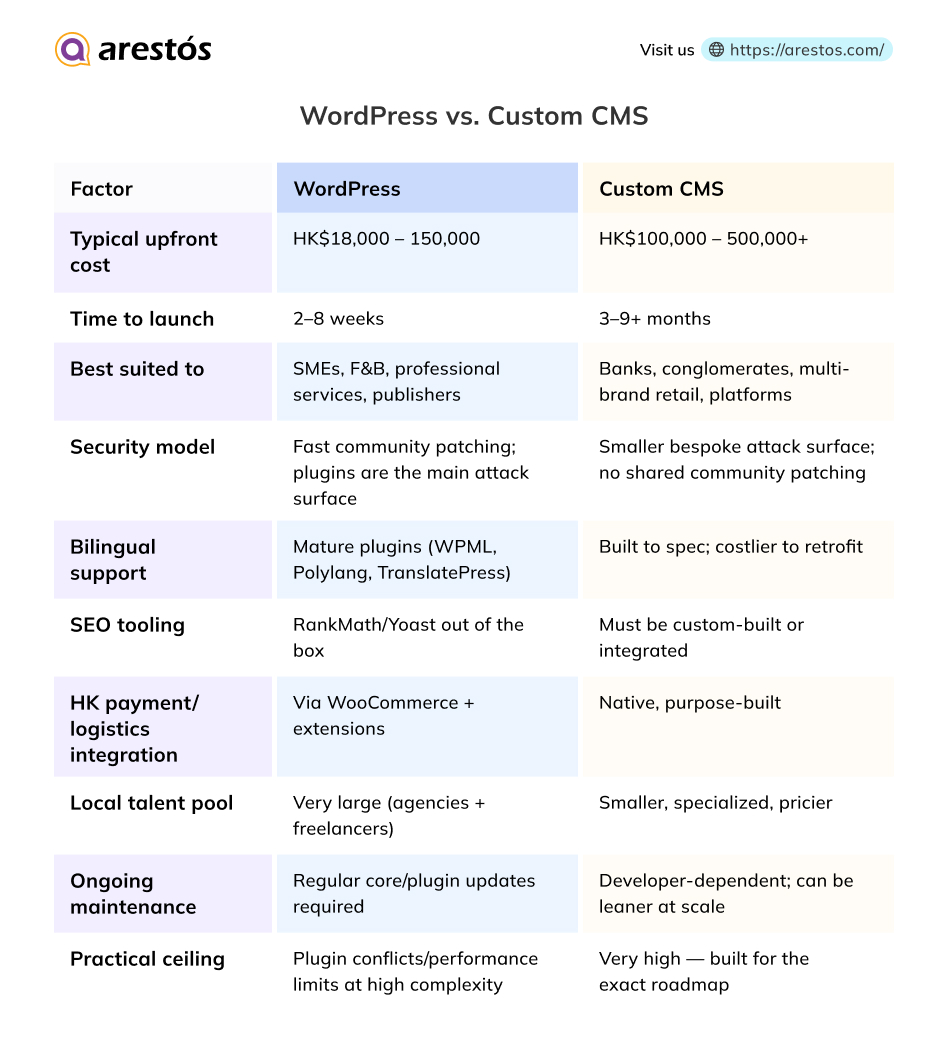
WordPress vs Custom CMS for HK companies: The Key Difference
Both WordPress and a Custom CMS can support business growth, but they differ in how they approach flexibility, scalability, and long-term management.
Cost Comparison: What Hong Kong Companies Actually Pay
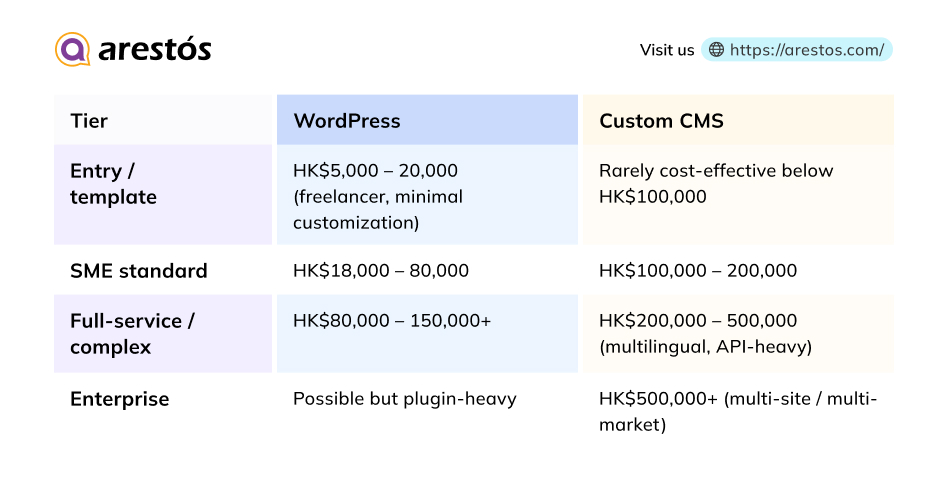
The table below compares the real costs of WordPress and a custom CMS for Hong Kong companies.
Flexibility and Customisation
Both WordPress and a custom CMS can be tailored to business needs, but they take different approaches.
WordPress
- Offers flexibility through themes, plugins, and custom code.
- Allows businesses to add new features without building everything from scratch.
- Can become harder to manage when extensive customisation and multiple plugins are required.
Custom CMS
- Can be designed around the company’s exact data models, workflows, and business requirements.
- Provides greater control over how features and integrations are built.
- Requires more development time and technical resources upfront.
In short, WordPress is often more flexible for standard and evolving website needs, while a custom CMS offers greater flexibility when the business itself has highly specific requirements that off-the-shelf platforms cannot easily support.
Security and PDPO Compliance: Which Platform Protects You Better?
Neither WordPress nor a custom CMS automatically makes a Hong Kong company PDPO-compliant. Compliance depends on how personal data is collected, stored, protected, and managed.
WordPress
- Benefits from a large security community and frequent updates.
- Most security risks come from third-party plugins and themes, making careful plugin selection, updates, and ongoing maintenance essential.
- Can meet strong security and privacy standards with the right architecture and governance.
Custom CMS
- Can have a smaller, less publicly exposed attack surface.
- Allows security and privacy by design to be built around the company’s specific requirements from day one.
- Places full responsibility for identifying, fixing, and maintaining security vulnerabilities on the organisation and its development team.
Regardless of the platform, Hong Kong companies must follow the PDPO’s six Data Protection Principles (DPPs), overseen by the PCPD. Privacy policies, appropriate cookie controls, access management, and data-retention limits are essential on both platforms.
Larger or regulated organisations may also face additional obligations under the Protection of Critical Infrastructures (Computer Systems) Ordinance.
Bilingual SEO: Traditional Chinese and English Content
For Hong Kong companies targeting both English and Chinese-speaking audiences, WordPress offers a mature multilingual ecosystem through plugins such as WPML, Polylang, and TranslatePress, while a custom CMS requires its own internationalisation (i18n) architecture but can be tailored more precisely to a company’s content model and workflows.
WordPress
- Supports multilingual content through established plugins and integrations.
- Can simplify the management of English and Traditional Chinese versions.
- Requires careful configuration to avoid duplicate or inconsistent content.
Custom CMS
- Allows multilingual architecture to be designed around the company’s exact content structure.
- Can provide greater control over language-specific workflows and content relationships.
- Requires additional development to build and maintain i18n functionality.
Regardless of the platform, Traditional Chinese (zh-HK) content should have its own keyword research and search strategy rather than simply mirroring a translated English sitemap. Correct hreflang implementation is also critical—and both WordPress and custom CMS platforms can get it wrong if multilingual SEO is treated as an afterthought.
Scalability and Hong Kong-Specific Integrations
Scalability is not just about handling more website traffic—it is also about how well a platform connects with the systems a Hong Kong business relies on. For e-commerce, this may include local payment methods such as FPS, PayMe, Octopus, AlipayHK, and WeChat Pay, alongside POS, inventory, and logistics systems.
WordPress
- Can support these requirements through WooCommerce and local payment or logistics extensions.
- Works well when integrations are relatively standard and can operate independently.
- May become increasingly complex when multiple systems require constant, real-time data synchronisation.
Custom CMS
- Allows integrations to be designed natively around the company’s specific workflows and data architecture.
- Becomes more valuable when payment, POS, inventory, logistics, and other systems need to work together tightly in real time.
- Can better support complex multi-entity or multi-brand data models.
In practice, WordPress reaches a practical—not absolute—ceiling when businesses need to manage very high-traffic checkout flows, complex approval workflows, or deeply interconnected multi-brand and multi-entity operations. At that point, a custom CMS or more specialised architecture may provide greater control and long-term scalability.
Maintenance and Long-Term Ownership
Both WordPress and a custom CMS require ongoing maintenance, but the responsibility is distributed differently.
WordPress
- Benefits from regular core updates and a large ecosystem of developers and support providers.
- Requires continuous updates to plugins, themes, and security patches.
- Is generally easier to hand over to another agency or developer due to its widespread adoption.
Custom CMS
- Gives the company greater control over the platform and its long-term architecture.
- Requires dedicated technical resources to maintain, update, and improve the system.
- Can create greater dependency on the original development team if documentation and knowledge transfer are limited.
WordPress usually offers easier long-term maintainability, while a custom CMS provides greater ownership and control—but also greater technical responsibility.
Which CMS Is Right for Your Hong Kong Business?
The right CMS depends on your business needs, growth plans, and the complexity of your digital operations.
Which Hong Kong Businesses Should Choose WordPress?
WordPress is often the better fit for Hong Kong businesses that need a flexible, cost-effective website without the complexity of building a CMS from scratch.
It is particularly suitable for:
- SMEs and startups validating a new idea or launching quickly.
- F&B businesses, retail storefronts, and professional services such as law firms, accounting firms, and consultancies.
- Content publishers and media sites that need to publish and update content frequently.
The common thread is simple: these businesses typically operate under a single brand, manage a moderate volume of content, are conscious of development costs, and need to launch in weeks rather than months.
Which Hong Kong Businesses Should Choose a Custom CMS?
A custom CMS is typically a better fit for Hong Kong organisations whose digital operations involve requirements that standard platforms cannot easily support.
It is particularly suitable for:
- Banks, insurers, and fintech companies with complex regulatory, security, or workflow requirements.
- Listed companies and large conglomerates managing complex corporate structures and digital operations.
- Multi-brand or multi-market retail groups that need tightly integrated content, product, and operational systems.
- SaaS and platform businesses with genuinely unique data models or workflows.
The common thread is complexity and long-term ownership: these organisations typically have specialised workflows, a longer technology horizon, and either an in-house development team or a retained technical partner capable of maintaining a custom-built platform.
The Middle Path: Headless WordPress for Growing Hong Kong Enterprises
Headless WordPress keeps WordPress as the content management back end while replacing its traditional front end with a modern framework such as Next.js. This gives content teams a familiar editing experience while providing developers with greater control over performance, design, and front-end functionality.
It can be a strong option for growing Hong Kong enterprises that have outgrown the limitations of a traditional themed WordPress site but do not want to replace established editorial workflows or rebuild years of SEO-indexed content from scratch.
The trade-off is that headless WordPress requires more consistent engineering support than a traditional WordPress setup and may introduce additional technical complexity compared with either a standard WordPress implementation or a fully integrated custom CMS.
To explore this approach further, read our guide on What Are Headless WordPress Development Benefits?
Decision Framework: 6 Factors Every Hong Kong Company Should Consider
Before choosing WordPress, a custom CMS, or a hybrid approach, Hong Kong companies should consider:
- Budget: Both the initial development cost and the ongoing monthly maintenance budget.
- Bilingual requirements: Whether English and Traditional Chinese content is needed from launch or can be added later.
- E-commerce and payments: Whether the business will sell online and which local payment methods, such as FPS, PayMe, Octopus, AlipayHK, or WeChat Pay, need to be integrated.
- Data sensitivity and compliance: Whether the business handles sensitive personal or financial data that requires stronger security and PDPO compliance measures.
- Growth plans: Whether the platform only needs to support a single website or may expand into a multi-brand, multi-market, or multi-application ecosystem within the next two to three years.
- Long-term technical support: Whether an in-house team or reliable development partner is available to maintain, secure, and evolve the platform over time.
Frequently Asked Questions
1. Is WordPress or a Custom CMS better for Hong Kong companies?
It depends on your needs: WordPress is better for speed and cost, while a Custom CMS suits more complex requirements.
2. Is WordPress secure enough for a business website?
Yes, if it is properly configured, regularly updated, and uses trusted plugins and themes.
3. When should a company choose a Custom CMS?
When its workflows, data models, or integrations are too complex for a standard CMS.
4. Is Headless WordPress a good alternative to a Custom CMS?
Yes, for businesses that need greater front-end flexibility without replacing WordPress as their CMS.
5. Can a Hong Kong company migrate from WordPress to a Custom CMS later?
Yes, but the migration should be carefully planned to protect content, SEO, and existing integrations.
Conclusion
Choosing between WordPress vs. Custom CMS ultimately depends on your business’s budget, technical requirements, growth plans, and long-term maintenance capacity. WordPress offers a faster and more cost-effective path for businesses with standard website needs, while a Custom CMS can provide greater control for organisations with complex workflows, data models, and integrations.
At Arestós, we provide web development solutions for both WordPress and custom-built platforms, helping Hong Kong businesses choose and build the right architecture for their specific requirements—from flexible corporate websites to more complex, scalable digital systems.
Looking for the right platform for your business? Contact us to discuss your website development requirements.
Subscribe to our newsletter!
Get updated to
the lastest IT trends
Related Posts
Update the latest technology trends for your business