
Back to featured insights
Offshore Software Development Security in Hong Kong: 6 Risks and Who Actually Owns Them
Offshore software development offers Hong Kong businesses access to global tech talent, but it also creates security risks. Explore six key risks, understand who owns each responsibility, and learn how to build a more secure offshore development model.

Table of Content
Share
Offshore software development security is becoming a critical concern as businesses increasingly rely on offshore development teams. Understanding the key risks and responsibilities helps enterprises protect data, source code, and systems while maintaining control over outsourced development.
This guide is for Hong Kong businesses evaluating or working with offshore development partners. In this guide, we examine six key security risks and who is actually responsible for managing them.
What Is Offshore Software Development Security?
Offshore software development security refers to the practices, contracts, and controls used to protect data, intellectual property, and systems when software development is handled by a team in another country. It covers access control, data protection, secure development, vendor management, IP ownership, and regulatory compliance.
Unlike nearshore development, which uses teams in nearby countries or time zones, offshore development involves teams in more distant locations. Outsourced development refers to hiring an external provider regardless of location, while a managed team is an outsourced team whose day-to-day delivery is managed by the provider.
For Hong Kong enterprises, offshore security is therefore not only a technical issue but also a matter of governance, contracts, and regulatory responsibility.

Why Hong Kong Enterprises Are Turning to Offshore Software Development
Hong Kong enterprises are increasingly adopting offshore software development to address:
- Talent shortages: Around 97% of Hong Kong organisations report skills gaps or hiring difficulties, making it harder to find specialised technology talent locally.
- Cost efficiency: Offshore teams can provide access to skilled developers while offering more flexible development costs.
- Scalability: Enterprises can quickly expand or reduce development capacity based on project requirements.
- Regional expansion: Greater integration with the Greater Bay Area (GBA) is creating new opportunities for Hong Kong businesses to extend their technology capabilities.
However, greater reliance on offshore teams also means more third-party access to source code, cloud environments, APIs, and potentially sensitive data.
As adoption grows alongside cybersecurity threats and regulatory requirements, security can no longer be assumed—it must be deliberately engineered and governed.
The Core Security Risks of Offshore Software Development
Offshore software development can introduce six major security risks, from data exposure and access control to IP protection and regulatory compliance.
Data Protection & Cross-Border Data Transfer Risk
Offshore developers can create data-protection risks when they access personal data, production systems, backups, or logs from outside Hong Kong.
- Data exposure: Limit access to personal and production data; use anonymised or synthetic data where possible.
- Cross-border access: Clearly define where data can be accessed, stored, and processed.
- Contractual controls: Include data-protection and security requirements in vendor agreements.
- Hong Kong: Section 33 of the PDPO is not yet in force, but PCPD guidance provides Recommended Model Contractual Clauses for cross-border data transfers.
Access Control & Identity Management Risk
Weak access controls can allow compromised or former offshore developer accounts to become entry points into corporate systems.
- Least privilege: Give developers only the access required for their roles.
- Strong authentication: Use MFA and individual accounts instead of shared credentials.
- Offboarding: Revoke access immediately when developers leave or change roles.
- Hong Kong: HKCERT recorded 15,877 cybersecurity incidents in 2025, with phishing accounting for 57% of cases.
Third-Party & Vendor Supply Chain Risk
A vendor’s security weaknesses can become the client’s risks, particularly when subcontractors and third-party tools are involved.
- Vendor risk: Assess the provider’s security controls before onboarding.
- Fourth parties: Require disclosure and security oversight of subcontractors.
- Dependencies: Monitor open-source components, APIs, and third-party services.
- Hong Kong: HKCERT identified supply-chain vulnerabilities as a key cybersecurity concern for 2026; HKMA-regulated institutions also address third-party risk under C-RAF Domain 7.
Intellectual Property (IP) Protection Risk
Offshore development can expose source code and proprietary technology if IP ownership and confidentiality are not clearly defined.
- Ownership: Clearly state who owns the code and other deliverables.
- Confidentiality: Protect source code, algorithms, architecture, and business information through contractual controls.
- Post-contract access: Revoke repository access and require the return or deletion of development assets.
- Hong Kong: Under the Copyright Ordinance (Cap. 528), ownership of commissioned works should be expressly addressed in the agreement.
Data Breach & Incident Response Risk
Unclear responsibilities can delay the detection, escalation, and containment of incidents involving offshore teams.
- Response roles: Define who detects, investigates, contains, and reports incidents.
- Escalation: Set clear notification timelines and emergency contacts.
- Evidence: Maintain sufficient logs and preserve evidence for investigations.
- Hong Kong: Hong Kong currently has no general mandatory data-breach notification requirement, although PCPD recommends notification as soon as practicable.
Regulatory & Compliance Risk
Offshore development can create compliance risks when vendor security is treated as an IT issue rather than a governance responsibility.
- Data compliance: Ensure vendors follow applicable privacy and security requirements.
- Vendor governance: Use contracts, audits, assessments, and ongoing monitoring.
- Sector requirements: Regulated industries may face additional third-party cybersecurity obligations.
- Hong Kong: The Protection of Critical Infrastructures (Computer Systems) Ordinance (Cap. 653) came into force on 1 January 2026, strengthening cybersecurity and supplier governance for designated operators.
Who Is Responsible for Security When You Work With an Offshore Development Partner?
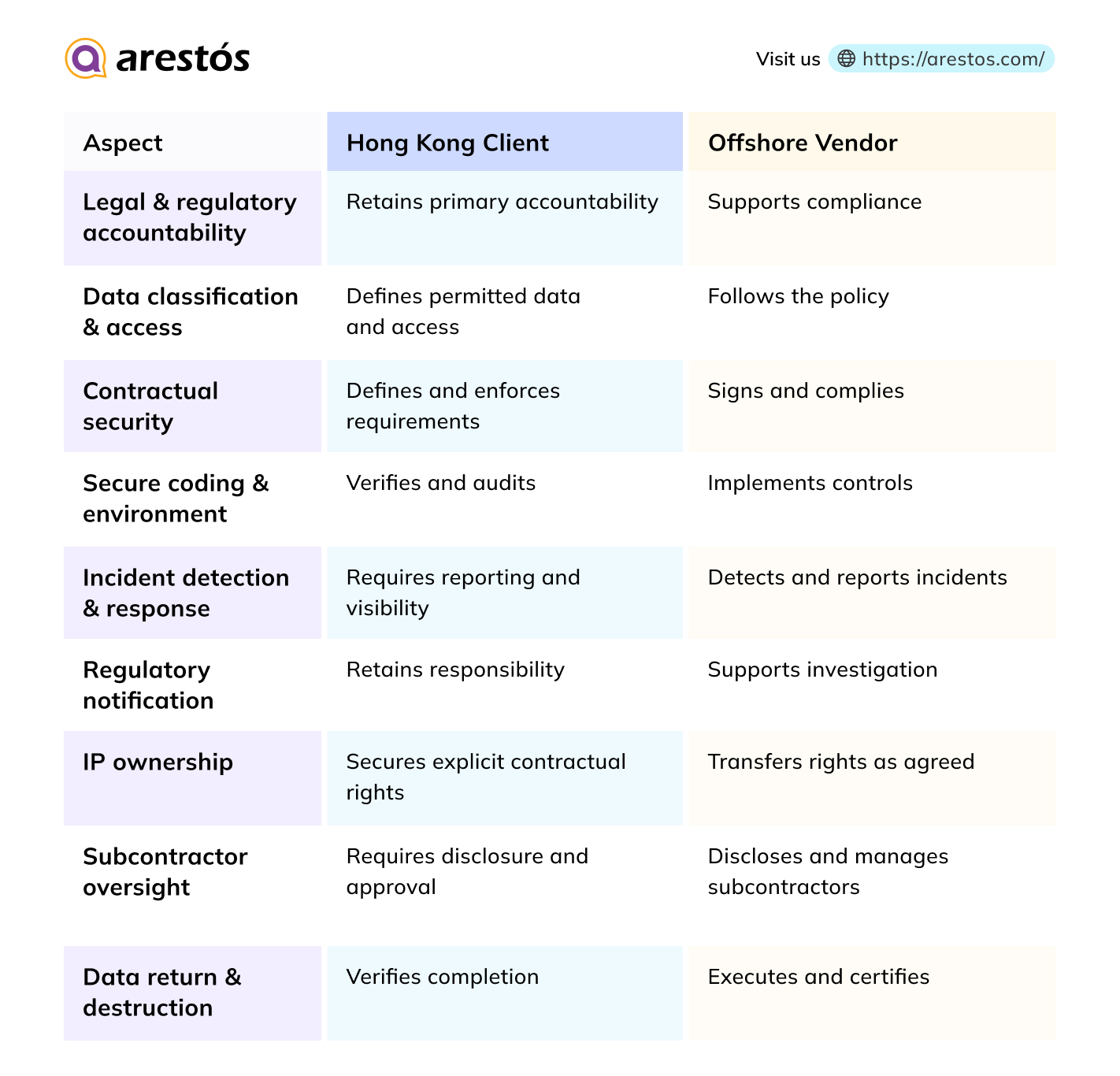
Under Hong Kong law, the client company generally retains primary legal responsibility for personal data handled by an offshore development partner. The PDPO treats the Hong Kong enterprise as the “data user” and requires it to use contractual or other means to ensure its data processor protects personal data.
The offshore vendor may execute security controls, but accountability cannot simply be transferred by outsourcing the work.
The practical approach is a shared responsibility model: the client retains legal and governance accountability, while the offshore vendor is responsible for implementing agreed security controls. The client must still verify that those controls are actually working.
The Responsibility Matrix
The Contractual Mechanisms That Make This Real
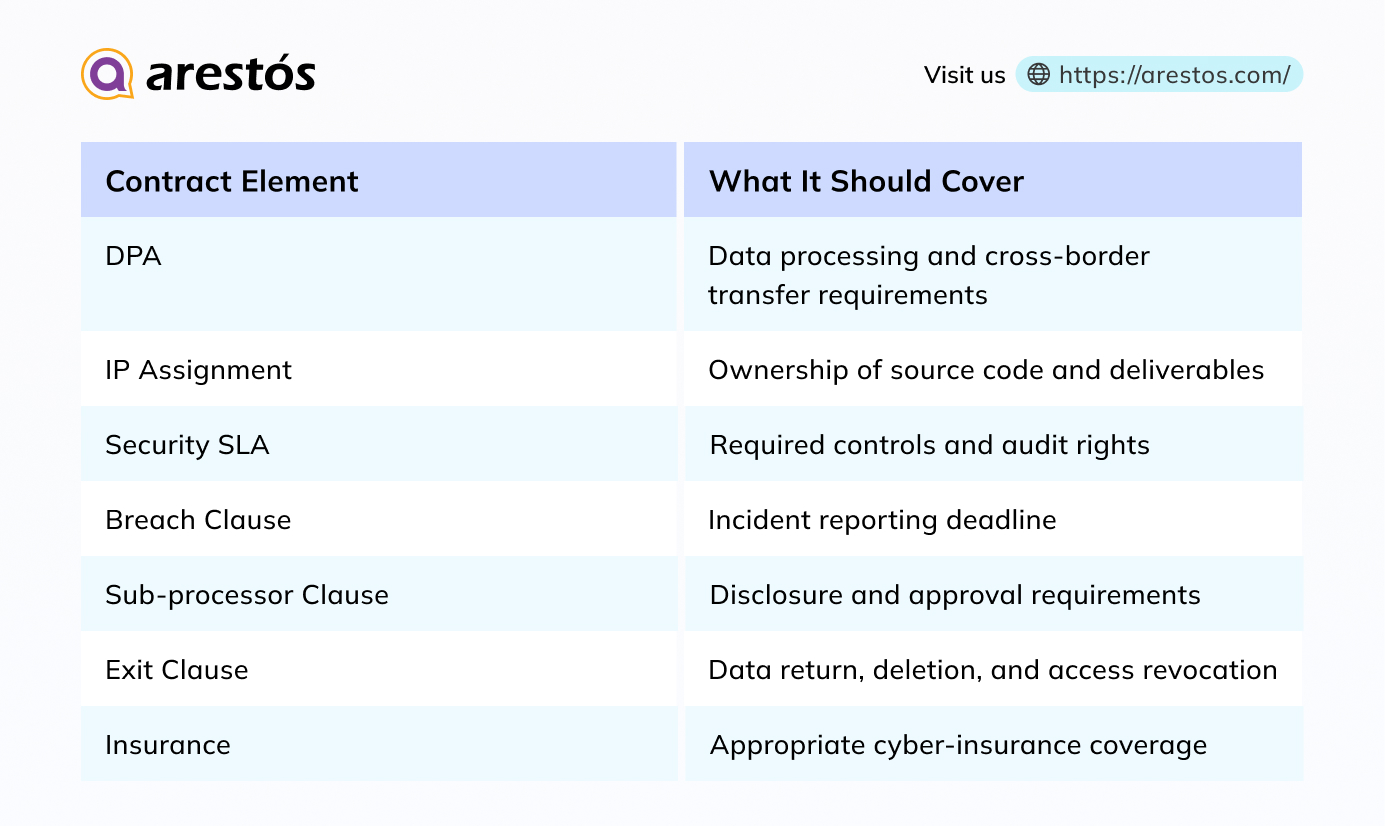
Security responsibilities should be written into the contract rather than left to assumptions.
- MSA + DPA: Define security, privacy, processing, and accountability requirements.
- IP assignment: Explicitly assign copyright and other IP rights for commissioned deliverables.
- Security schedule: Specify required controls and standards, such as ISO 27001 alignment.
- Audit & breach clauses: Establish audit rights and a contractual incident-notification deadline.
- Sub-processor controls: Require disclosure and approval before engaging subcontractors.
- Liability & insurance: Define indemnification, liability limits, and cyber-insurance requirements.
- Exit provisions: Require secure data return, deletion, and access revocation when the engagement ends.
For Hong Kong enterprises, the key principle is simple: outsourcing development does not mean outsourcing security accountability.
Security Best Practices & Risk Mitigation Framework for Hong Kong Businesses
Effective offshore development security best practices should be built into every stage of the engagement—not added after development has already started.
Pre-Engagement Due Diligence
Before signing with an offshore partner, Hong Kong enterprises should answer one question: Can this provider be trusted with our systems and data?
What to verify:
- Security credentials: Request ISO 27001 or SOC 2 Type II documentation and review the actual report.
- Testing history: Check a recent penetration-test summary and unresolved findings.
- Client references: Speak with enterprise clients that have similar security requirements.
- Data handling: Confirm where data is stored, accessed, and processed.
- Jurisdiction: Identify the laws and regulatory requirements that may apply to the offshore team.
Contractual Safeguards
Security commitments should be specific, measurable, and enforceable.
Technical & Operational Controls
A secure offshore environment should follow a defence-in-depth approach:
Access → Code → Environment → Data → Monitoring
- Access: Apply RBAC, MFA, least privilege, and zero-trust access.
- Code: Use branch protection, code reviews, secrets scanning, SAST, DAST, and dependency scanning.
- Environment: Keep development, staging, and production separate.
- Data: Use masked or synthetic data in non-production environments and encrypt sensitive data.
- Monitoring: Ensure the client can access relevant logs and security alerts.
Ongoing Governance
Once the engagement begins, security should become part of the regular vendor-management cycle.
Every quarter
- Review access rights and security performance.
- Check vulnerabilities and remediation progress.
- Reassess material changes to the vendor or subcontractors.
At least annually
- Conduct a deeper security assessment.
- Review penetration-testing results.
- Update contractual and security requirements.
When an incident occurs
- Activate the joint incident-response plan.
- Preserve logs and evidence.
- Review root cause and corrective actions.
Offboarding & Exit Strategy
A secure exit should leave no unnecessary access, data, or IP behind.
- Before termination: Revoke accounts, credentials, keys, and system access.
- During handover: Verify source code, documentation, credentials, and other deliverables.
- After handover: Confirm data return or certified destruction.
- Final check: Ensure confidentiality and other surviving contractual obligations remain in force.
How to Choose a Secure Offshore Development Partner
Hong Kong enterprises should evaluate an offshore partner based on security controls, compliance readiness, and proven risk-management capabilities.
- Security Credentials: ISO 27001, SOC 2, penetration testing, and security assessments.
- Access Controls: MFA, least-privilege access, and regular permission reviews.
- Data Protection: Clear data location, transfer, storage, and access controls.
- Secure Development: Code reviews, vulnerability scanning, and secure SDLC practices.
- Third-Party Risk: Transparency and controls over subcontractors and sub-processors.
- Incident Response: Clear breach notification, escalation, and response procedures.
- IP Protection: Explicit ownership, confidentiality, and source-code protection.
- Offboarding: Prompt access revocation and secure data return or deletion.
- Regulatory Readiness: Ability to support PDPO and applicable industry requirements.
- Auditability: Reasonable rights to verify security and compliance controls.
For a broader comparison of potential providers, see our guide to the Top 10 Offshore IT Staffing Companies in Hong Kong.
Why Partner With Arestós for Offshore Software Development
Security is a key concern when offshore developers access source code, systems, or business data. Arestós helps Hong Kong enterprises build and manage offshore development teams with security considerations integrated into the engagement.
- Vetted IT Professionals: Select qualified developers based on technical expertise, project requirements, and security awareness.
- Access Control: Support clear roles and controlled access to client systems, source code, and project resources.
- Secure Development Practices: Encourage secure coding, code review, and responsible handling of client data and source code.
- Confidentiality & IP Protection: Protect confidential business information and establish clear responsibilities for client source code and intellectual property.
- Managed Offshore Teams: Maintain consistent team management, communication, and oversight throughout the development lifecycle.
Learn more about our Offshore Development Staffing and how we help Hong Kong enterprises build and manage dedicated offshore development teams with greater control and security.
Frequently Asked Questions
1. Is offshore software development secure?
Yes. Offshore software development can be secure when the provider applies strong access controls, secure development practices, data protection measures, and clear security responsibilities.
2. What are the main security risks of offshore software development?
Key risks include unauthorised access, data exposure, intellectual property loss, insecure code, third-party vulnerabilities, and delayed incident response.
3. Can offshore software development meet enterprise security requirements?
Yes. With proper vendor due diligence, contractual controls, technical safeguards, and ongoing monitoring, offshore development can meet enterprise security requirements.
4. Is offshore development suitable for regulated industries in Hong Kong?
Yes, but regulated enterprises may need additional vendor due diligence, contractual controls, audit rights, and compliance measures depending on their industry and regulatory requirements.
5. How can Hong Kong companies assess an offshore development provider’s security?
Companies should review security certifications, access controls, secure SDLC practices, incident response, third-party management, IP protection, audit rights, and offboarding procedures.
Conclusion
Offshore software development can help Hong Kong enterprises access technical talent, but it also creates security risks involving data, access, IP, and third parties. Clear responsibilities and strong security controls are essential to manage these risks.
Arestós offers Offshore Software Development services to help Hong Kong enterprises build and manage offshore development teams with greater control, security, and flexibility.
Contact us to discuss your offshore software development needs.
Subscribe to our newsletter!
Get updated to
the lastest IT trends
Related Posts
Update the latest technology trends for your business