Back to featured insights
How Is AI Changing Software Developer Hiring in Hong Kong?
AI is transforming software developer hiring in Hong Kong, changing the skills, roles and hiring strategies enterprises need to stay competitive in a fast-evolving technology landscape.
Table of Content
Share
Software Developer Hiring in Hong Kong is evolving as AI reshapes how enterprises build and grow their technology teams. Understanding this shift can help businesses stay competitive and make more informed decisions about their future talent needs.
This guide is for businesses navigating the changing technology and talent landscape in Hong Kong. In this guide, we take a closer look at how AI is reshaping the software developer hiring landscape and what it means for the future of tech talent.
The State of Software Developer Hiring in Hong Kong Right Now
Hong Kong’s software developer market is competitive, especially for developers with specialised skills. While overall hiring remains cautious, demand for technology talent is still strong in areas driven by AI and digital transformation.
The shortage, by the numbers
- 76% of tech hiring managers say recruitment is “very” or “quite” competitive.
- Skill shortages are the biggest challenge, cited by 25%, followed by pay and benefits (22%) and headcount approval (19%).
- In Q1 2026, Hong Kong’s Net Employment Outlook was only 2%, yet 66% of employers still expected difficulties filling roles.
Where demand is concentrated
- Demand is strongest in AI, data, cloud and cybersecurity, alongside software development.
- Fintech, Web3, digital assets and GBA-related roles are also driving demand for specialised tech talent.
- KPMG identifies Technology and IT as the leading area of external-talent demand among Hong Kong employers.
The regional competitive set
- Hong Kong is competing with Singapore and Mainland China for experienced technology talent.
- Higher salaries and benefits in competing markets can make local hiring more difficult.
- Greater Bay Area connectivity is also widening the talent pool available to Hong Kong companies.
- The real challenge is no longer simply finding developers, but finding developers with the right mix of software, AI, cloud and data skills.
Why AI Is Disrupting Hiring — Not Just the Job
AI is changing software developer hiring in two ways at the same time. First, it is reshaping how companies hire. Second, it is changing what skills companies hire for. Understanding this difference is important because AI is affecting both the recruitment process and the definition of a qualified developer.
AI as the new recruiter
- AI is increasingly used for candidate sourcing, CV screening, interview scheduling and initial assessments.
- Globally, around 87% of organisations now use AI somewhere in the hiring process, showing how quickly AI has become part of recruitment workflows.
- AI can help recruiters process more applications and reduce administrative work, especially for high-volume hiring.
- However, AI is also making candidate verification more important, as more applicants use AI tools to create or enhance CVs and job applications.
- For Hong Kong employers, this means hiring decisions should rely more on practical assessments, technical interviews and skill validation, not just application documents.
AI as a skills filter
- AI is changing what companies consider a “qualified” software developer.
- In Hong Kong, the share of organisations widely deploying AI increased from 8% in 2025 to 24% in 2026, according to KPMG.
- At the same time, 47% of organisations now identify AI understanding as a priority skill, up from 20% a year earlier.
- Employers are increasingly looking for developers who can combine software engineering, AI, cloud, data and problem-solving skills.
- Technical ability still matters, but AI literacy is becoming an important differentiator.
- The question is no longer: “Can this person code?”. It is becoming: “Can this person work effectively in an AI-enabled environment?”
How the Developer Skill Set Employers Want Is Shifting
AI is not making software engineering skills less important. Instead, it is raising the bar for what employers expect from developers. The focus is moving from simply writing code to using AI effectively, reviewing its output and taking responsibility for the final product.
From “writes code” to “directs and reviews AI-generated code”
- Developers are increasingly expected to work with AI coding tools, rather than treat them as optional extras.
- The value is shifting toward knowing what to ask AI, what to accept, what to reject and how to improve the result.
- Strong developers still need solid programming fundamentals, but they also need the judgment to review and take accountability for AI-generated code.
Skills moving up the priority list
- AI and prompt literacy — understanding how to use AI tools effectively in development workflows.
- Code-review judgment — spotting errors, security issues and poor design in AI-generated output.
- System design — thinking beyond individual lines of code to build scalable and maintainable systems.
- Security discipline — ensuring AI-assisted development does not introduce new vulnerabilities or data risks.
- Business and domain knowledge — especially valuable in Hong Kong’s finance-heavy market, where fintech and compliance requirements can shape software decisions.
Hong Kong’s 2026 IT skills outlook reinforces this shift: AI/ML, cybersecurity and data engineering/analytics rank among the most in-demand technology skills.
Portfolios are becoming more meaningful
- A strong portfolio can show how a developer actually uses AI to solve problems, not just what tools they list on a CV.
- Employers can look for evidence of AI-assisted projects, code quality, system thinking and real-world problem-solving.
- This makes demonstrated capability increasingly valuable alongside traditional coding or algorithmic tests.
Salary and Compensation Pressure — What’s Actually Happening to Pay
AI is not driving a broad-based salary surge across Hong Kong’s technology market. Instead, pay is becoming more skill-dependent, with specialised AI, cybersecurity and data professionals commanding stronger premiums while salary growth for the wider workforce remains relatively moderate.
The premium at the top
- AI, cybersecurity and data specialists can command 15–25% above standard salary packages, according to KOS International.
- The premium reflects a structural gap between the supply of generalist technology talent and demand for specialised skills.
- For enterprises, the challenge is not simply raising salaries across the board, but offering competitive packages for hard-to-find capabilities.
- Robert Half also identifies AI, data and cybersecurity among the key areas shaping Hong Kong’s 2026 technology hiring market.
Moderation in the middle
- Salary expectations across Hong Kong remain relatively restrained, with most professionals surveyed by KPMG expecting either no increase or a 3–5% increase.
- This broadly tracks the government’s 3.3% Nominal Wage Index increase.
- Pay growth also varies by seniority: 76% of assistant-manager-level or below employees received a salary increase, compared with 30% of C-level respondents.
- This suggests that employers are becoming more selective about where they allocate salary increases rather than raising compensation uniformly.
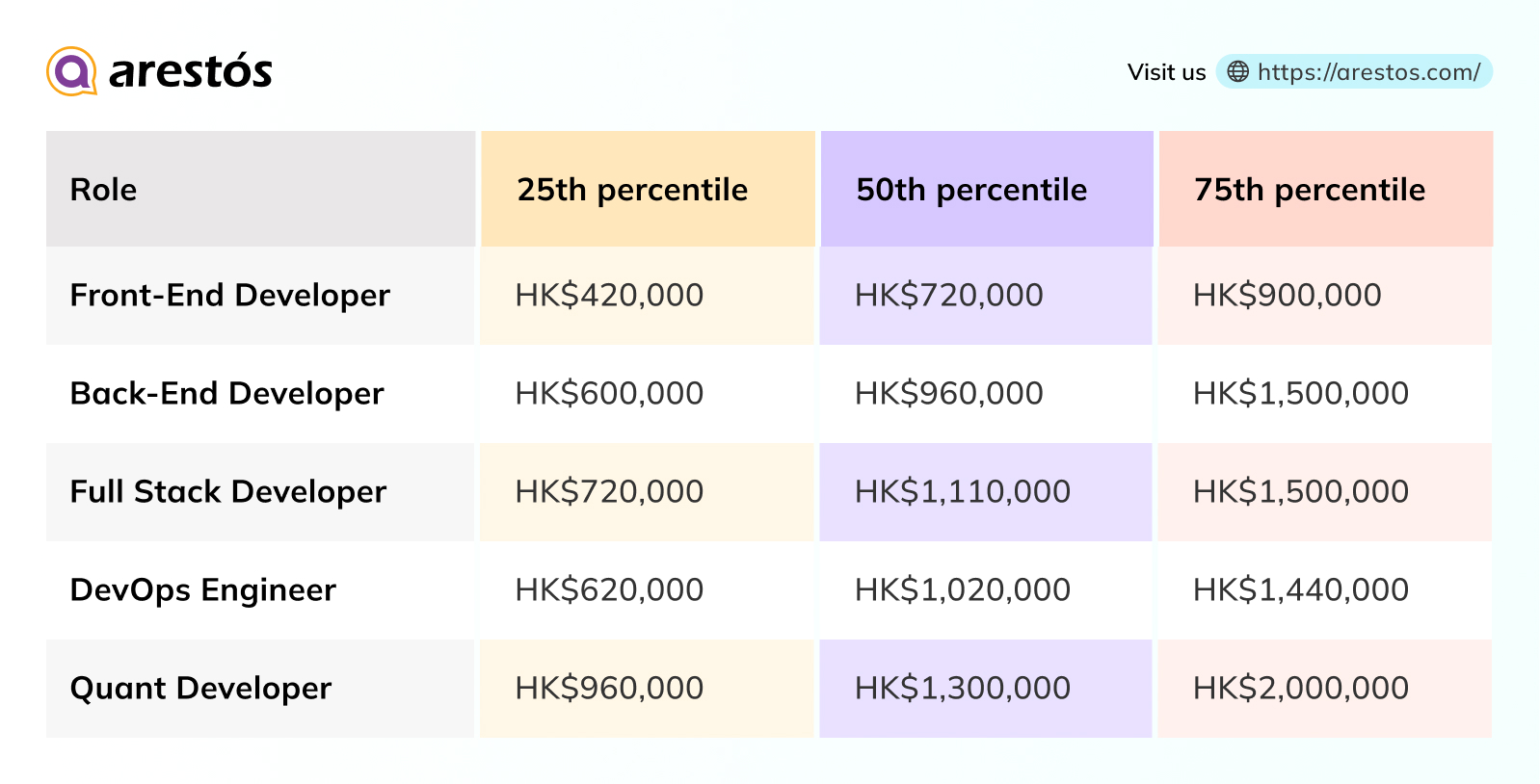
Indicative software developer salary ranges in Hong Kong
Robert Half’s 2026 Hong Kong IT Salary Guide shows that software development salaries vary significantly by role and experience.
Its benchmarks use the 25th, 50th and 75th percentiles, which broadly represent candidates with lower, moderate and extensive experience or specialised skills.
How Hong Kong Employers Are Adapting Their Hiring Strategy
AI is changing not only who Hong Kong enterprises hire, but also how they approach hiring itself. Companies are adapting by focusing on skills, speeding up decisions, widening talent access and making better use of their existing workforce.
- Skills-based job descriptions: Replacing broad “software developer” requirements with specific capabilities such as AI-assisted development, cloud, cybersecurity, data and system design.
- Faster time-to-offer: Shortening interview, assessment and approval processes to avoid losing scarce senior developers and AI specialists to competing employers.
- Broader talent sourcing: Using the expanded Technology Talent Admission Scheme (TechTAS) to access specialised overseas technology talent. Since December 2025, eligible companies can submit quota and visa applications in parallel, while the previous restriction limiting eligible R&D work to 14 designated technology areas has been removed.
- Internal AI upskilling: Training existing engineers to use AI coding tools, automated testing and AI-assisted development instead of relying entirely on external hiring.
- Stronger candidate verification: Using technical assessments, structured interviews and practical tasks to validate candidates’ real capabilities as AI makes it easier to enhance CVs, applications and technical submissions.
- Balanced use of recruitment AI: Treating automated screening as a support tool rather than relying solely on AI-generated scores to make hiring decisions.
The result is a more flexible hiring model: hire selectively where specialist expertise is missing, develop existing engineers where possible, and use technology to make the recruitment process faster without weakening quality controls.
Hong Kong’s Policy Tailwinds — What Employers Should Know
According to the Digital Policy Office, Hong Kong is accelerating its AI development through the “AI+” strategy, expanded computing infrastructure and government-backed funding. For enterprises, these initiatives are creating a stronger environment for AI adoption and specialised technology hiring.
AI is becoming a strategic priority
Hong Kong is promoting the integration of AI across industries and public services while strengthening AI infrastructure, R&D and talent development.
For employers, this means AI capabilities are likely to become increasingly important across software development, data, cybersecurity and digital transformation roles.
Computing capacity is scaling rapidly
Cyberport’s AI Supercomputing Centre (AISC) provides 3,000 PFLOPS of computing power, while the planned Sandy Ridge Data Facility Cluster is expected to reach 180,000 PFLOPS by 2032.
This gives enterprises greater access to local computing resources for developing, testing and deploying AI applications.
Government funding is accelerating AI development
The government has allocated HK$1 billion to establish the Hong Kong Artificial Intelligence Research and Development Institute (AIRDI) and launched a HK$3 billion AI Subsidy Scheme to support access to AI computing resources.
Together, these initiatives strengthen Hong Kong’s AI ecosystem and can make the market more attractive to specialised AI and software engineering talent.
What this means for employers
For Hong Kong enterprises, these policy tailwinds create more than just better infrastructure. They support a growing AI ecosystem that can help companies attract specialised talent, accelerate AI adoption and build stronger in-house technology capabilities.
Local Hiring vs Offshore Development Staffing: Which Model Makes Sense for Hong Kong Enterprises?
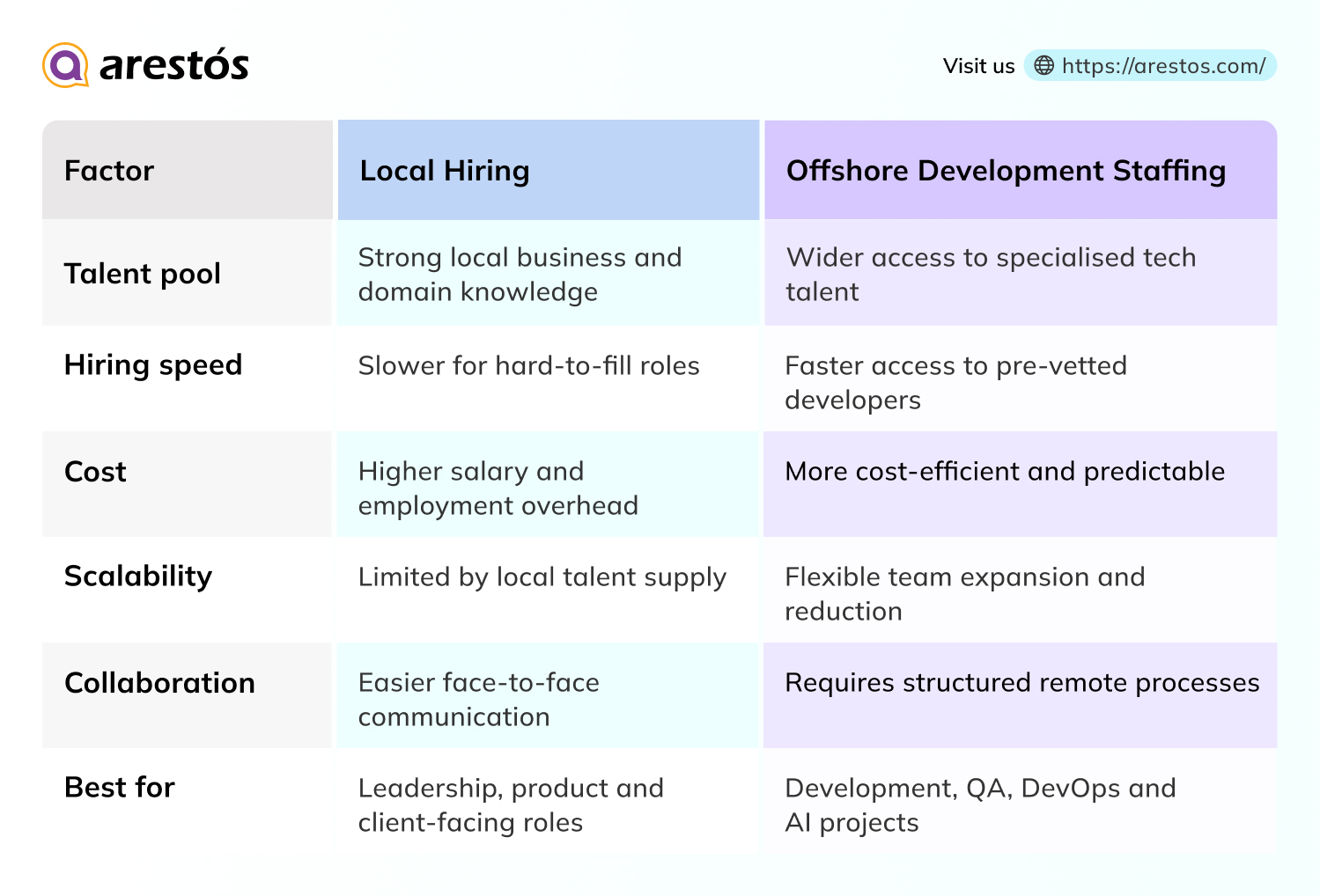
For Hong Kong enterprises, choosing between local hiring and offshore development staffing depends on more than cost. The right model depends on the skills required, hiring urgency, project scope and how quickly the business needs to scale its technology team.
When Local Hiring Makes More Sense
- Local market knowledge: Best for roles requiring strong understanding of Hong Kong customers, regulations and business practices.
- Stakeholder interaction: Works well for product owners, technology leaders and client-facing roles that require frequent in-person collaboration.
- Strategic ownership: Suitable when the role involves business decisions, product strategy or long-term technology leadership.
When Offshore Development Staffing Makes More Sense
- Specialised skills: Useful when enterprises need AI/ML, software development, QA, DevOps or cloud expertise that is difficult to source locally.
- Faster scaling: Enables companies to add engineering capacity quickly for new projects, system upgrades or peak workloads.
- Cost control: Provides additional technical capacity without the full salary and employment overhead of expanding the local workforce.
- Flexible delivery: Teams can be scaled based on project requirements rather than maintaining a fixed headcount.
The hybrid model may be the strongest option
Hong Kong enterprises do not necessarily have to choose one model exclusively. A local core team can own strategy, product decisions, compliance and stakeholder management, while an offshore engineering team provides additional development capacity.
The key is to match the hiring model to the role, rather than treating local hiring or offshore staffing as a one-size-fits-all solution.
As Hong Kong enterprises face increasing competition for specialised tech talent, Arestós’ Offshore Development Staffing provides a flexible way to extend engineering teams with dedicated IT professionals.
Frequently Asked Questions
1. Will AI replace software developers in Hong Kong?
No. AI is automating routine coding tasks, but developers are still needed for system design, problem-solving and technical decision-making.
2. What skills do Hong Kong companies want from software developers?
Strong programming fundamentals, AI fluency, problem-solving and skills in areas such as cloud, cybersecurity and data.
3. What AI skills should software developers have in Hong Kong?
Developers should be able to use AI coding tools, review AI-generated code and identify errors or security risks.
4. Which software development roles are most in demand in Hong Kong?
AI/ML, cybersecurity, data engineering, cloud and specialised software development roles remain in strong demand, particularly in fintech and other technology-intensive industries.
5. Is offshore development staffing suitable for Hong Kong enterprises?
Yes, especially when enterprises need specialised talent or additional engineering capacity faster than local hiring can provide.
Conclusion
AI is reshaping software developer hiring in Hong Kong, changing both the skills enterprises need and how they build technology teams. As demand for specialised talent grows, businesses need more flexible approaches to accessing the right technical capabilities.
For enterprises that need to expand their engineering capacity, Arestós Offshore Development Staffing provides dedicated software developers and IT professionals to support projects, strengthen existing teams and access specialised technical expertise without relying solely on local hiring.
Contact us today to explore the right solution for your business.
Subscribe to our newsletter!
Get updated to
the lastest IT trends
Related Posts
Update the latest technology trends for your business