
Back to featured insights
An Unfilled Developer Role: Saving or Costing?
An unfilled developer role may appear to save money, but its true impact can be harder to see. Learn how to assess the cost of a vacancy and understand its wider impact on the business.


Table of Content
Share
An unfilled developer role can appear to save salary costs, but it can also create hidden costs through lost capacity, project delays, and additional workload. Understanding these costs helps enterprises make better decisions about hiring timelines and development capacity. In this guide, we examine whether an unfilled developer role is actually saving money or costing the business more.
What an Unfilled Developer Role Actually Costs, and Why the Recruitment Budget Misses It
The recruitment fee is easy to see because it sits in the hiring budget. The larger cost of an unfilled developer role is harder to see because it is spread across delivery delays, contractor spend, overtime, technical debt, and additional management effort.
On a Hong Kong P&L, an open developer requisition can look like an underspend, while the business is actually paying for the capacity it has lost.
The problem is that these costs appear in different reports. Finance sees salary underspend, IT sees delivery variance, and managers see overtime or workload. None necessarily identifies the vacancy as the underlying cause.
Therefore, the real cost of a vacancy is not the salary budget left unused. It is the cost of the work, capacity, and delivery impact created by the missing developer.
How Long Does a Developer Role Actually Stay Unfilled in Hong Kong?
Time-to-fill is not the same as the vacancy window. For an enterprise, the capability gap begins when productive capacity is lost and ends only when the replacement reaches full productivity.
Capability Gap = Approval Latency + Time-to-Fill + Notice Period + Ramp to Full Productivity
The gap can extend well beyond the period shown in a recruitment plan. A new developer may still need to complete a notice period after accepting an offer, followed by time to understand an unfamiliar enterprise codebase, systems, and processes.
Hong Kong’s talent market makes this gap particularly relevant. The Hong Kong Government’s 2023 Manpower Projection, published by the Labour and Welfare Bureau in 2024, projected a manpower shortage of 180,000 by 2028, with skilled technical workers accounting for more than one-third of the projected shortage.
For IT and HR leaders, the key measure is therefore not simply how long it takes to hire, but how long the business operates without full development capacity. That capability gap is the period that creates the hidden cost of an unfilled developer role.
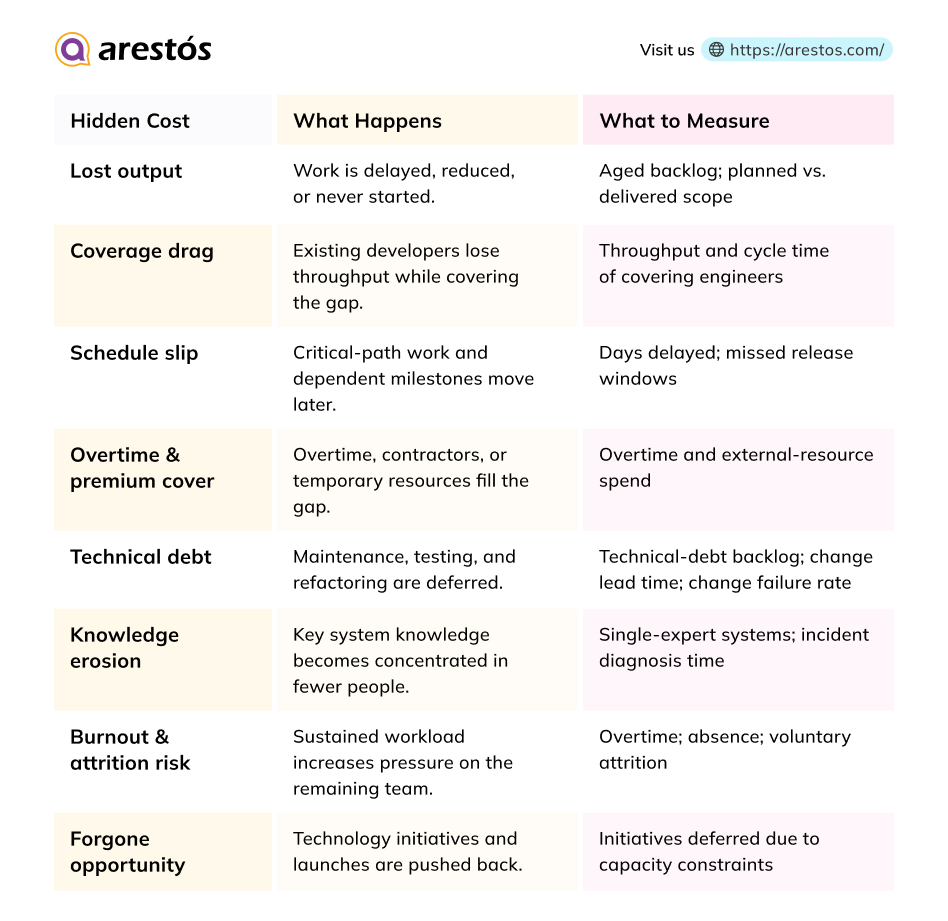
The Eight Hidden Costs of an Unfilled Developer Role
An unfilled developer role creates costs beyond the unused salary budget. These costs appear across delivery, team capacity, technology, and business opportunities, and each can be measured.
McKinsey research found that CIOs in financial services and technology companies estimated technical debt at 20–40% of the value of their technology estate, highlighting the potential business impact of deferred technical work.
How to Calculate the Cost of an Unfilled Developer Role
The cost of an unfilled developer role includes lost capacity, additional cover, delivery impact, and other measurable costs, offset by the salary saved during the vacancy.
Net Vacancy Cost = Lost Capacity + Incremental Cover + Delivery Impact + Technical Debt + Management Cost − Salary Saved
First, measure the vacancy period from when the role becomes vacant until the replacement reaches productive capacity. Then estimate lost capacity, add measurable costs such as overtime, contractors, delivery delays, and technical debt, and subtract the salary saved.
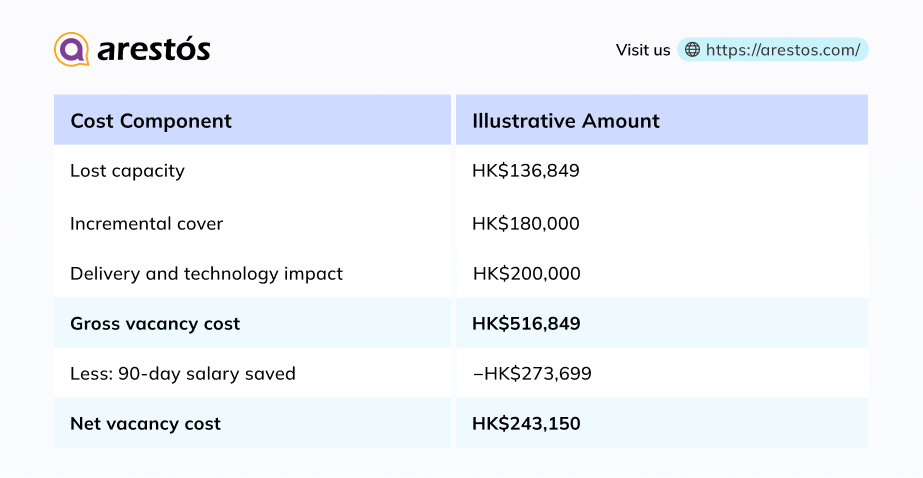
As a market reference, Robert Half’s 2026 Hong Kong IT Salary Guide lists a Full Stack Developer starting salary of HK$720,000–HK$1.5 million, with a 50th percentile of HK$1.11 million. Using HK$1.11 million as an illustration, a 90-day vacancy represents HK$273,699 in salary saved.
Assuming 50% lost capacity, HK$30,000 in overtime, HK$150,000 in contractor support, and HK$200,000 in delivery and technology impact:
Because productivity is an assumption, test different scenarios rather than relying on one estimate:
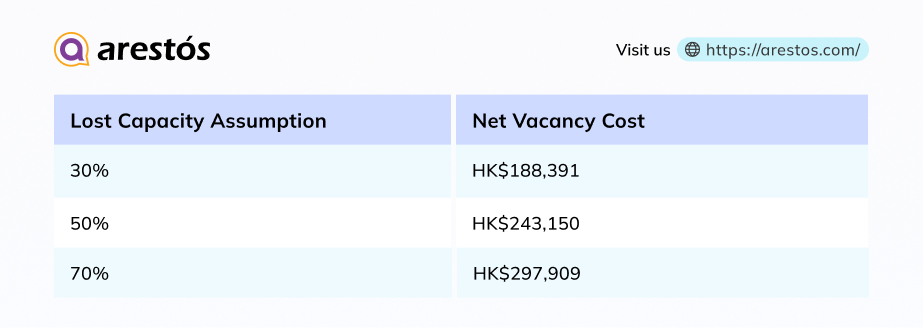
These figures are illustrative. Use internal data for productivity, overtime, contractor costs, delivery impact, and technical debt where available. Salary saved is a credit against the vacancy, not proof that leaving the role unfilled saves money.
How to Reduce Open-Role Costs and Fill Critical Tech Vacancies Faster
A critical developer vacancy creates a growing capacity gap while the hiring process continues. Enterprises can reduce its cost by shortening the hiring cycle, improving candidate conversion, and adding temporary development capacity when permanent hiring takes longer than planned.
Shorten the Technical Hiring Process
Long interview processes can increase candidate drop-off and delay time-to-fill. Review each stage and remove unnecessary assessments, duplicate interviews, and slow approval steps.
For critical developer roles, define the required technical criteria in advance, consolidate overlapping interview rounds, and set clear decision timelines between stages. The goal is to move qualified candidates from first contact to offer without compromising technical evaluation.
Expand the Talent Pool for Hard-to-Fill Roles
When local hiring produces too few qualified candidates, continuing to use the same sourcing approach can extend the vacancy period. Enterprises can expand the talent pool through specialized recruiters, employee referrals, targeted technical communities, and offshore talent markets.
This is particularly relevant when the role requires skills that are in high demand or difficult to source locally.
Add Development Capacity While Hiring Continues
Permanent recruitment and immediate capacity needs do not always have to follow the same timeline. Offshore development staffing can provide additional developers for suitable workstreams while the enterprise continues searching for a permanent hire.
This can help reduce backlog growth, overtime, and delivery delays without requiring the enterprise to stop its permanent recruitment process.
For a broader look at how this model works, see our guide to Offshore IT Staffing: Benefits, Costs & Challenges for Hong Kong Companies.
Track Time-to-Fill and Vacancy Cost Together
Time-to-fill alone does not show the full business impact of an open role. Track it alongside lost capacity, overtime, contractor spending, delivery delays, and technical debt.
This gives hiring and technology leaders a clearer basis for deciding when to continue recruiting, adjust the hiring approach, or add temporary development capacity.
The objective is not simply to fill every role faster. It is to reduce the time a critical capability remains unavailable and control the business cost created by the gap.
How Offshore Development Staffing Can Reduce Developer Vacancy Costs
When a developer vacancy remains open, the immediate problem is not the missing headcount but the development capacity gap it creates. Offshore development staffing can help bridge that gap while the enterprise continues its permanent hiring process.
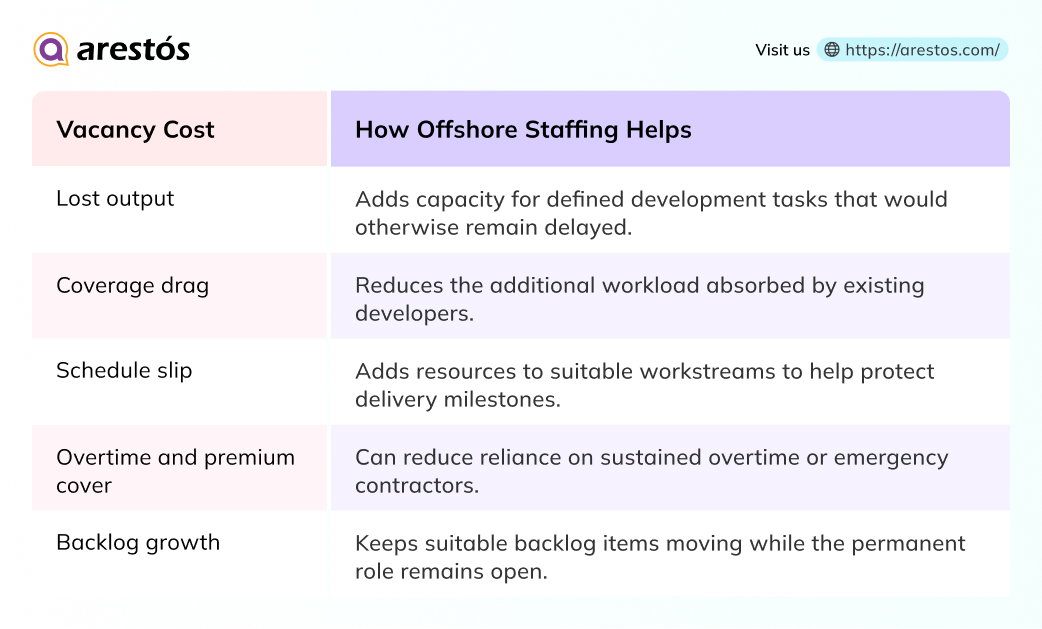
The approach works best when separable development work can be assigned to a dedicated offshore team without transferring ownership of critical business decisions.
Offshore staffing does not remove the vacancy cost. It gives the enterprise another way to control the cost of the capacity gap while the permanent hiring process continues.
The decision should therefore compare the cost of offshore capacity with the measurable cost of leaving the role unfilled.
For enterprises that need to bridge a development capacity gap while continuing to hire, explore our Offshore Development Staffing Services to see how the model works.
Frequently Asked Questions
1. What is the cost of an unfilled developer role?
It depends on the vacancy period and its impact on productivity, overtime, contractors, delivery, and technical debt. Net vacancy cost = total vacancy-related costs − salary saved.
2. Does an unfilled developer role save the company money?
Not necessarily. Salary savings can be offset by lost productivity, overtime, contractor costs, project delays, and technical debt.
3. How do I calculate the cost of an unfilled developer role?
Estimate lost capacity + incremental cover + delivery impact + management costs, then subtract the salary saved during the vacancy.
4. Can offshore development staffing reduce the cost of a developer vacancy?
Yes. It can add development capacity for suitable workstreams, helping reduce backlog, overtime, and delivery delays while permanent hiring continues.
5. Should a company use offshore developers while still recruiting locally?
It can be considered when a critical role remains open and the business needs immediate development capacity. The decision should account for work requirements, governance, security, and cost.
Conclusion
An unfilled developer role can cost more than the salary saved during the vacancy. Lost development capacity, overtime, contractor costs, delivery delays, and technical debt can increase the business impact over time. Measuring these costs helps enterprises identify when a vacancy is creating a wider capacity problem and determine when additional resources are needed.
Arestós offers Offshore Development Staffing Services to help enterprises add dedicated development capacity while continuing their permanent hiring process. Our offshore developers can support suitable workstreams, helping enterprises maintain delivery capacity and reduce the operational impact of critical developer vacancies.
Need to bridge a critical development capacity gap? Contact us to discuss your workforce needs.
Subscribe to our newsletter!
Get updated to
the lastest IT trends
Related Posts
Update the latest technology trends for your business