Back to featured insights
Scaling System Migration Teams with Offshore IT Staffing: How Does It Work?
Major system migrations bring complex technical demands and changing resource needs. Offshore IT Staffing helps enterprises access specialized expertise, scale development capacity when required, and maintain control throughout the transition.

Table of Content
Share
Offshore IT Staffing gives enterprises a flexible way to expand development capacity when a major system migration puts pressure on internal resources. By adding specialized talent when needed, organizations can address skill gaps, maintain delivery momentum, and adapt capacity as the program evolves.
In this guide, we explore how offshore staffing can support enterprises throughout this complex transition.
What Is Offshore IT Staffing?
Offshore IT Staffing is a workforce model that provides dedicated technology professionals in another country who work as an extension of a client’s internal team. Unlike outsourcing, where a provider typically manages defined projects or deliverables, offshore staffing allows the client to retain control over the team’s work, priorities, and roadmap.
Learn more about Offshore IT Staffing here.
For a major system migration, this allows enterprises to increase development capacity while retaining control over migration strategy and delivery.
The Core Challenges of Scaling a Development Team for a Major System Migration
Major system migrations create development capacity challenges that go beyond simply adding more people. The main pressure points include:
- Tight, non-negotiable timelines: Regulatory deadlines, vendor end-of-life dates, and board-mandated go-live dates can leave little room for delays or lengthy hiring cycles.
- Hong Kong’s structural talent shortage: Specialized roles such as software engineers, cloud specialists, DevOps engineers, and cybersecurity professionals can be difficult to fill when migration increases hiring demand.
- Legacy system complexity and disappearing skills: Mainframe, COBOL, and proprietary platform expertise can be scarce, making it difficult to maintain legacy systems while transitioning to modern technologies.
- Technical and architectural complexity: Data migration, application dependencies, API integrations, and parallel-run requirements can significantly increase the workload and coordination needed across development teams.
- Security, data privacy, and regulatory risk: Additional developers and external resources may require access to source code, databases, cloud environments, and sensitive data, increasing the compliance surface.
- Knowledge transfer and institutional memory: Critical knowledge about legacy systems, business rules, and undocumented dependencies may be concentrated among a small number of internal experts.
- Business continuity during migration: Internal teams must continue maintaining existing systems and supporting daily operations while simultaneously delivering the new environment.
How Offshore IT Staffing Solves Each Migration Challenge
Offshore IT staffing helps enterprises address migration challenges by adding dedicated capacity, specialized skills, and workforce flexibility without giving up control of the migration programme.
Rapid, Elastic Capacity
Offshore IT staffing helps enterprises scale development capacity quickly when migration deadlines create additional workload.
- Add dedicated developers without waiting through lengthy local hiring cycles.
- Scale the team up or down as migration phases change.
- Relieve pressure on internal teams during critical delivery periods.
Access to Specialized Skills
Offshore IT staffing provides access to specialized technical skills that may be difficult to source locally.
- Add cloud, data engineering, DevOps, QA, or legacy-language specialists.
- Match technical skills to specific migration workstreams.
- Reduce dependence on a limited local talent pool.
Technical Complexity and Governance
Dedicated offshore engineers can work within the client’s existing technical and governance framework.
- Follow the client’s architecture, development standards, security policies, and tools.
- Work alongside internal architects and technical leaders.
- Support complex migration workstreams without transferring programme control.
Structured Knowledge Transfer
Structured onboarding and documentation help transfer critical system knowledge across the wider migration team.
- Document legacy dependencies, processes, and technical decisions.
- Pair offshore engineers with internal subject-matter experts.
- Reduce knowledge concentration around a small number of employees.
Business Continuity and Institutional Ownership
Offshore staffing augments the internal team while keeping business knowledge and ownership within the enterprise.
- Offshore engineers focus on migration workloads while internal teams maintain existing operations.
- Reduce the risk of migration work disrupting business-as-usual activities.
- Preserve institutional knowledge through collaboration and knowledge transfer.
Capacity and Workforce Strategy
Offshore IT staffing is primarily a capacity and workforce strategy, not a cost-reduction tactic.
- The core value is flexible access to development capacity and specialized skills.
- Cost efficiency may be a byproduct, but it should not be the primary migration objective.
- The enterprise retains control while expanding its ability to deliver the migration programme
What IT Expertise Is Needed for a Major System Migration?
A major system migration requires expertise across architecture, development, data, infrastructure, security, and testing. The exact requirements depend on the migration scope, systems involved, and target environment.
Migration & Solution Architecture
Architecture expertise provides the technical direction for the migration and connects the existing environment with the target system.
- Migration Architecture: Defines the migration approach, transition stages, dependencies, and migration strategy.
- Solution Architecture: Designs how applications, services, databases, and integrations will work together in the target environment.
- Enterprise Architecture: Ensures the migration aligns with the organization’s broader technology architecture and long-term IT strategy.
These roles help identify architectural dependencies and technical risks before development and migration activities begin.
Software Development & Legacy Systems
Development expertise is required to modify existing applications, build new components, and maintain systems that cannot be migrated immediately.
- Software Developers: Rebuild, refactor, or develop applications for the target environment.
- Legacy Technology Specialists: Maintain and adapt older systems while migration activities are underway.
- Integration Developers: Build and maintain connections between legacy applications, new systems, APIs, and third-party services.
This combination is particularly important when an enterprise needs to operate legacy and modern environments in parallel during the transition.
Need the right technical talent for your migration? Explore our Offshore Development Staffing service.
Data Engineering & Migration
Data migration is often one of the most technically complex parts of a major system migration because data must be moved without compromising integrity, availability, or business usability.
- Data Engineers: Design and implement data migration pipelines.
- ETL Developers: Extract, transform, and load data into the target environment.
- Database Specialists: Manage database structures, performance, data mapping, and migration validation.
The team may also need to perform data reconciliation and validation to confirm that migrated data is complete, accurate, and consistent with the source system.
Cloud, Infrastructure & DevOps
Infrastructure expertise supports the technical environment in which the target system will operate.
- Cloud Engineers: Design and manage cloud environments, services, networking, and scalability.
- Infrastructure Engineers: Configure servers, networks, storage, environments, and related infrastructure.
- DevOps Engineers: Automate development, testing, deployment, monitoring, and release processes.
These capabilities become particularly important when migration involves moving workloads to cloud or hybrid environments and requires repeatable deployment and rollback processes.
QA, Testing & Cybersecurity
Testing and security expertise help ensure that the migrated environment works correctly and remains protected throughout the transition.
- QA Engineers: Validate application functionality and integration behavior.
- Test Automation Engineers: Automate regression, integration, and other repeatable tests.
- Cybersecurity Engineers: Protect applications, infrastructure, credentials, source code, and data throughout the migration.
Testing should cover not only application functionality but also performance, integrations, data integrity, security controls, and system behavior after cutover.
Scale your QA capabilities with our Offshore Testing and QA Staffing service.
AI & Machine Learning
AI and machine learning expertise can support migrations involving AI-powered applications, predictive models, intelligent automation, or data-intensive workloads.
- AI Engineers: Develop and integrate AI capabilities within the target environment.
- Machine Learning Engineers: Build, deploy, and optimize machine learning models and pipelines.
- MLOps Engineers: Support model deployment, monitoring, versioning, and lifecycle management.
For enterprises incorporating AI into their modernized environment, the right AI and ML expertise can help integrate these capabilities as part of the migration strategy.
Explore our Offshore AI & ML Engineers service to access dedicated AI and machine learning professionals.
E-commerce Website Administration
For migrations involving e-commerce platforms, ongoing website administration is essential to keep product content, storefront functionality, and online operations running smoothly during and after the transition.
- E-commerce Website Administrators: Manage product updates, website content, storefront operations, and day-to-day platform administration.
- Platform Support: Support ongoing maintenance, performance, and content management across e-commerce environments.
Need ongoing support for your e-commerce platform? Explore our Offshore E-commerce Website Administrator service.
Building the Right Offshore Team for a System Migration
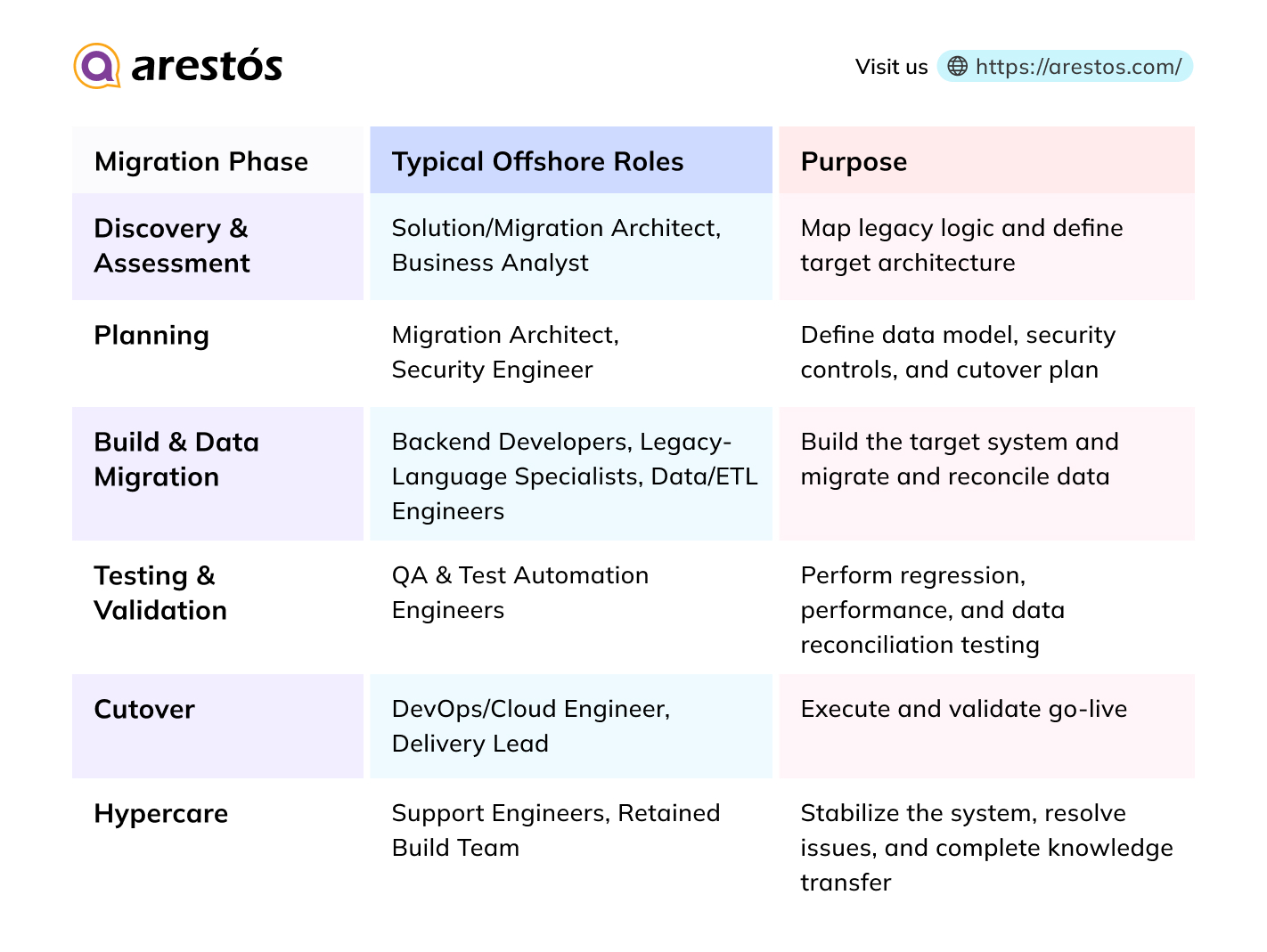
A system migration team should change with the project phase rather than remain the same size and structure throughout the programme. Offshore IT staffing allows enterprises to add or reduce specific roles as technical requirements evolve.
How Does Offshore IT Staffing Work for a System Migration?
Offshore IT Staffing works by adding dedicated professionals to the enterprise’s existing migration team based on its technical needs and project phases.
- Assess the Capacity Gap: Identify the skills and development capacity missing from the internal team.
- Define the Required Roles: Determine which professionals are needed, such as developers, data engineers, QA engineers, DevOps engineers, or legacy technology specialists.
- Recruit & Onboard: The staffing provider sources and screens suitable candidates before they join the enterprise’s workflows and development environment.
- Integrate with the Internal Team: Offshore professionals work within the enterprise’s existing tools, processes, communication routines, and governance framework.
- Scale by Migration Phase: Add or reduce specific roles as the project moves through planning, development, testing, cutover, and hypercare.
- Maintain Workforce Support: The staffing provider continues to manage recruitment, HR, payroll, and personnel support throughout the engagement.
This model allows enterprises to expand technical capacity without creating a separate delivery structure or transferring overall migration ownership to an external provider.
Looking for potential providers? Explore our list of the Top 10 Offshore IT Staffing Companies in Hong Kong to compare potential partners before making a decision.
The right partner should provide more than technical talent. Arestós offers Offshore IT Staffing Services that combine access to skilled professionals with end-to-end workforce support, from recruitment and onboarding to HR management, payroll, and ongoing coordination. This allows enterprises to scale their migration teams while retaining control over technical decisions, priorities, and governance.
Frequently Asked Questions
1. Is Offshore IT Staffing suitable for a major system migration?
Yes. It provides additional technical capacity and specialized skills while the enterprise retains control over migration strategy and priorities.
2. How does Offshore IT Staffing help scale a migration team?
It allows enterprises to add or reduce dedicated professionals based on the skills and workload required at each migration phase.
3. Does Offshore IT Staffing mean the enterprise loses control of the project?
No. The enterprise retains control over priorities, technical decisions, workflows, and day-to-day direction.
4. Can offshore developers work with an enterprise’s existing development tools?
Yes. Offshore developers can integrate with the client’s existing project management, source control, communication, documentation, and CI/CD tools.
5. Is Offshore IT Staffing only useful for reducing development costs?
No. Its primary value is providing flexible access to additional technical capacity and skills as project requirements change.
Conclusion
A major system migration requires the right technical expertise, development capacity, and governance to maintain delivery and business continuity. Offshore IT Staffing can help enterprises scale resources as requirements evolve while retaining control over the program.
Arestós offers Offshore IT Staffing services with skilled IT professionals and end-to-end workforce support, including recruitment, HR management, payroll, and ongoing coordination.
Need to scale your migration team? Contact us to discuss your requirements.
Subscribe to our newsletter!
Get updated to
the lastest IT trends
Related Posts
Update the latest technology trends for your business