Back to featured insights
Maximizing Offshore Dev Performance from HK Office: Best Practices & Extra Tips
Want to maximize Offshore Dev Performance from your Hong Kong office? Discover what truly drives high-performing offshore teams and how to turn everyday development challenges into stronger, more sustainable results.

Table of Content
Share
Offshore developers can expand your engineering capacity—but more developers do not automatically mean better performance. For Hong Kong companies, the real challenge is ensuring offshore teams deliver faster, maintain quality, and collaborate effectively across locations.
So, which KPIs actually matter, and what can you do when performance falls short? This guide covers the metrics, best practices, and actionable tips you need to get more value from your offshore development team.
What Does “Good Performance” Actually Mean for an Offshore Development Team?
Good performance is not simply about how busy offshore developers are. It is about whether their work leads to reliable software delivery and meaningful business results. Before choosing KPIs, companies should distinguish between activity, output, and outcomes.
Activity, Output and Outcomes Are Not the Same Thing
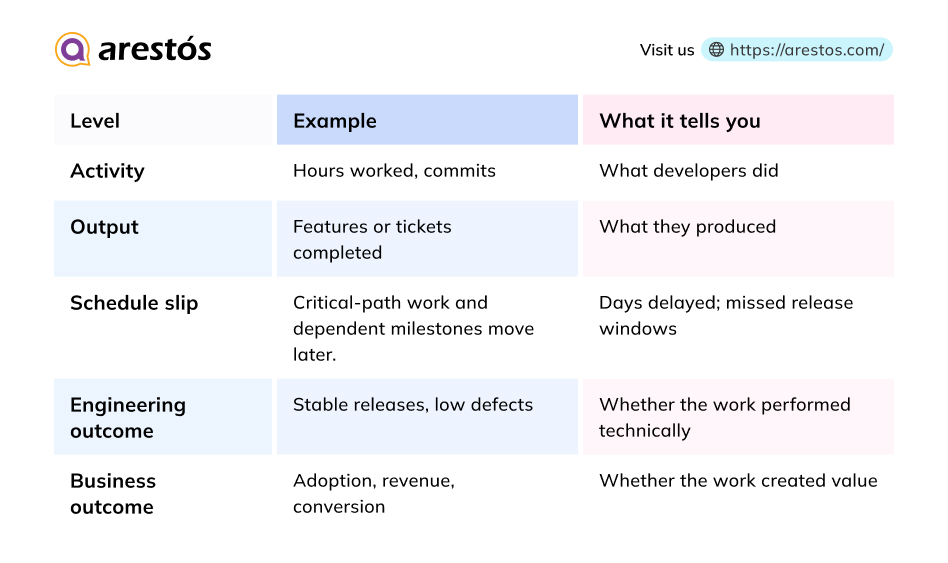
Activity and output metrics provide useful context, but they should not become the definition of performance. The closer measurement gets to engineering and business outcomes, the clearer the picture of whether an offshore team is actually creating value.
Why Offshore Developer Performance Requires Multiple KPIs
No single KPI tells the whole story. Optimizing one metric can easily hide problems elsewhere:
- High velocity + high defect rate = fast delivery, but poor quality
- Many releases + frequent rollbacks = high deployment activity, but weak stability
- Low cost + slow delivery = potentially weak outsourcing ROI
- Many commits + little customer impact = activity without demonstrated value
This is why performance should be evaluated across speed, quality, stability, collaboration, and business impact. DORA’s research similarly finds that speed and stability should not automatically be treated as trade-offs; strong software delivery performance considers both.
Measure Teams Before Individuals
Most engineering outcomes are created collectively, so measurement should generally move from:
Product → Service → Team → Individual
DORA recommends evaluating software delivery metrics in the context of a specific application or service and notes that software delivery performance is fundamentally a team measure. Individual activity can also be affected by system-level constraints—for example, slow code reviews can reduce a developer’s commit velocity regardless of their ability.
The goal is therefore to use KPIs to understand how effectively the offshore team delivers value and where the delivery system can improve, rather than simply measuring how much each developer does.
How to Measure Collaboration Across Offshore and Hong Kong Teams
Collaboration should be measured by whether information, decisions, and knowledge move smoothly between Hong Kong and offshore teams—not by how many messages developers send or how quickly they reply to every chat.
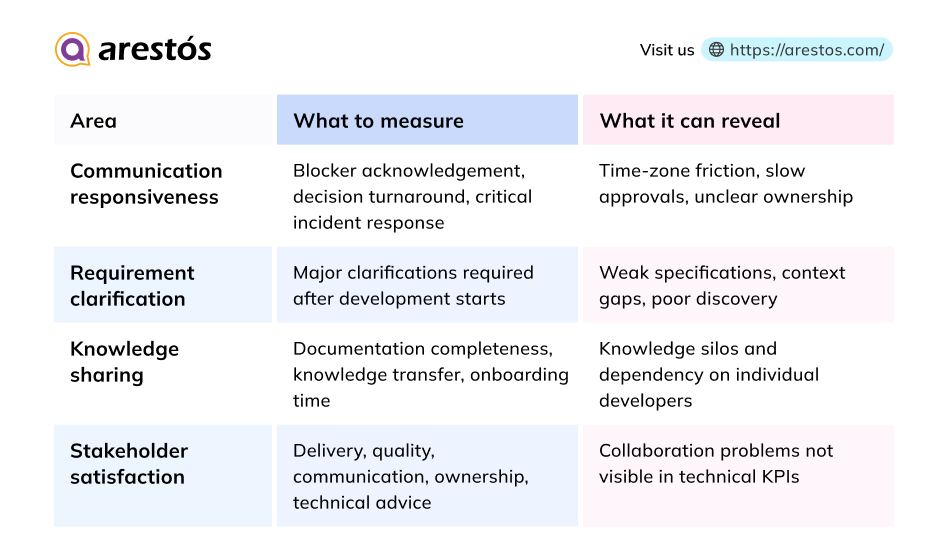
When interpreting these metrics:
- Communication responsiveness: Focus on delays that actually block delivery, rather than monitoring everyday Slack or Teams response times.
- Requirement clarification: Treat a high rate as a signal to examine the requirements process—not automatically as poor offshore developer performance.
- Knowledge sharing: Look for improvement over time, particularly reduced dependency on individual developers and smoother onboarding.
- Stakeholder satisfaction: Use qualitative feedback to complement technical KPIs, not as the primary measure of performance.
Connect Offshore Developer KPIs to Business Outcomes
Engineering KPIs show how well the offshore team performs. Business KPIs show whether that performance creates enough value to justify the investment.
Engineering investment → Delivery capability → Product outcome → Business result
- Feature adoption: Track adoption rate, active users, usage frequency, or task completion to see whether customers actually use what the team builds.
- Time-to-market: Measure approved initiative → production availability to assess whether offshore capacity helps the business ship faster.
- Cost per delivered outcome: Compare total development cost with usable production outcomes, including rework, QA, management, delays, and vendor costs.
- Engineering ROI: Connect engineering investment to measurable outcomes such as adoption, revenue, conversion, cost savings, or customer experience.
The goal is to determine whether offshore development delivers more than lower labor costs—it should improve the company’s ability to create business value efficiently.
KPIs You Should NOT Use to Judge Offshore Developers
Some metrics are easy to track but can create the wrong incentives when used to judge offshore developer performance. Treat the following as contextual signals, not performance scores.
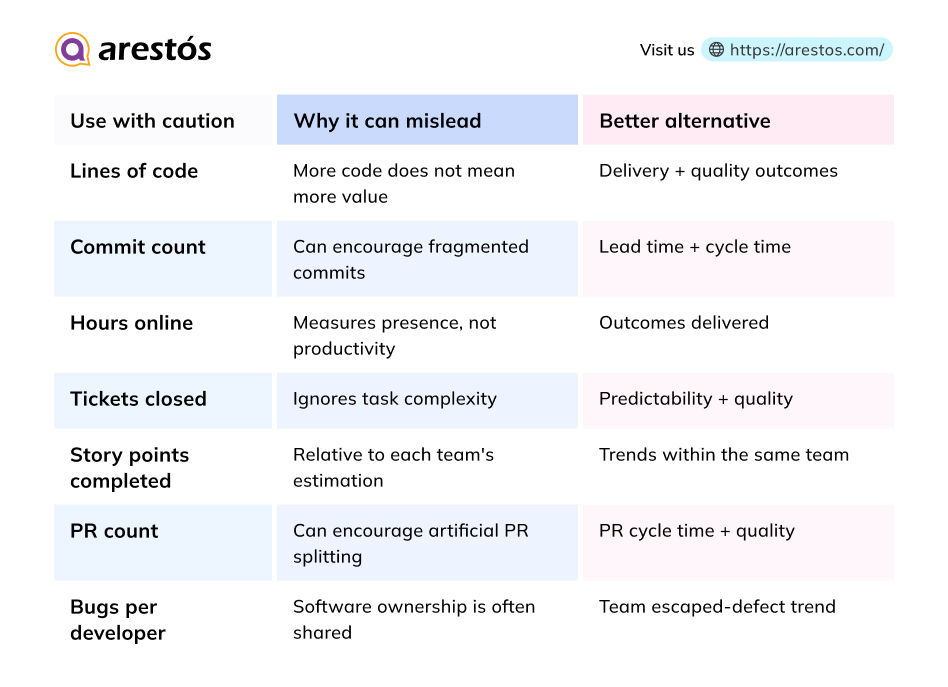
The principle is simple: do not mistake activity for productivity. The SPACE framework similarly treats developer productivity as multidimensional rather than something that can be captured by a single activity metric.
Use these metrics for context where appropriate, but evaluate offshore performance primarily through delivery, quality, collaboration, and business outcomes.
Best Practices & Tips for Improving Offshore Developer Performance
Once performance gaps are identified, the next step is to improve the working system around the offshore team. For Hong Kong companies, the following practices can help turn KPI insights into better delivery.
- Set clear expectations: Define ownership, deliverables, quality standards, and Definition of Done before development begins.
- Create working-hour overlap: Reserve shared time between Hong Kong and offshore teams for blockers, reviews, and decisions that cannot wait.
- Prioritize asynchronous communication: Document requirements, decisions, and technical context so progress does not depend on real-time meetings.
- Remove blockers quickly: Establish clear owners and escalation paths for approvals, access, dependencies, and technical decisions.
- Involve developers early: Include offshore developers in planning and requirement discussions to reduce misunderstandings and rework.
- Standardize engineering workflows: Align PRs, code reviews, testing, documentation, and deployment practices across teams.
- Review trends, not isolated KPIs: Evaluate performance across several sprints to distinguish recurring problems from temporary fluctuations.
- Turn KPI insights into action: Use retrospectives and regular feedback to understand why metrics change and agree on specific improvements.
Building a High-Performing Offshore Development Team
KPIs can tell you whether an offshore team is performing, but consistent performance starts earlier—with hiring the right developers and creating the right team structure.
Performance Starts With Hiring the Right Offshore Developers
Technical ability alone is not enough. Offshore developers should be selected based on:
- Technical fit: Skills and experience relevant to the project and technology stack.
- Domain experience: Familiarity with the industry or similar development environments.
- Communication: Strong English and ability to collaborate across cultures and time zones.
- Remote readiness: Experience with Agile/Scrum, distributed teams, and remote workflows.
- Team fit: Ability to work effectively with existing Hong Kong product and engineering teams.
For Hong Kong companies without an established offshore recruitment pipeline, a staffing partner can help source, screen, and assemble developers against these requirements.
What to Look for in an Offshore Staffing Partner
Hong Kong companies should evaluate potential partners on:
- Developer vetting: How are technical and communication skills assessed?
- Talent relevance: Can they source developers with the required stack and experience?
- Transparency: Are pricing, employment costs, and responsibilities clear?
- Retention and replacement: What happens if a developer leaves or is not the right fit?
- Security: How are IP, confidentiality, and access handled?
- Scalability: Can the team expand or contract as requirements change?
- Ongoing support: Does support continue after developers are onboarded?
To compare potential providers against these criteria, explore our Top 10 Offshore IT Staffing Companies in Hong Kong for a closer look at the options available in the market.
Build Your Offshore Development Team with Arestós
Measuring performance becomes easier when the right people, expectations, and processes are in place from the beginning. Arestós’ offshore development staffing service helps Hong Kong businesses build development capacity around their technology requirements, project needs, and preferred team structure.
Rather than focusing only on filling developer seats, the objective is to build an offshore team that can integrate with your existing operation and be measured against clear delivery, quality, collaboration, and business outcomes.
Talk to Arestós about the developer skills and capabilities your team needs.
Frequently Asked Questions
1. How do I know if my offshore developers are performing well?
Look for predictable delivery, consistent quality, reliable releases, effective collaboration, and business impact.
2. How many KPIs should I track for an offshore development team?
Use a focused set covering delivery, quality, reliability, collaboration, and business outcomes. Avoid tracking metrics simply because they are available.
3. Should I compare offshore developers with my in-house developers?
Not directly. Compare performance against relevant goals and trends, as teams may have different responsibilities, complexity, and dependencies.
4. How long should I measure offshore developer performance before making a decision?
Track performance across multiple delivery cycles rather than judging the team based on a single sprint.
5. Can KPIs improve offshore developer performance?
KPIs identify problems; they do not solve them. Use the insights to improve processes, remove bottlenecks, and set clearer expectations.
Conclusion
Maximizing offshore developer performance is not about tracking more activity—it is about improving delivery, quality, collaboration, and business outcomes. The right KPIs help Hong Kong teams identify bottlenecks, understand what is driving performance, and turn those insights into meaningful improvements.
Strong performance also starts with having the right people in the right roles. Arestós’ Offshore Development Staffing service helps Hong Kong businesses access developers aligned with their technical requirements, project needs, and team structure—making it easier to build and scale an offshore development team designed for long-term performance.
Ready to strengthen your offshore development team? Talk to us about the developer skills and capabilities your business needs.
Subscribe to our newsletter!
Get updated to
the lastest IT trends
Related Posts
Update the latest technology trends for your business