Back to featured insights
How to Build a High-Performing Offshore Development Team in Hong Kong
What does it take to build a high-performing offshore development team? Learn how Hong Kong companies can build the right foundation, integrate offshore talent effectively and create a team that delivers consistent, high-quality outcomes.

Table of Content
Share
What turns a group of offshore developers into a high-performing development team?
It takes more than technical talent. The team needs to deliver consistently, take ownership and work as an integrated part of your Hong Kong engineering operation.
This guide explains how to build an offshore development team that works effectively, delivers quality outcomes and contributes to your business goals.
What Does a High-Performing Offshore Development Team Look Like?
A high-performing offshore development team is not defined by how many hours developers work or how many tasks they complete. It is defined by how consistently the team delivers quality software, collaborates with the Hong Kong team and contributes to product and business goals.
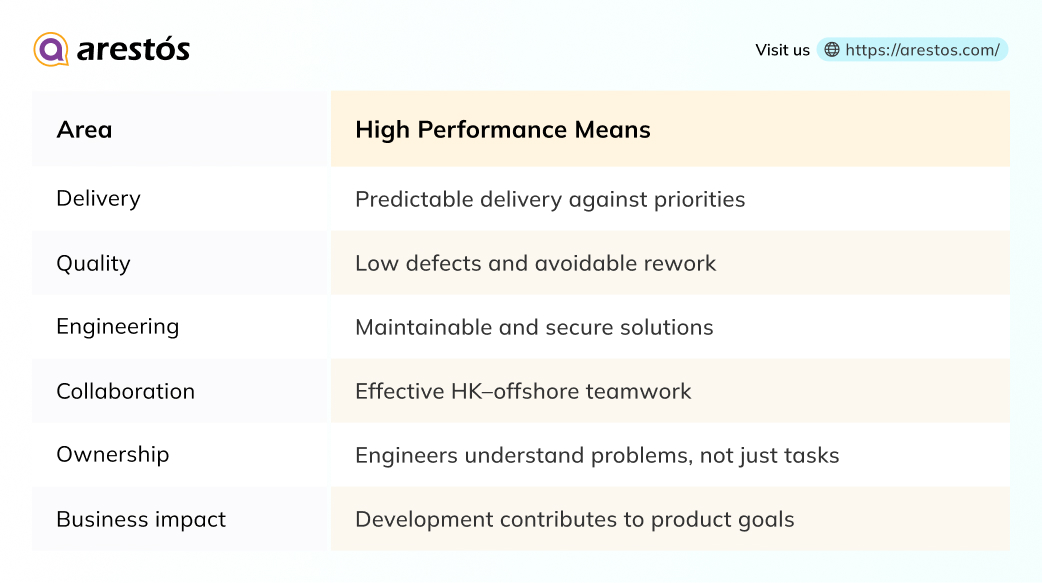
The key distinction is outcomes over activity. Hours online, tickets closed, commits and lines of code may indicate activity, but they do not reliably show whether the team is delivering valuable, high-quality outcomes.
For offshore development to work effectively, both locations should operate as one engineering organization:
One roadmap. One backlog. One engineering standard. One team.
Once the team is operational, a structured approach to measuring offshore developer performance helps engineering leaders connect delivery and engineering metrics with actual business outcomes.
A 9-Step Framework for Building a High-Performing Offshore Development Team
A high-performing offshore development team is built through a structured process—from defining what the team needs to achieve to selecting the right model, hiring the right talent, integrating operations and scaling sustainably.
Step 1: Define the Business Case, Scope and Success Criteria
Start by defining why you need an offshore team and what you expect it to achieve. The goal may be to access scarce skills, increase development capacity, accelerate delivery, improve cost efficiency or strengthen business continuity.
Before hiring, clarify three areas:
- Scope: Decide which workloads can move offshore and which responsibilities should remain with the Hong Kong team.
- Readiness: Assess whether your current engineering environment can support a distributed team.
- Success: Set measurable 6–12 month targets for ramp-up, delivery, quality and capability.
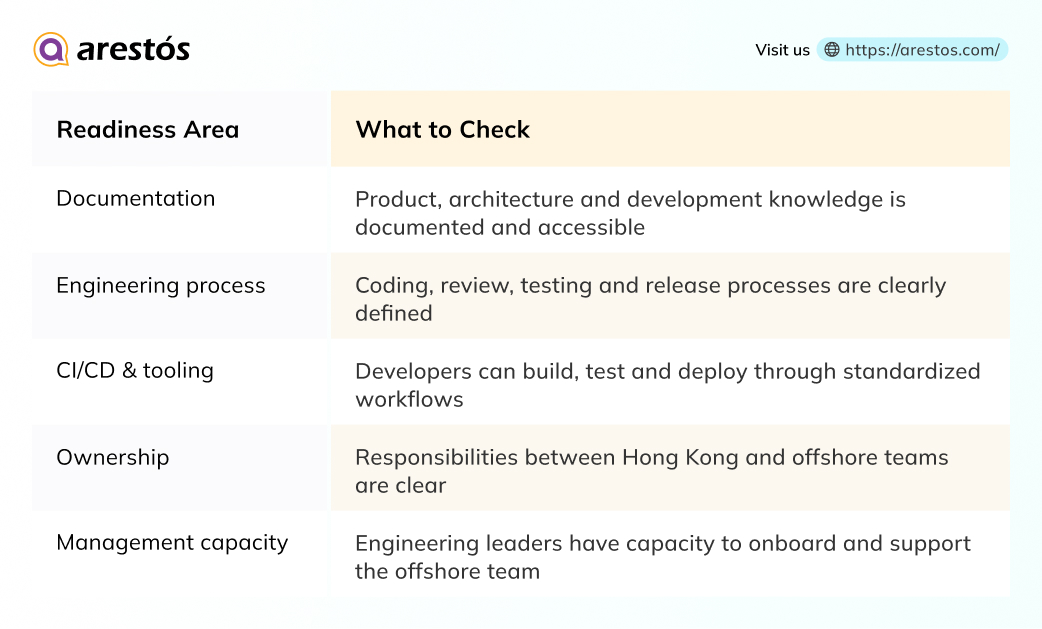
The objective is to establish a clear purpose, workable scope and measurable definition of success before recruitment begins.
Step 2: Choose the Right Engagement Model
Choose an engagement model based on the level of control, internal management capacity and flexibility your company needs.
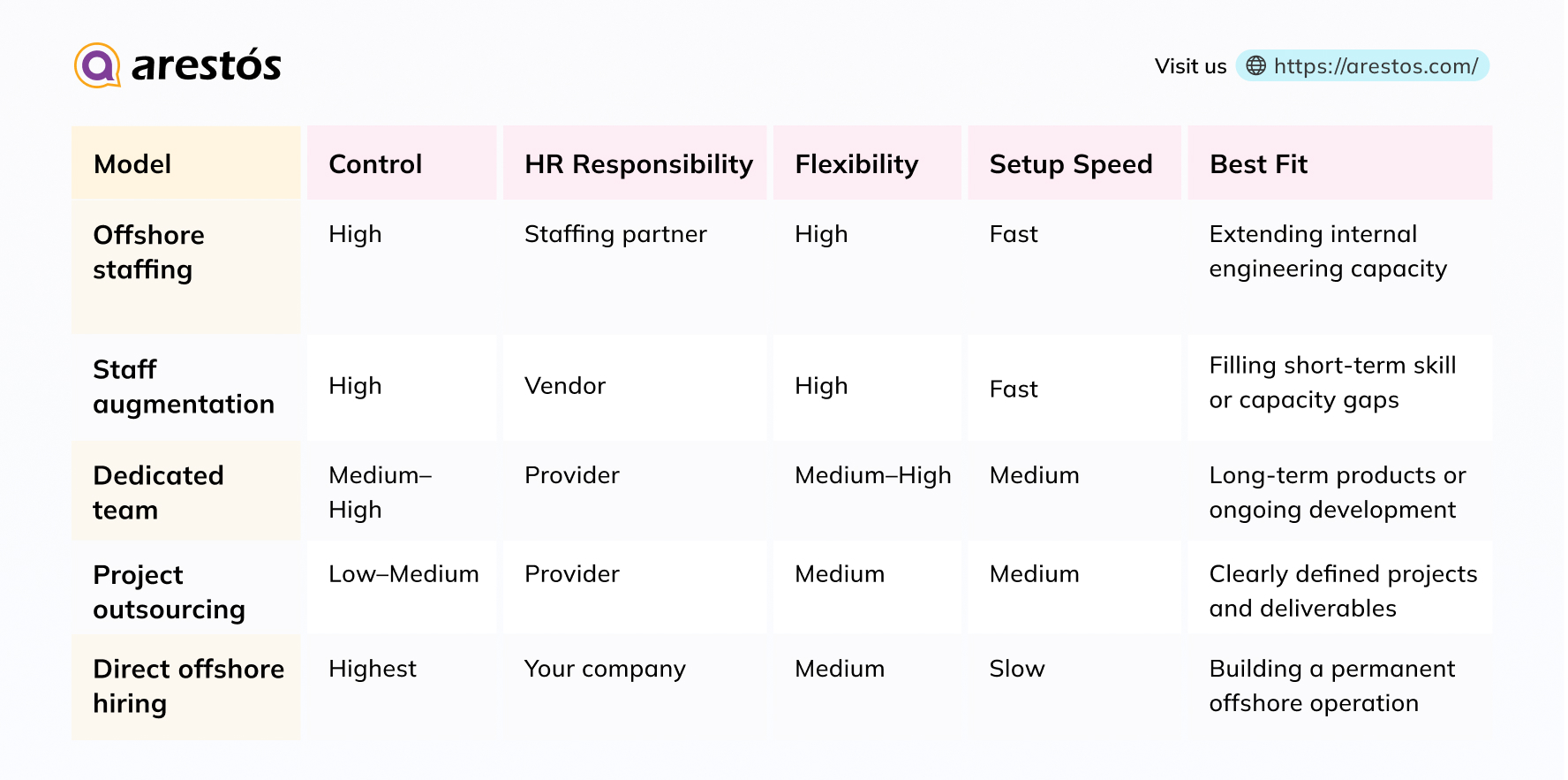
With staffing-based models, your company retains product direction and technical management, while the partner handles recruitment and workforce administration. Direct hiring offers greater control but requires more employment, HR and compliance infrastructure.
Arestós’ Offshore Development Staffing model allows Hong Kong companies to manage offshore engineers directly while Arestós supports talent acquisition and workforce administration—suitable for extending existing teams or building long-term development capacity.
Step 3: Select the Right Offshore Talent Market
The right offshore market should match your technical requirements, collaboration model and long-term workforce needs. Evaluate potential markets consistently rather than choosing primarily on labour cost.
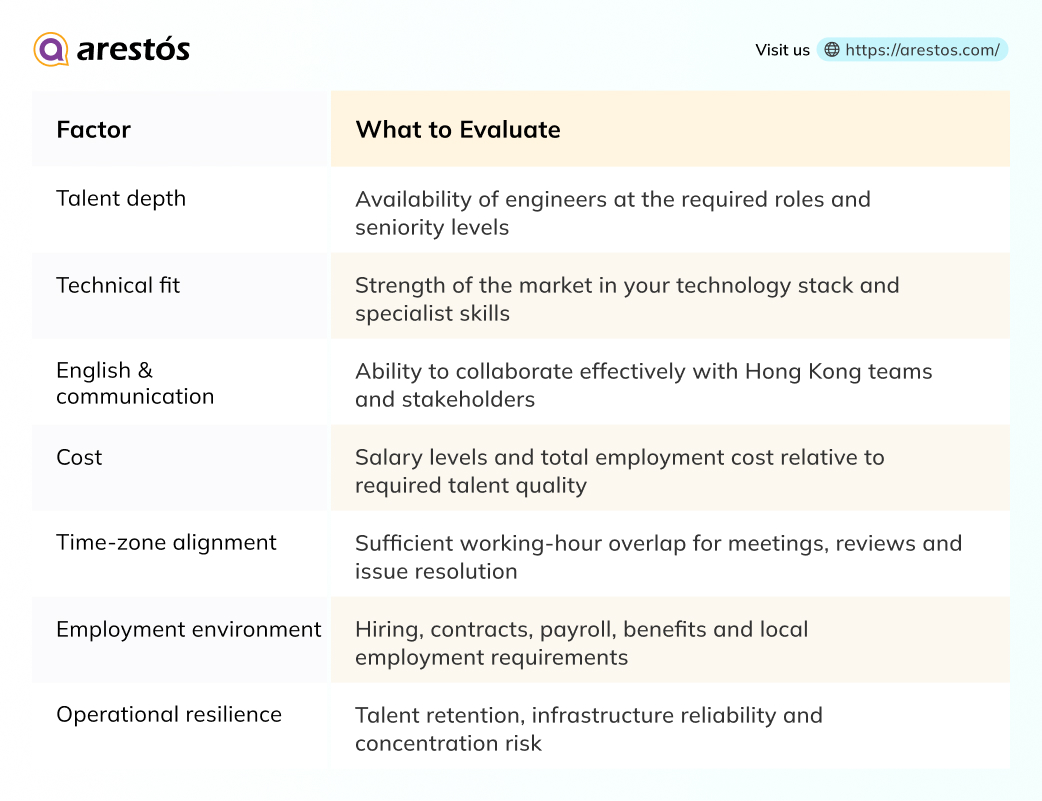
For most teams, working-hour alignment matters as much as geographic proximity. Developers need enough overlap with Hong Kong for sprint planning, code reviews, technical discussions and urgent issues.
Companies can source from a single market to simplify management or use multiple markets to broaden the talent pool and reduce concentration risk. The right approach depends on team size, skill requirements and management capacity.
Step 4: Evaluate and Select the Right Offshore Development Partner
Choose a partner that can support talent quality, workforce operations and long-term continuity, not simply provide developers at a lower rate.
Evaluate potential partners across:
- Technical recruitment: Look for a structured process for sourcing, technical screening and candidate matching.
- Talent availability: Check whether the partner can provide the required roles, skills and seniority within a realistic timeframe.
- Pricing transparency: Understand what is included in the fee and identify any recruitment, onboarding or management costs.
- HR & employment: Clarify who manages contracts, payroll, benefits and ongoing employee support.
- Security & IP: Review how intellectual property, confidentiality and system access are protected.
- Continuity: Ask what happens if an engineer resigns and how replacement is handled.
- Scalability: Confirm whether the partner can add new roles or expand the team as requirements change.
- Hong Kong support: Consider the level of local communication, responsiveness and accountability available.
Watch for red flags such as rate-only selling, weak technical screening, hidden fees, unclear employment arrangements or no defined replacement process.
Step 5: Design the Team Structure and Define Responsibilities
Build the team around actual workload and existing internal capabilities, rather than starting with a large offshore headcount. Start lean, then add roles as delivery needs become clearer.
A typical structure may include:
- Technical Lead: Owns technical direction, architecture decisions and engineering standards.
- Developers: Build, maintain and improve the product based on the required technology stack.
- QA Engineers: Manage testing, quality assurance and test automation.
- DevOps Engineers: Support infrastructure, CI/CD, deployment and reliability.
- Specialists: Add capabilities such as AI/ML, data, cloud or cybersecurity when required.
Balance seniority and specialization carefully. Senior engineers can provide technical ownership and mentoring, while mid-level developers support delivery capacity and specialists address capability gaps.
For Hong Kong–offshore teams, clearly define reporting lines, technical ownership, decision rights and escalation paths so responsibilities do not become fragmented across locations.
Suggested visual:
Hong Kong Product/Engineering Lead → Offshore Technical Lead → Developers + QA + DevOps/Specialists
The team can be built role by role—starting with core offshore software developers and adding QA, AI/ML or other specialist capabilities as requirements evolve.
Step 6: Recruit and Vet Talent Rigorously
Effective offshore hiring requires both rigorous screening and efficient recruitment. Start with a clear candidate profile covering technical skills, seniority, domain experience, English proficiency, communication and working-hour requirements.
Use a consistent vetting process:
Sourcing → CV Screening → Technical Assessment → Technical Interview → Communication & Team-Fit Assessment → Reference Check → Offer
Hong Kong technical leaders should participate in the final selection to validate technical fit and ensure candidates can work effectively within the existing engineering team.
Before hiring, also clarify:
- Compensation & benefits: Align packages with the target talent market and seniority.
- Employment: Define contracts, payroll and employment responsibilities.
- IP & confidentiality: Establish IP assignment and NDAs from the outset.
- Working arrangements: Confirm working hours, availability and collaboration expectations.
Recruitment speed matters, but it should not come at the expense of quality. A fast hire who lacks the required technical or collaboration fit can create greater delivery costs later.
Step 7: Onboard and Integrate the Team
A structured onboarding process helps offshore developers become productive faster and integrate into the wider engineering team. Use a 30–60–90-day framework to gradually move from setup and learning to independent ownership.
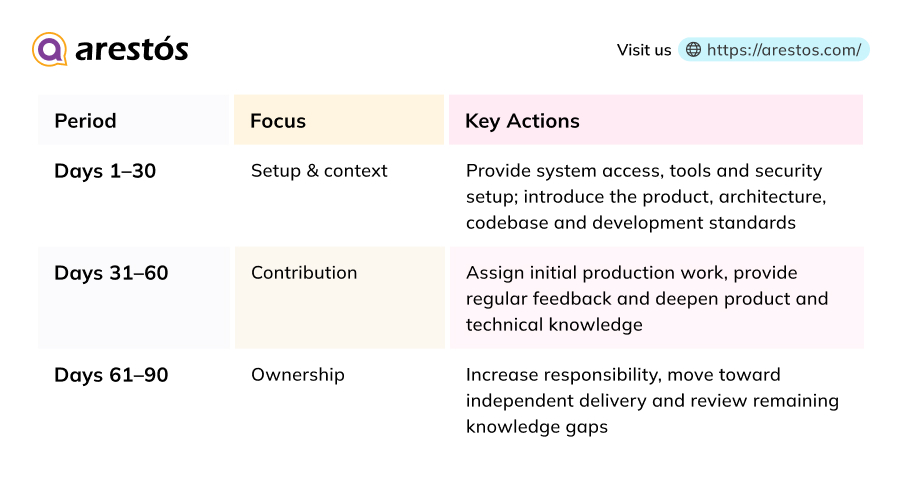
Assign a buddy or mentor and include offshore developers in stand-ups, sprint planning, retrospectives, code reviews and relevant team communication from the start.
Support knowledge transfer with architecture documentation, runbooks, coding standards and recorded walkthroughs. The goal is to build one integrated engineering team rather than separate “Hong Kong” and “offshore” groups.
Where a staffing partner is involved, it can support workforce onboarding and employee administration, while the client should retain ownership of technical, product and team integration.
Step 8: Manage Delivery, Communication and Performance
Once the team is operational, establish a consistent approach to communication, engineering delivery and performance management across Hong Kong and offshore locations.
- Communication: Set core overlap hours, regular team syncs and clear synchronous vs asynchronous communication practices.
- Engineering standards: Apply the same Definition of Done, code review, automated testing, CI/CD and documentation standards across locations.
- Performance: Measure delivery predictability, cycle time, deployment frequency, defects, rework and collaboration.
- Requirements: Use clear acceptance criteria and clarify requirements before development begins.
- Knowledge sharing: Maintain documentation, cross-training and shared ownership to reduce key-person dependency.
Avoid using hours online, commit count or lines of code as primary performance measures. Focus instead on outcomes that reflect delivery, quality and collaboration.
The goal is to maintain consistent performance across Hong Kong and offshore teams.
Step 9: Retain, Protect and Scale the Team
Once the offshore team is performing consistently, the priority shifts from building the team to sustaining its capability and preparing it to scale.
Retain: Keep the right talent engaged
Support retention through competitive compensation, career development, learning opportunities, recognition and consistent leadership. Stable teams preserve experience and reduce repeated ramp-up costs.
Protect: Preserve knowledge and reduce risk
Use documentation, cross-training and backup ownership to prevent key-person dependency. Protect the business through clear IP ownership, NDAs, repository controls, access policies and relevant PDPO safeguards.
Scale: Grow capacity without losing performance
Add headcount only when capacity or capability gaps justify it. Develop technical leaders, expand into additional squads gradually and regularly review whether the team structure still supports business needs.
Common Mistakes When Building an Offshore Development Team
Even with the right setup, offshore teams can underperform when ownership, communication and integration are poorly managed. Common mistakes include:
- Hiring primarily on cost: Prioritize technical capability, experience and team fit instead of choosing the lowest-cost talent.
- Treating offshore engineers as task executors: Give them sufficient product context, decision-making scope and ownership.
- Separating Hong Kong and offshore teams: Use shared goals, engineering standards and workflows to operate as one team.
- Over-relying on meetings: Balance synchronous discussions with clear asynchronous communication and documentation.
- Micromanaging developers: Set clear expectations and evaluate outcomes rather than monitoring day-to-day activity.
- Allowing knowledge silos: Use documentation, cross-training and shared ownership to reduce dependency on individuals.
- Scaling too quickly: Stabilize processes, responsibilities and leadership before adding more headcount.
Many of these mistakes start before recruitment, so understanding offshore IT staffing can help organizations clarify responsibilities, costs, management models and risks before building the team.
When Should You Work With an Offshore Staffing Partner?
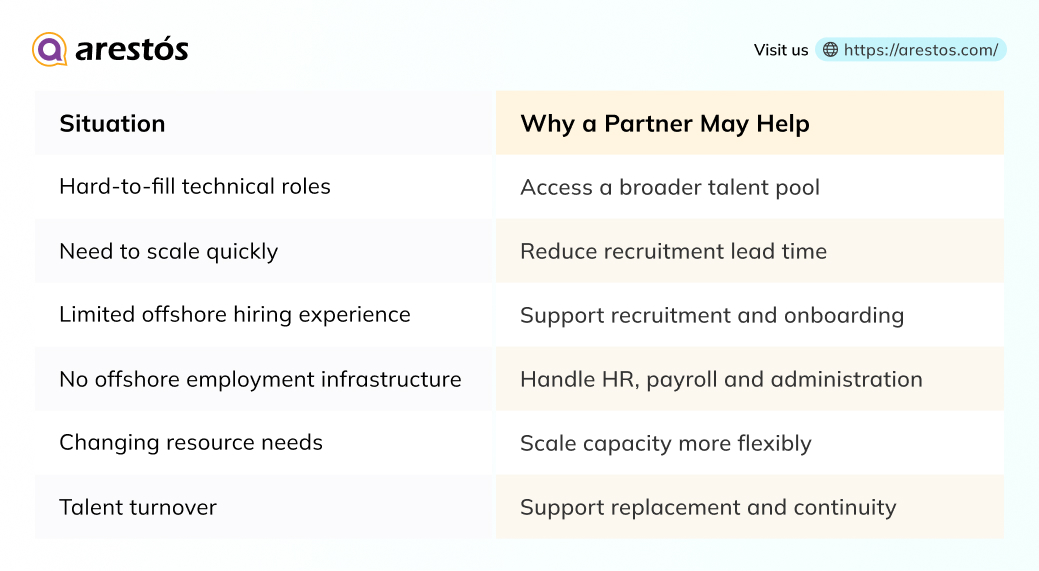
A staffing partner becomes relevant when building and maintaining an offshore team starts creating additional recruitment, HR or operational complexity.
Signs You May Need a Staffing Partner
What to Look for in an Offshore Staffing Partner
When evaluating a provider, consider whether they can:
- Source the right technical talent for the required skills and seniority.
- Screen candidates effectively for technical and communication capabilities.
- Support flexible team structures as development needs change.
- Handle HR and employment administration for offshore staff.
- Scale with your engineering needs while maintaining talent continuity.
Compare the Top 10 Offshore IT Staffing Companies in Hong Kong to find the right partner for your needs.
Why Choose Arestós for Your Offshore Development Team?
Arestós combines technology expertise with offshore staffing capabilities to help Hong Kong companies build and scale development teams around their technical and business requirements.
Key advantages include:
- Flexible team models: Scale from individual staff extension to dedicated development teams or development outsourcing based on project needs.
- Broad technology talent: Access expertise across software development, QA, DevOps/cloud, data, AI/ML and cybersecurity.
- End-to-end staffing support: Cover recruitment, onboarding, HR administration, payroll, employee support and talent continuity.
- Technology delivery experience: Combine staffing capabilities with practical software development and technology expertise.
- Scalable capacity: Adjust team size, structure and technical capabilities as development requirements evolve.
See why businesses choose Arestós to support their technology and offshore staffing needs.
Frequently Asked Questions
1. What roles should an offshore development team include?
A typical team includes developers, a technical lead, QA and DevOps, with specialists such as AI/ML, data or cloud engineers added based on project requirements.
2. When should you use a dedicated offshore development team?
A dedicated team is suitable for long-term development, ongoing product work or projects requiring stable engineering capacity and close integration with your internal team.
3. Is an offshore development team cheaper than hiring developers in Hong Kong?
It can be. Offshore hiring may reduce salary and recruitment costs, but the actual savings depend on location, role, seniority, staffing model and management requirements.
4. Should I hire individual offshore developers or a dedicated team?
Individual developers work well for specific skill or capacity gaps. A dedicated team is more suitable when you need multiple roles working together on long-term development.
5. How long does it take to build an offshore development team?
The timeline depends on team size, technical requirements, talent availability and recruitment model. Starting with a small core team and scaling gradually can reduce hiring and integration risk.
Conclusion
Building a high-performing offshore development team requires the right strategy, talent, structure, integration and management. When these elements work together, offshore teams can deliver consistently and operate as an effective extension of your Hong Kong engineering team.
Arestós helps Hong Kong companies build offshore development capacity with the right technical talent and workforce support, while keeping day-to-day technical management in your hands.
Ready to build your offshore development team? Contact us to discuss your requirements.
Subscribe to our newsletter!
Get updated to
the lastest IT trends
Related Posts
Update the latest technology trends for your business