Back to featured insights
Hiring AI Engineers in Hong Kong: In-House vs Offshore Costs
Hiring AI engineers in Hong Kong can be costly as demand for specialised talent grows. How does in-house hiring compare with offshore staffing? Explore the cost differences and find the right approach to building your AI team.
Table of Content
Share
Hong Kong enterprises are moving AI from experimentation to real business use, but talent is becoming a bottleneck. According to HKPC’s AI Readiness in Workplace Survey 2025, 88% of employees at surveyed Hong Kong companies already use AI tools, while a lack of AI expertise and training remains the top barrier to wider adoption.
The cost gap is significant. A Machine Learning Engineer in Hong Kong earns around HKD 65,000 per month, according to Morgan McKinley’s 2026 Salary Guide.
So, should enterprises hire in-house or go offshore? This guide compares the true cost of both models to help Hong Kong enterprises decide when to hire locally and when Offshore AI & ML Engineers.
Quick Answer: How Much Does an AI Engineer Cost in Hong Kong?
For Hong Kong enterprises, hiring AI talent in-house typically means HKD 50,000–65,000 per month in base salary, while offshore costs vary significantly by location, seniority and engagement model.
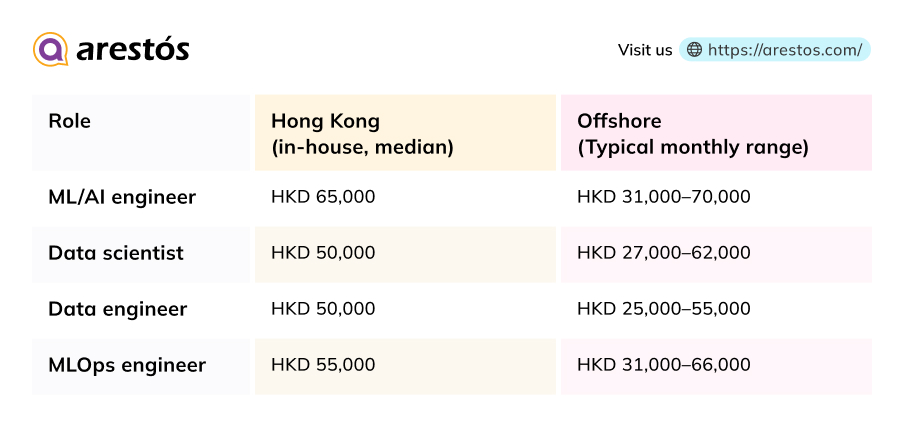
According to Morgan McKinley’s 2026 Hong Kong Salary Guide, median monthly salaries range from HKD 50,000 for Data Scientists and Data Engineers to HKD 65,000 for ML Engineers.
Offshore costs are less uniform. Current 2026 market benchmarks show that specialist AI engineering rates can range from roughly USD 30–60/hour in Asia to USD 50–90/hour in Eastern Europe and Latin America, depending on seniority and specialisation.
The key takeaway: offshore can reduce the cost of accessing AI engineering capability, but the actual saving depends on where and how the team is staffed—not simply the “offshore” label.
Offshore figures are directional planning ranges, not fixed salaries. Actual costs vary by geography, seniority, provider and engagement model.
Why Hiring AI Engineers in Hong Kong Is Difficult
Hong Kong’s AI hiring challenge comes from a widening gap between how quickly enterprises want to deploy AI and how quickly experienced capability can be built or hired.
Adoption is outpacing capability
Many Hong Kong organisations are adopting AI, but relatively few have moved from experimentation to measurable production impact.
According to the Deloitte-HKU AI Adoption Index 2026, 69% of Hong Kong organisations are still experimenting with AI or running limited pilots, while only 23% have operational deployments delivering measurable financial impact. Meanwhile, 24% identify a shortage of skilled AI and data science professionals as a barrier.
The challenge is therefore shifting from accessing AI technology to securing the capability required to operationalise it.
Competition raises the cost of experienced talent
Hong Kong enterprises are competing with banks, technology companies and well-funded startups for a limited pool of experienced AI professionals.
According to KOS International’s 2026 Hong Kong talent analysis, AI, data and cybersecurity specialists can command 15–25% salary premiums, while strong candidates may leave the market within three to four weeks.
For employers, that means greater compensation pressure and less time to secure the right candidate.
The problem is also a skills mismatch
More candidates do not necessarily mean more deployment-ready talent. Enterprises increasingly need a combination of:
- Production experience: Engineers who have deployed and operated AI systems—not only built prototypes.
- AI + domain expertise: Technical capability combined with knowledge of sectors such as finance, logistics or retail.
- AI governance: Skills spanning privacy, security, risk and responsible AI.
Governance is becoming particularly relevant. According to HKPC’s AI Readiness in Workplace Survey 2025, 54% of surveyed companies lack a comprehensive AI governance framework.
This mismatch shows up directly in the cost—and time—required to hire AI engineers in Hong Kong.
In-House AI Engineer Costs in Hong Kong
The true cost of an in-house AI engineer goes beyond base salary. Enterprises also need to account for recruitment, MPF, benefits, technology, onboarding and the cost of leaving a specialist role unfilled.
Salary by role
According to Morgan McKinley’s 2026 Hong Kong Salary Guide, monthly salaries for key AI and data roles vary significantly by seniority, industry and employer:
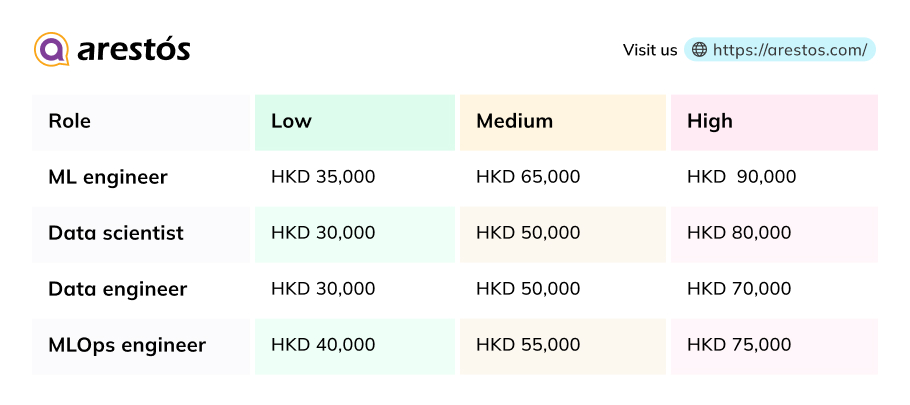
These benchmarks are consistent within one methodology, but actual offers can be higher. For example, Robert Half’s 2026 Salary Guide places the median AI Engineer salary at HKD 1.02 million per year, or approximately HKD 85,000 per month.
Market pressure can push specialist packages higher still. KOS International reports that AI, data and cybersecurity specialists can command 15–25% premiums over standard packages.
Hidden costs beyond salary
For a median ML Engineer earning HKD 780,000 per year, base salary is only the starting point.
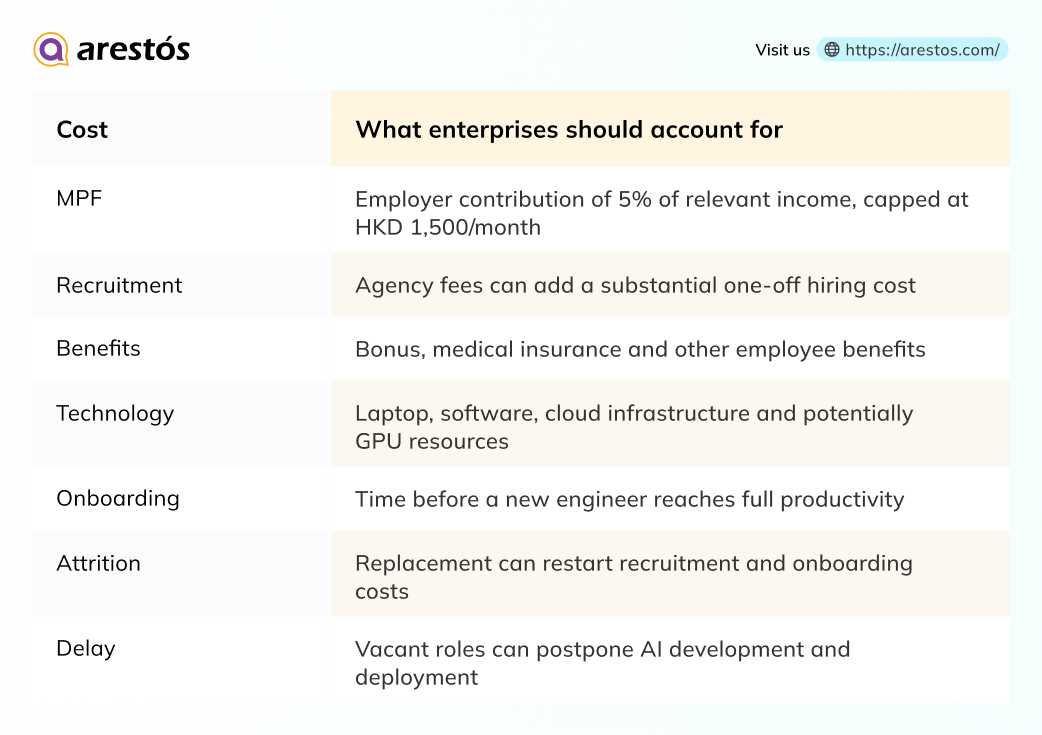
Under Hong Kong’s MPF system, employers contribute 5% of an employee’s relevant income, subject to a maximum mandatory contribution of HKD 1,500 per month. Hong Kong Mandatory Provident Fund Schemes Authority (MPFA).
Recruitment can be much larger. A 20–25% agency-fee benchmark on an ML Engineer earning HKD 780,000 annually would equal approximately HKD 156,000–195,000 for a single hire.
But one of the largest hidden costs can be delay. While a specialist role remains vacant, AI projects may remain stuck between pilot and production. Some enterprises reduce this dependency by starting with focused solutions such as Generative BI, using existing enterprise data to create value without first assembling a complete in-house AI team.
Time to hire
Hiring a senior AI engineer typically involves sourcing, technical assessment, multiple interview rounds, offer approval and then the candidate’s notice period.
At the same time, KOS International’s 2026 Hong Kong talent analysis indicates that strong AI candidates can be off the market within three to four weeks.
For enterprises, this creates a timing problem: a slow hiring process does not only increase recruitment effort—it can delay when AI capability becomes available to the business.
Offshore AI Engineer Costs
Offshore AI engineering costs vary by role, seniority and engagement model. Vietnam provides a useful benchmark for Hong Kong enterprises because of its established technology talent market and near-full working-day overlap with Hong Kong.
Rates by role and seniority
Offshore AI engineer rates vary by role, seniority, talent location and engagement model. As a general planning benchmark, enterprises can expect monthly costs to fall within these ranges:
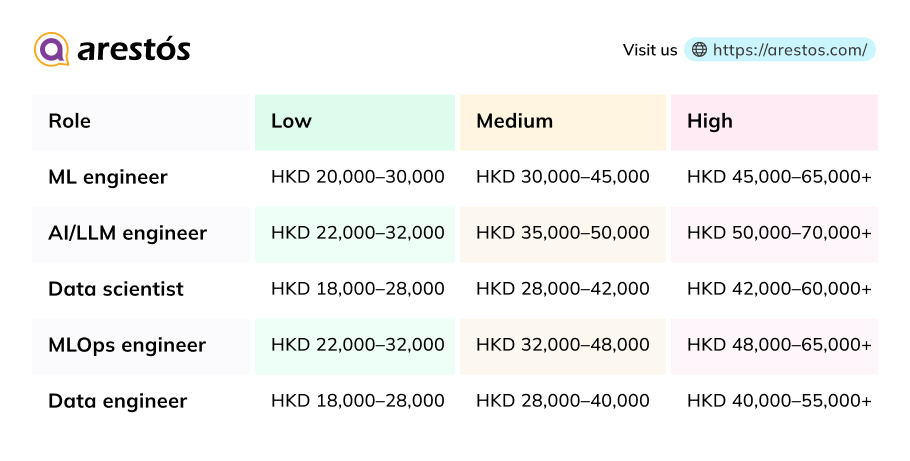
These are indicative offshore engagement ranges rather than employee salaries. Actual rates depend on geography, technical specialisation, experience and what the staffing provider includes in the monthly fee.
For cost planning, enterprises should compare the total monthly offshore rate with the total employment cost of an in-house engineer, rather than comparing base salaries alone.
What a dedicated offshore model includes
Under a dedicated offshore IT staffing model, engineers work as an extension of the client’s team while the provider handles much of the employment infrastructure, including:
- Recruitment and technical vetting
- HR, payroll and statutory contributions
- Equipment and workplace support
- Retention and replacement support
- Ongoing staffing administration
The client retains day-to-day control over priorities, workflows and technical delivery.
Costs and risks to plan for
Lower salary benchmarks do not eliminate the operational requirements of offshore staffing. Enterprises should still plan for internal management time, communication processes, data security and IP protection.
Clear documentation, meeting cadence, access controls and ownership should be established from the start. Ultimately, the goal is not simply to access cheaper engineering hours, but to achieve lower total cost without sacrificing delivery quality or control.
In-House vs Offshore: Side-by-Side Comparison
The right model depends on more than salary. For Hong Kong enterprises, the key trade-offs are total cost, speed, scalability, control and long-term ownership.
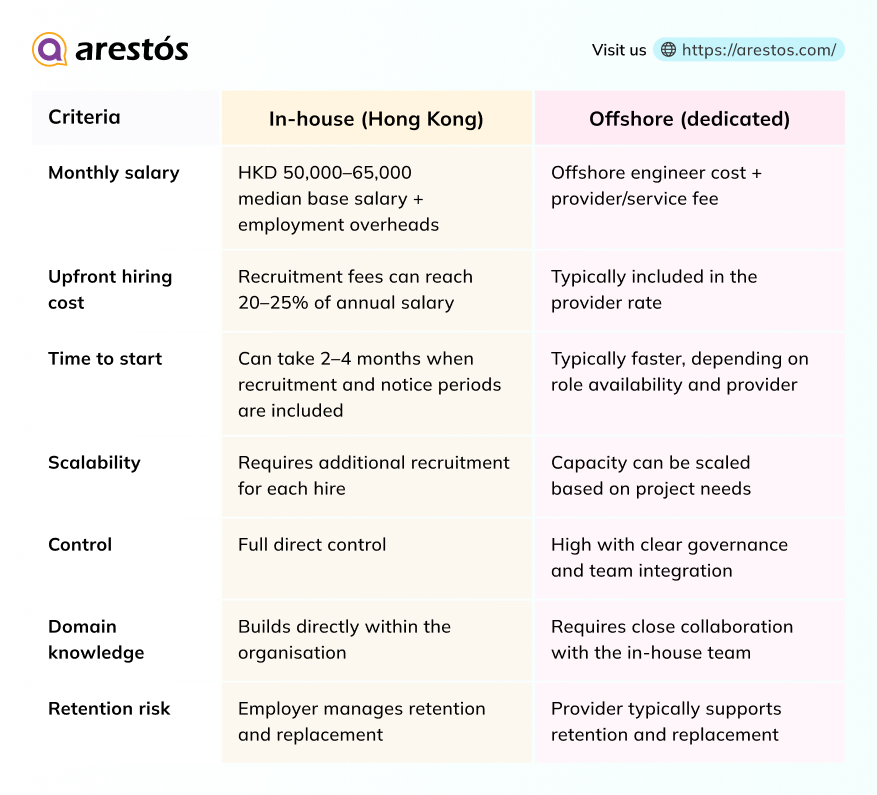
In-house hiring offers direct ownership, deeper institutional knowledge and maximum control, but comes with higher fixed employment commitments and recruitment responsibility.
Dedicated offshore staffing prioritises faster access to specialised talent, flexible capacity and lower employment overhead, provided the enterprise retains strong internal ownership of strategy, priorities and delivery standards.
For many AI teams, the decision is therefore not strictly in-house vs offshore. A hybrid model can keep strategy, domain knowledge and critical IP in-house, while using offshore engineers to expand specialised delivery capacity.
Cost Example: Building a 3-Person AI Team
Consider a Hong Kong enterprise building a three-person AI team with one ML Engineer, one Data Engineer and one MLOps Engineer. Using current salary benchmarks, the first-year cost can look very different depending on the staffing model.
Option A: All In-House
At Hong Kong median salaries, the three roles cost:
HKD 65,000 + HKD 50,000 + HKD 55,000 = HKD 170,000/month
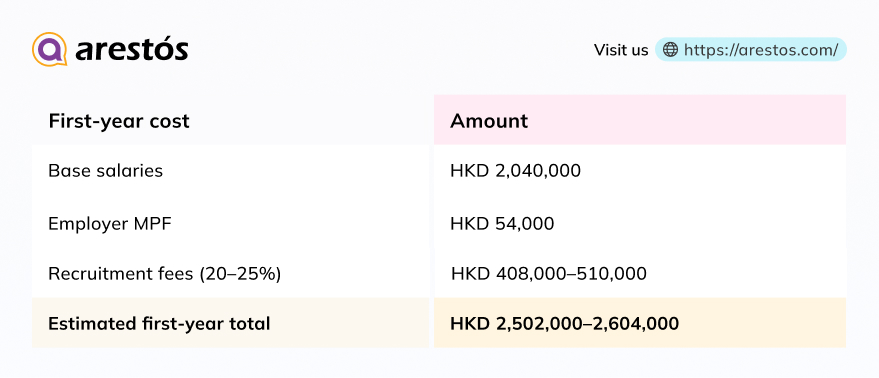
That is approximately HKD 2.5–2.6 million in year one, before bonuses, medical benefits, equipment, office costs and other employment overheads.
Option B: All Offshore
Using mid-level offshore salary benchmarks, the same three roles total approximately:
HKD 17,600 + HKD 16,900 + HKD 19,900 = HKD 54,400/month
That equals approximately HKD 652,800 per year in underlying engineer salaries.
However, this is not the final client cost. Under a dedicated staffing model, the actual comparison should use the provider’s all-inclusive monthly rate:
3 Offshore Engineers × [Arestós monthly rate] × 12 months
This accounts for the staffing and employment services included in the engagement, rather than comparing Hong Kong employment costs directly with offshore salaries.
Option C: Hybrid Team
A hybrid model keeps strategic ownership in Hong Kong while moving more execution capacity offshore:
- 1 senior in-house AI lead: ~HKD 90,000/month → HKD 1,080,000/year base salary
- 2 Offshore AI Engineers: 2 × [Arestós monthly rate] × 12
This structure keeps AI strategy, business context and technical leadership in-house, while offshore engineers provide specialised build and delivery capacity.
A common hybrid setup is an in-house AI lead who owns the roadmap, supported by a dedicated offshore team that handles engineering and delivery. Arestós provides Offshore AI & ML Engineers.
Which AI Roles to Keep In-House and Which to Offshore
Not every AI role should follow the same staffing model. A practical rule is to keep strategic ownership and business-critical knowledge close to the enterprise, while using offshore talent to extend specialised engineering and delivery capacity.
Keep In-House: Strategy, Governance and Domain Ownership
Roles that shape what AI should do, how it creates value and what risks are acceptable generally benefit from close proximity to the business.
- AI Product Owner / AI Lead: Owns the AI roadmap, priorities and business outcomes.
- AI Governance & Risk: Sets policies for security, privacy, compliance and responsible AI.
- Domain Experts: Define use cases, provide business context and evaluate whether AI outputs are useful and reliable.
These roles depend heavily on institutional knowledge, stakeholder access and decision-making authority, making internal ownership particularly valuable.
Good Fit for Offshore: Engineering and Delivery
Execution-heavy capabilities are often easier to extend through dedicated offshore specialists, particularly when the enterprise already has clear internal ownership.
- Model development and fine-tuning: Build and adapt models for defined use cases.
- Data engineering: Develop pipelines and prepare reliable data for AI systems.
- MLOps and deployment: Deploy, monitor and maintain AI workloads in production.
- Application integration: Connect models with APIs, enterprise systems and user-facing applications.
AI models rarely operate alone. Offshore software developers can build the APIs, integrations and application layers around AI systems, while offshore QA engineers help test model outputs, workflows and integrations before release.
When AI functionality needs to connect deeply with ERP, CRM or other internal platforms, it may be better treated as part of a broader custom software development project rather than as an isolated AI hire.
When to Choose In-House, Offshore or Hybrid
The right model depends on how strategic the AI capability is, how quickly it is needed, and how much ownership the enterprise needs to retain.
Choose In-House If:
- AI is core to your product or competitive advantage.
- Sensitive data or regulatory requirements require tight internal control.
- You need long-term ownership of critical AI knowledge and IP.
- You have the budget and time to build the team internally.
In-house works best when control and long-term capability ownership outweigh speed and cost considerations.
Choose Offshore If:
- You need specialised AI engineering capacity quickly.
- Cost efficiency is an important consideration.
- The scope, architecture and expected deliverables are well defined.
- Your internal team can provide clear technical and product direction.
Offshore works best when the business knows what it needs to build but needs additional engineering capability to execute it.
Choose Hybrid If:
- You want to retain AI strategy and business knowledge internally.
- You need specialised skills that are difficult to hire locally.
- Engineering capacity needs to scale with projects.
- You want internal ownership without building every capability in-house.
A typical hybrid model keeps AI leadership, governance and domain expertise in Hong Kong, while offshore engineers extend development, data and MLOps capacity.
If the use case itself has not yet been validated, building a full team may be premature. A scoped machine learning project can help validate technical feasibility and business value before committing to a larger team.
The decision is ultimately not in-house versus offshore—it is deciding which capabilities the business needs to own and which it can access externally.
How to Hire Offshore AI Engineers Safely
Use the same technical, security and governance standards you would apply to an in-house AI team.
- Technical vetting: Use coding tests, an ML/GenAI case study and reviews of past production work.
- Trial period: Start with a 2–4 week trial on a defined real-world task.
- IP ownership: Ensure contracts assign all code, models and project outputs to your company.
- Data protection: Follow PCPD guidance and use data masking, role-based access and secure connections.
- Security: Apply least-privilege access and restrict sensitive production data.
- Governance: Use shared repositories, code reviews, weekly demos and clear reporting lines.
- Knowledge transfer: Require ongoing documentation to avoid dependency on individual engineers.
Offshore should change where talent comes from—not your standards for quality, security and control.
Hire Offshore AI & ML Engineers with Arestós
Arestós helps Hong Kong enterprises scale their AI capabilities with dedicated Offshore AI & ML Engineers, providing specialised expertise and flexible engineering capacity to support evolving project needs.
With Arestós, you can access:
- Specialised AI talent: ML Engineers, AI/LLM Engineers, Data Engineers and MLOps specialists.
- Dedicated staffing: Engineers work as an extension of your team, aligned with your tools, workflows and priorities.
- Faster hiring: Arestós states that offshore talent can be hired in as little as 2–4 weeks, depending on requirements.
- End-to-end staffing support: Recruitment, screening, contracts, payroll, HR and ongoing employee support are handled by Arestós.
- Flexible capacity: Scale your offshore engineering team as project requirements evolve.
Your internal team retains AI strategy, business context and technical direction, while Arestós provides the specialised engineering capacity to execute and scale.
Learn more about why Hong Kong enterprises work with Arestós, or request a tailored estimate for your AI team.
Frequently Asked Questions
1. How much does an AI engineer earn in Hong Kong?
An ML Engineer earns a median HKD 65,000/month, with a typical range of HKD 35,000–90,000, according to Morgan McKinley’s 2026 Salary Guide.
2. Is it cheaper to hire AI engineers offshore?
Generally, yes. Offshore salary benchmarks can be significantly lower, but actual savings depend on location, seniority, provider fees and management costs.
3. How long does it take to hire an AI engineer in Hong Kong?
Typically 2–4 months, including sourcing, interviews, offer approval and the candidate’s notice period.
4. Can offshore AI engineers work with sensitive enterprise data?
Yes, with appropriate data masking, access controls, secure infrastructure and PDPO-aligned contractual safeguards.
5. What is the difference between an AI Engineer and an ML Engineer?
An ML Engineer focuses mainly on machine-learning models, while an AI Engineer has a broader scope that may include LLMs, RAG, AI agents and application integration.
6. Can we start with one offshore engineer and scale later?
Yes. Dedicated staffing allows enterprises to start with one engineer and add capacity as requirements grow.
Conclusion
Hiring AI engineers in Hong Kong offers direct control and long-term capability ownership, but comes with higher employment costs and a competitive talent market. Offshore staffing provides an alternative for accessing specialised AI skills with greater cost efficiency and flexible capacity, while a hybrid model can combine the strengths of both.
With Arestós Offshore AI & ML Engineers, Hong Kong enterprises can extend their internal teams with dedicated AI, ML, data and MLOps talent while retaining control over strategy, priorities and delivery.
Contact us now to discuss your AI talent needs and find the right staffing approach for your business.
Subscribe to our newsletter!
Get updated to
the lastest IT trends
Related Posts
Update the latest technology trends for your business