Back to featured insights
Build, Buy, or Staff? Choosing the Right AI Capability Strategy
Build, Buy, or Staff? The right AI capability strategy can shape your business's future. Discover how to make the right choice and turn your AI ambitions into lasting business value.

Table of Content
Share
As AI becomes central to business innovation, enterprises face a critical decision: Should they build AI capabilities in-house, buy ready-made solutions, or staff specialised engineers to execute their AI roadmap?
Each approach offers different trade-offs in cost, speed, control, and scalability. This guide compares Build, Buy, and Staff to help Hong Kong businesses choose the right AI capability strategy and determine when offshore AI staffing makes strategic sense.
Why Is the AI Sourcing Decision Changing?
As AI evolves from traditional machine learning to Generative AI and agentic workflows, enterprises face growing challenges in data readiness, specialised talent, and implementation. These pressures are reshaping how organisations choose to build, buy, or staff AI capabilities.
The Shift from Classic ML to Agentic AI
Enterprise AI has evolved beyond traditional prediction and classification models. Modern applications increasingly incorporate large language models (LLMs), retrieval-augmented generation (RAG), and agentic AI workflows that interact with enterprise data, APIs, and business systems.
This shift introduces additional engineering requirements, including data integration, model evaluation, orchestration, security, and MLOps. As a result, buying an AI platform may not be sufficient, while building everything internally can place significant pressure on existing engineering teams.
The Talent Scarcity and Project Failure Crisis
The challenge is not simply accessing AI technology, but turning it into measurable business value.
According to Gartner, organisations are predicted to abandon 60% of AI projects unsupported by AI-ready data through 2026. Meanwhile, MIT Project NANDA’s State of AI in Business 2025 found that approximately 95% of enterprise generative AI initiatives showed no measurable profit-and-loss impact.
These findings highlight the gap between AI experimentation and production-ready business outcomes. Beyond data quality and integration challenges, enterprises must also secure specialised talent in LLM engineering, data engineering, and MLOps to develop, deploy, and maintain reliable AI systems.
The Dual Executive Friction Line
For enterprise decision-makers, these challenges create two competing pressures:
- CTOs and IT Directors: Deliver AI initiatives faster while managing technical complexity, integration risks, and limited engineering capacity.
- HR and Talent Directors: Source specialised AI professionals despite competitive salaries, lengthy recruitment cycles, and notice periods that can delay onboarding.
For Hong Kong enterprises, these pressures make relying exclusively on local recruitment increasingly difficult. Offshore AI staffing offers an additional route to specialist engineering capacity, allowing organisations to expand execution resources while retaining internal control over AI strategy and technical direction.
Ultimately, the sourcing decision is shifting from simply choosing technology to determining which capabilities to build, which solutions to buy, and where additional AI talent is needed.
What Do Build, Buy, and Staff Mean for AI?
Enterprises can acquire AI capabilities through three main approaches: building solutions in-house, buying existing AI technologies, or staffing dedicated AI specialists. Each offers different levels of control, investment, and technical responsibility.
Build: In-House AI Engineering Ecosystems
Building AI in-house means developing, deploying, and maintaining AI capabilities using an organisation’s own engineering team, typically comprising permanent Machine Learning Engineers, Data Scientists, Data Engineers, and MLOps specialists.
This approach gives enterprises direct control over the entire AI development lifecycle, from data preparation and model development to deployment, monitoring, and continuous improvement.
Key advantages include:
- Full technical control: Define AI architecture, select technologies, and manage development priorities independently.
- Greater customisation: Develop proprietary models and AI applications tailored to unique business processes and requirements.
- Long-term capability ownership: Retain institutional knowledge, intellectual property, and technical expertise within the organisation.
However, building an in-house AI team requires significant investment in recruitment, competitive salaries, training, infrastructure, and employee retention. Finding specialised AI talent can also take months, delaying implementation and increasing pressure on existing teams.
These challenges reflect how unfilled technical positions can generate hidden operational costs through delayed projects, additional workloads, and lost productivity.
Best suited for: Enterprises with long-term AI roadmaps, highly customised requirements, sufficient engineering resources, and a strategic need to retain AI capabilities internally.
Buy: Prebuilt Platforms and Packaged AI
Buying AI means adopting ready-made solutions, such as SaaS applications, prebuilt AI platforms, or predictive analytics frameworks, rather than developing the underlying technology from scratch.
This approach enables enterprises to deploy AI capabilities faster by integrating existing tools with their business systems and corporate data.
Key advantages include:
- Faster implementation: Accelerate AI adoption through prebuilt features and established technologies.
- Lower development requirements: Reduce the need for extensive in-house AI engineering resources.
- Predictable deployment: Leverage vendor-supported platforms and configurable frameworks to simplify implementation.
However, packaged AI solutions often provide limited competitive differentiation, since competitors can access similar technologies. Enterprises must also consider vendor lock-in, customisation restrictions, recurring costs, and contractual terms governing data usage, model training, and intellectual property.
For organisations requiring greater flexibility, solutions such as Arestós Jumpstart Machine Learning and Arestós Generative BI offer starting points for adapting AI and analytics capabilities to specific business needs. Enterprises should evaluate secure cloud or on-premises deployment options, data access controls, and model-training policies to ensure alignment with their privacy and governance requirements.
Best suited for: Enterprises prioritising rapid AI adoption, established functionality, and lower initial development complexity.
Staff: Dedicated Offshore AI Engineers Embedded in Your Team
Staffing AI means extending your internal engineering team with dedicated offshore AI specialists who work under your company’s technical direction, development processes, and project priorities.
Under this co-sourcing model, an offshore IT staffing partner manages recruitment, employment administration, local compliance, and payroll, while your organisation retains control over AI architecture, workflows, and delivery.
Key advantages include:
- Access to specialised talent: Bring in offshore AI engineers, including ML, LLM, Data, and MLOps specialists, without relying solely on local recruitment.
- Greater flexibility: Expand engineering capacity as project requirements evolve without committing to permanent local headcount.
- Technical control and integration: Embed dedicated engineers into existing teams, repositories, and development processes while retaining ownership of the AI roadmap and deliverables.
However, offshore AI staffing still requires strong internal technical leadership, clear requirements, and effective communication. Without experienced engineering managers or AI architects to guide development, adding external specialists may increase coordination complexity rather than improve delivery.
Best suited for: Enterprises with an established AI roadmap and internal technical leadership that need additional specialised engineering capacity without expanding their permanent in-house workforce.
Build vs Buy vs Staff: Key Differences
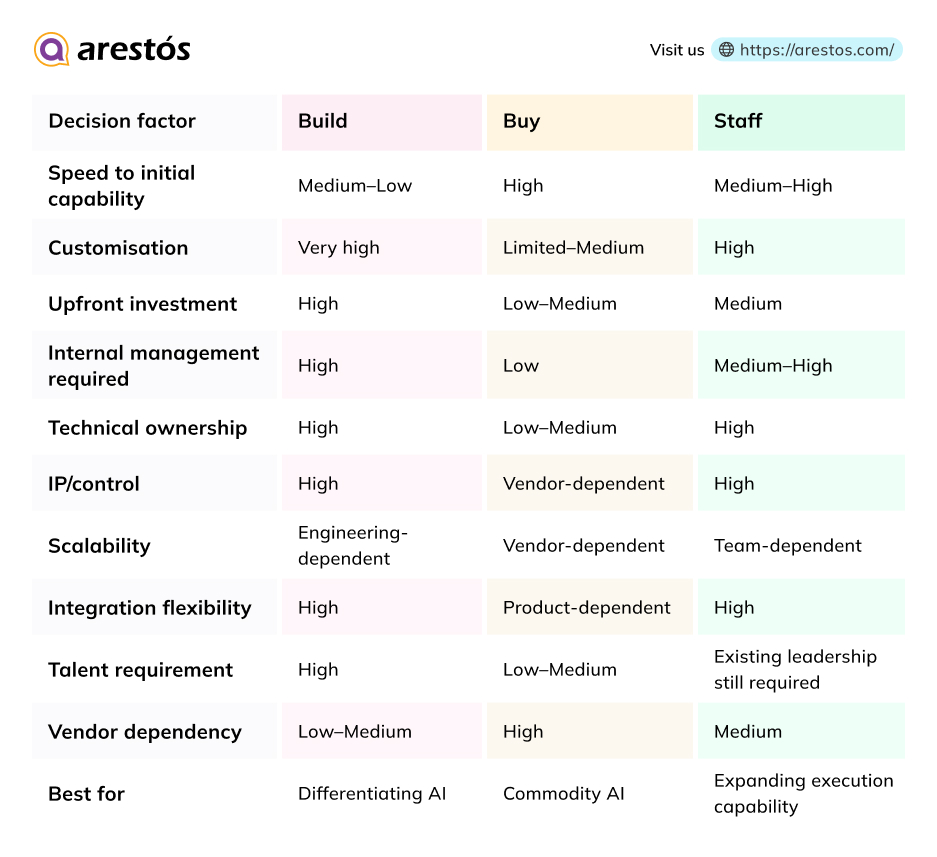
Understanding the key differences between Build, Buy, and Staff helps enterprises evaluate which AI capability strategy best aligns with their business goals, technical resources, and long-term priorities.
Side-by-side across the dimensions leaders care about
Compare Build, Buy, and Staff across the key factors that influence enterprise AI sourcing decisions.
Dimension-by-Dimension Commentary
Beyond the comparison table, three factors deserve closer examination: speed to execution, total cost of ownership, and internal technical leadership.
Speed to Operational Velocity
- Build: Recruiting specialised AI engineers can extend project timelines, particularly when organisations lack the required expertise internally.
- Buy: Provides faster access to ready-made AI capabilities, although integration, configuration, and security assessments may delay production deployment.
- Staff: Offshore staffing accelerates access to engineering talent through established recruitment pipelines. Arestós highlights pre-vetted candidates and a 100% on-time onboarding commitment, helping enterprises reduce recruitment-related delays.
Key takeaway: Buy accelerates access to technology, while Staff accelerates access to engineering capacity.
Financial Architecture & Total Cost of Ownership (TCO)
- Build: In-house hiring involves salaries, recruitment fees, MPF contributions, benefits, and infrastructure. According to Morgan McKinley’s 2026 Hong Kong Salary Guide, median monthly salaries reach HK$65,000 for ML Engineers and HK$50,000 for Data Engineers, excluding additional employment costs.
- Buy: Shifts expenditure toward software licences, subscriptions, API consumption, integration, and potential vendor switching costs.
- Staff: Offshore staffing can reduce recruitment and employment overhead through consolidated monthly fees. However, actual savings depend on engineering seniority, location, service fees, and internal management requirements.
Key takeaway: Evaluate the full lifecycle cost rather than comparing salaries, subscription fees, or staffing rates in isolation.
Internal Technical Leadership Requirements
- Build: Requires strong internal AI leadership to oversee architecture, development, deployment, and maintenance.
- Buy: Reduces development responsibilities but still requires oversight of integration, data governance, and vendor performance.
- Staff: Expands engineering capacity but requires an internal Product Owner, Engineering Lead, or AI Architect to define sprint goals, review code, and guide technical decisions.
Key takeaway: Offshore staffing addresses engineering capacity gaps, but cannot replace internal technical leadership or a clearly defined AI strategy.
How Do You Decide Between Build, Buy and Staff?
Use a practical decision framework based on the factors that most affect AI sourcing decisions:
- Strategic differentiation: Build if the AI capability creates proprietary value; Buy if it is standardized.
- Technical leadership: Staff when internal leaders can define architecture and manage external AI engineers.
- Time to capability: Buy for the fastest deployment; Staff for faster capacity expansion; Build when long-term capability outweighs speed.
- Data and IP sensitivity: Favor Build or tightly governed Staff models when greater control is required.
- Talent and capacity: Staff when the strategy is clear but ML, LLM, data or MLOps talent is unavailable internally.
- Long-term ownership: Build for permanent core capability; Buy for non-core functionality; Staff for flexible or specialist capacity.
Decision rule: Build for differentiation, Buy for standardized capability, and Staff for execution capacity. Use a Hybrid approach when different layers of the AI stack require different sourcing models.
What Makes AI Staffing Work (and What Makes It Fail)?
Successful offshore AI staffing requires more than hiring qualified engineers. It depends on clear technical ownership, rigorous talent selection, seamless team integration, and strong operational governance.
What Makes AI Staffing Successful?
- Clear scope and technical ownership: Define project requirements, deliverables, and responsibilities, with an internal Engineering Lead or AI Architect overseeing technical decisions.
- Rigorous talent vetting: Evaluate candidates through technical interviews, live coding assessments, and portfolio reviews to verify relevant AI/ML expertise.
- Seamless onboarding and integration: Integrate offshore engineers into existing repositories, development tools, sprint planning, and communication workflows from day one.
- IP and data protection: Establish NDAs, IP assignment agreements, role-based access controls, and secure workstations to protect proprietary technology and sensitive data.
- Talent continuity planning: Minimise disruption through documentation, knowledge transfer, cross-training, and clearly defined engineer replacement procedures.
- Employment compliance: Ensure contracts, payroll, employment obligations, and applicable cross-border data protection requirements are properly managed.
What Commonly Causes AI Staffing to Fail?
Even highly skilled engineers may underperform when organisations overlook fundamental management requirements:
- Vague requirements: Unclear priorities lead to rework, delays, and misaligned deliverables.
- Lack of internal leadership: Without technical direction, offshore engineers struggle to make consistent architectural and development decisions.
- Transactional management: Treating engineers as interchangeable vendors weakens engagement, accountability, and knowledge retention.
- Poor communication: Inconsistent meetings, limited feedback, and unclear escalation processes create unnecessary delivery bottlenecks.
For practical guidance on managing distributed engineering teams, explore Maximizing Offshore Dev Performance from HK Office.
How the Right Staffing Partner Makes a Difference
A reliable offshore staffing partner should handle recruitment, technical screening, employment administration, payroll, and workforce continuity while allowing the client to retain technical control.
Through its Offshore IT Staffing Services, Arestós helps enterprises access vetted offshore engineers, integrate dedicated specialists into existing teams, and manage cross-border employment requirements.
The key is to treat offshore AI engineers as long-term contributors to your engineering capability, not simply external resources hired to complete isolated tasks.
Frequently Asked Questions
1. Should you build, buy, or staff AI capabilities?
Build for proprietary AI, Buy for ready-made solutions, and Staff when additional engineering capacity is needed.
2. What should remain in-house when using offshore AI engineers?
Keep AI strategy, architecture, product ownership, data governance, and critical technical decisions in-house.
3. Can offshore AI engineers work with an in-house team?
Yes. Offshore AI engineers can integrate into existing teams, following the same workflows, development tools, and technical standards.
4. Which AI roles can be staffed offshore?
Common roles include ML Engineers, LLM Engineers, Data Scientists, Data Engineers, and MLOps Engineers.
5. Is offshore AI staffing cheaper than hiring AI engineers locally?
Often, yes. Offshore staffing can reduce recruitment and personnel costs, although actual savings depend on location, seniority, and staffing fees.
Conclusion
The right AI capability strategy is not about choosing one approach over another. Build when AI creates competitive advantage, Buy when existing solutions meet your needs, and Staff when specialised engineering capacity is the missing piece.
For many enterprises, combining these approaches offers the best balance of speed, cost, control, and scalability. With the right strategy and engineering talent, organisations can move AI initiatives from experimentation to sustainable business value.
Need additional AI engineering capacity? Explore Arestós Offshore AI & ML Engineers to scale your team without compromising technical control.
Subscribe to our newsletter!
Get updated to
the lastest IT trends
Related Posts
Update the latest technology trends for your business