Back to featured insights
AI vs Traditional Software Development: Cost and Speed Comparison
AI vs Traditional Software Development is reshaping how businesses build software. While AI accelerates development, traditional engineering remains essential for quality, security, and compliance. This guide helps you understand the strengths of each approach and choose the right strategy for your business.
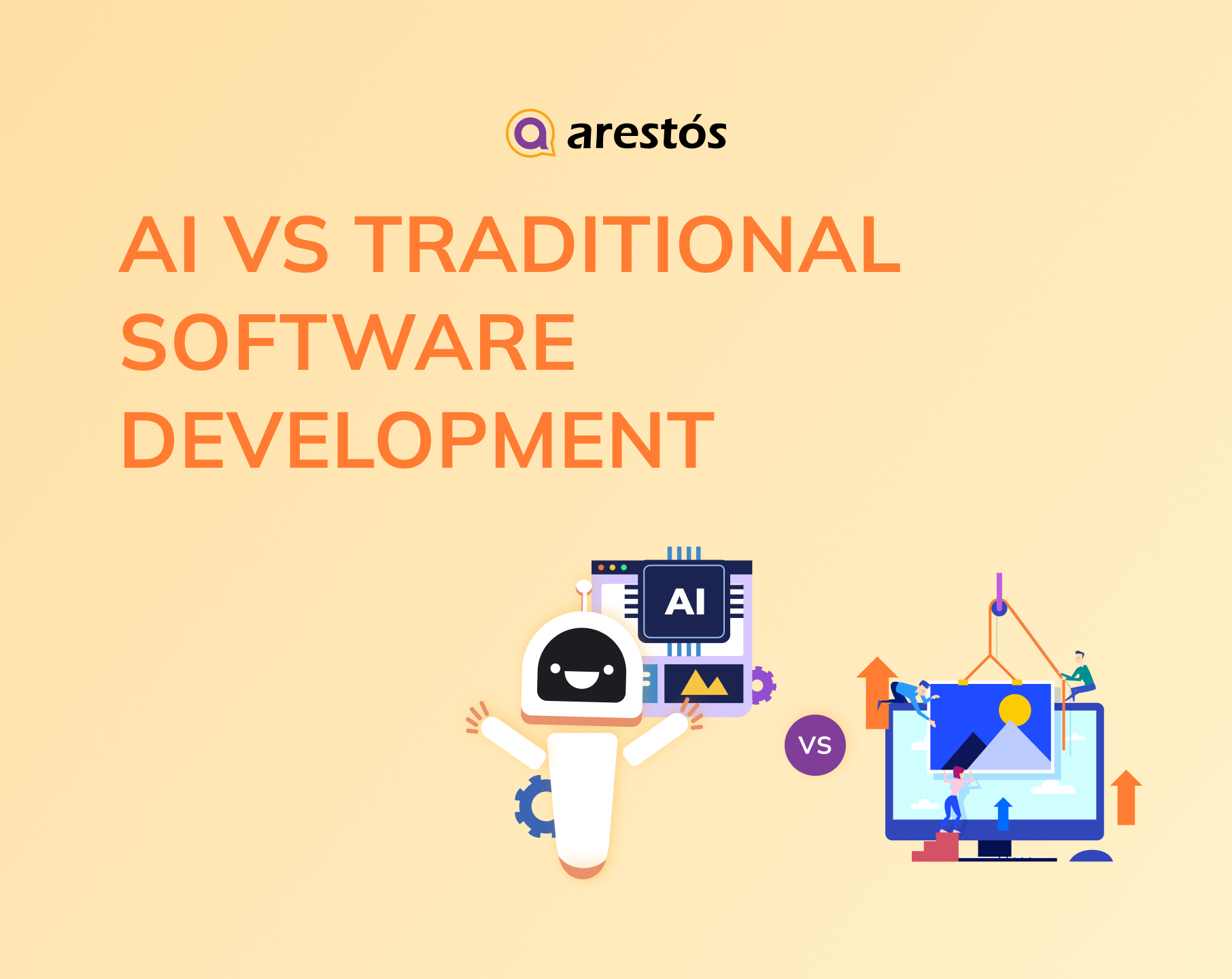
Table of Content
Share
AI vs Traditional Software Development is no longer a question of choosing one over the other. While AI can accelerate coding, testing, and documentation, the biggest cost driver remains skilled developers rather than software tools.
For most businesses, the best approach is a hybrid model that combines AI-assisted development with human expertise and oversight. In Hong Kong, organizations should also consider local regulations, talent availability, and long-term business goals when deciding which approach best fits their projects.
What Is Traditional Software Development?
Traditional software development is human-driven: developers design, build, test, and maintain software against predefined requirements. Because every feature and business rule is explicitly coded by hand, system behavior stays predictable and controlled.
Core Principles
Traditional development follows deterministic, rule-based logic: humans intentionally program every behavior, using established methodologies like Waterfall, Agile, Scrum, or DevOps. This delivers predictable outcomes, full human control, and clear audit trails through documentation and code reviews.
The Traditional Software Development Lifecycle (SDLC)
A traditional software project follows these stages:
Requirements Gathering → Architecture & Design → Development → QA & Testing → Deployment → Maintenance
Each phase is planned, documented, and reviewed to protect quality and reduce deployment risk.
Practical Example
In Hong Kong’s banking sector, core transaction-processing systems are typically built using traditional software development because every transaction must follow explicit business rules and regulatory requirements. This deterministic approach makes system behavior predictable, allowing financial institutions to meet the Hong Kong Monetary Authority (HKMA)’s expectations for governance, auditability, and technology risk management while ensuring regulators and auditors can trace how each decision was made.
What Is AI-Assisted Software Development?
AI-assisted development uses artificial intelligence to support developers throughout the lifecycle. AI doesn’t replace engineers – it automates repetitive tasks, generates code, flags issues, and accelerates development, while humans still own design, architecture, and final decisions.
The Spectrum: AI-Assisted vs. AI-Native
AI-powered development exists on a spectrum.
- AI-assisted development keeps developers in control: engineers direct the work while AI suggests code, generates functions, drafts documentation, or creates test cases. Examples: GitHub Copilot, Amazon Q Developer.
- AI-native (agentic) development gives AI greater autonomy: agents plan tasks, write code, run tests, and deploy software with minimal supervision. Examples: Claude Code, Cursor’s Agent Mode, Devin-style tools.
You may also hear the term “vibe coding,” describing what you want in natural language and letting AI generate the implementation with only light human review.
How AI Fits Into Each SDLC Stage
AI assists throughout the lifecycle by:
- Generating and completing code
- Creating automated test cases
- Reviewing code and flagging bugs
- Drafting technical documentation
- Supporting CI/CD workflows and deployment
AI coding tools are now mainstream: the Stack Overflow 2025 Developer Survey found 84% of developers already use or plan to use AI tools, and GitHub reports over 180 million developers on its platform, with AI adoption still accelerating.
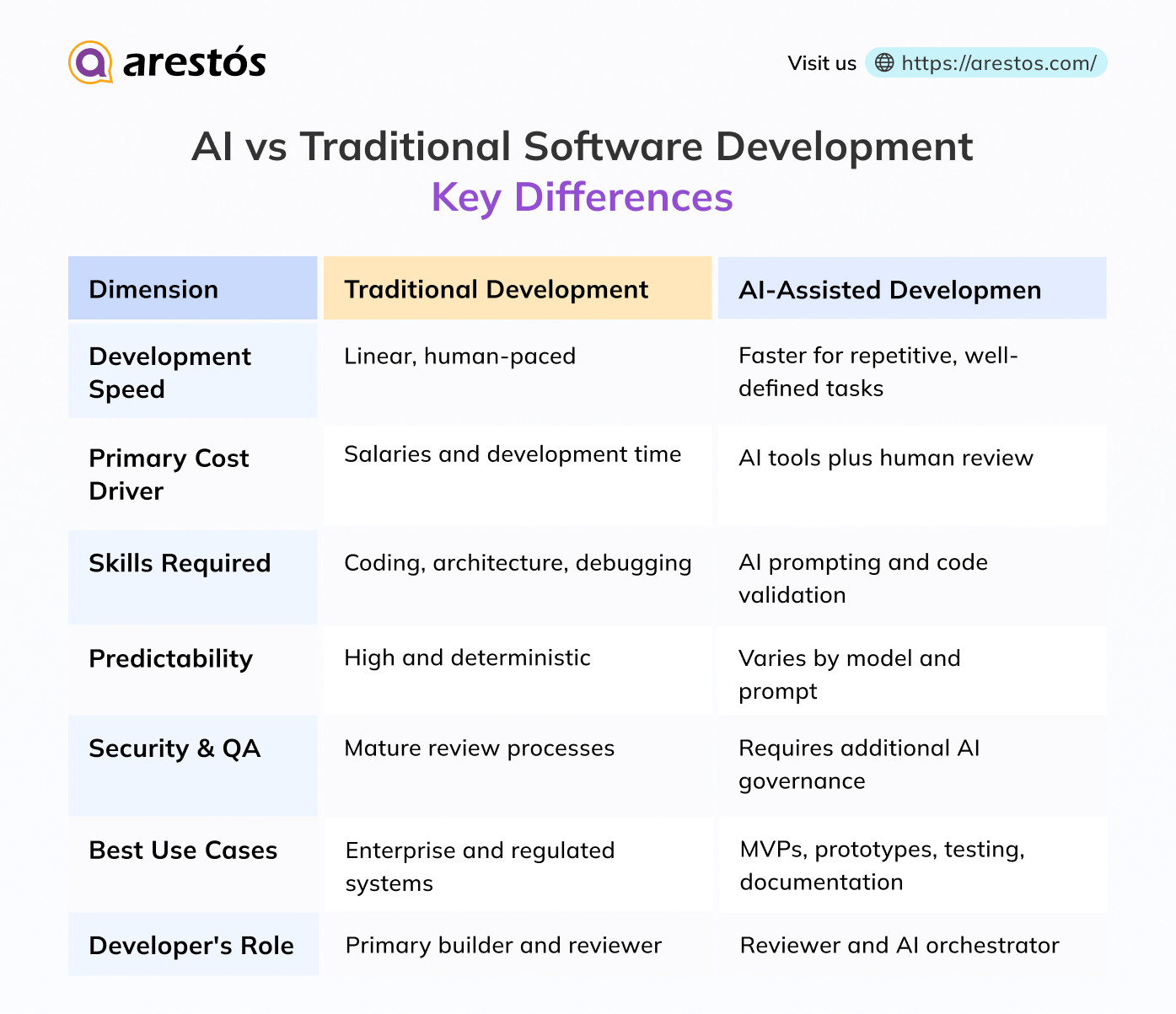
AI vs Traditional Software Development: Key Differences
The table below summarizes the key differences between traditional and AI-assisted development.
Cost Comparison: AI vs Traditional Development
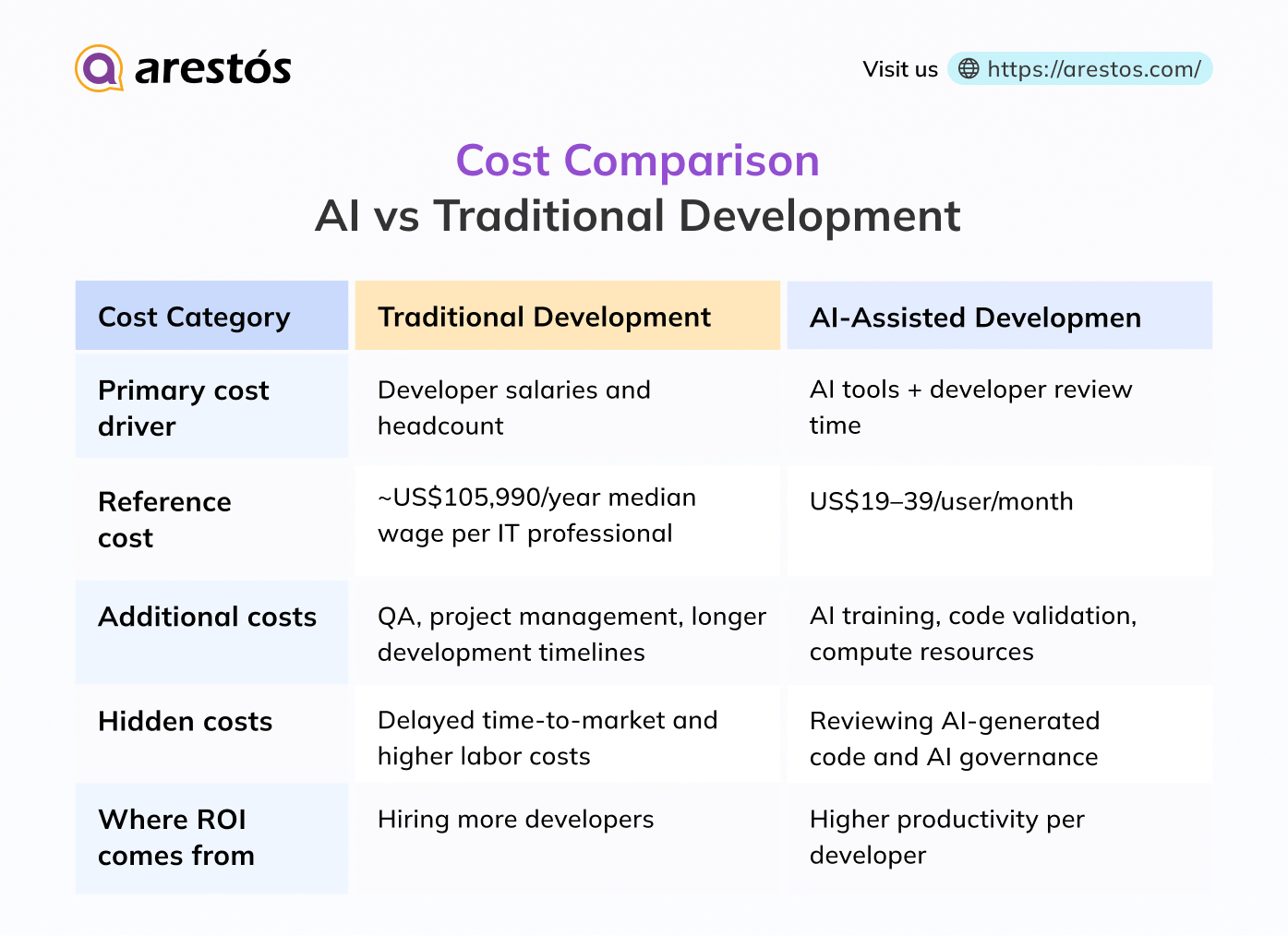
Software development cost is often pinned on AI tools, but people, not software licenses, remain the biggest expense. AI adds new costs, but its real value is boosting developer productivity, not replacing engineering teams.
What Traditional Development Actually Costs
For traditional software development, the engineering team is the largest cost driver. According to the Hays Asia Salary Guide 2025, software developers in Hong Kong typically earn HK$350,000–840,000 per year, depending on their role and experience. Combined with a highly competitive tech talent market, recruitment and retention costs can represent a significant share of the overall project budget.
Additional costs include:
- Developer salaries and benefits.
- Longer development timelines.
- QA and project management overhead.
- Opportunity costs from delayed product launches.
What AI-Assisted Development Actually Costs
AI-assisted development adds new cost categories, but software licenses make up only a small portion of the total budget.
Common costs include:
- AI tool subscriptions (e.g., GitHub Copilot).
- Compute costs for advanced AI workloads.
- Time spent reviewing and refining AI-generated code.
- Training developers to use AI effectively.
The Real Cost Advantage
AI’s biggest financial benefit is higher productivity per developer, not lower labor costs. It automates repetitive tasks like code generation, testing, and documentation, letting engineering teams deliver more work without growing headcount.
According to McKinsey, generative AI could affect 20–45% of current annual software-engineering spending by boosting productivity, not cutting salaries.
Hidden Costs to Consider
Whether using AI or traditional development, businesses should also account for these often-overlooked hidden costs:
- AI-generated code still needs review and testing, which can eat into productivity gains.
- Security and governance grow more critical as AI tools spread. According to IBM’s 2025 Cost of a Data Breach Report, organizations using unmanaged “shadow AI” tools experienced significantly higher breach costs.
- Developer upskilling is an ongoing investment, since AI tools and workflows keep evolving.
What This Means for Hong Kong Businesses
For Hong Kong businesses, the choice between traditional and AI-assisted software development depends not only on productivity but also on regulatory requirements, talent availability, and long-term business objectives.
Regulatory Landscape
Organizations in regulated industries should ensure AI-assisted development complies with the Hong Kong Monetary Authority (HKMA)’s technology risk management guidance, the Securities and Futures Commission (SFC)’s requirements for licensed firms, and the Personal Data (Privacy) Ordinance (PDPO). AI-generated code should follow the same governance, security, and audit standards as human-written code.
Local Talent Market
Hong Kong continues to face strong demand for skilled software engineers. According to the Hong Kong Digital Policy Office, software development is the largest IT occupation in the city, accounting for around 34% of more than 112,000 ICT professionals. At the same time, Hays reports that many employers continue to face skill shortages, making recruitment and retention increasingly expensive. As a result, many businesses are adopting AI to improve developer productivity rather than simply expanding headcount.
Government & Industry Initiatives
The Hong Kong Government is actively promoting AI adoption through initiatives led by the Digital Policy Office, Cyberport, and Hong Kong Science and Technology Parks (HKSTP). These programs support AI innovation, workforce upskilling, and digital transformation for local businesses.
The Productivity Paradox: Does AI Actually Build Software Faster?
AI can significantly improve developer productivity, but the answer isn’t as simple as “AI is always faster.” Research shows that the impact depends largely on the type of task, the complexity of the codebase, and how AI is used.
Research Showing Productivity Gains
Several large studies have found that AI coding tools can accelerate software development. McKinsey reports that developers completed tasks such as writing new features, refactoring code, and documentation up to 2× faster with generative AI. Meanwhile, a large randomized study by Microsoft Research involving nearly 4,900 developers found that using an AI coding assistant increased completed tasks by 26.08%, with the greatest improvements among less-experienced developers.
The Evidence for Caution
However, AI doesn’t improve productivity in every situation. A randomized trial by METR found that experienced open-source developers were 19% slower when using AI on complex, real-world repository issues. Likewise, the Stack Overflow 2025 Developer Survey found that 66% of developers spend more time fixing AI-generated code that’s “almost right” than writing the code themselves.
The key takeaway is that AI delivers the biggest productivity gains for well-defined, repetitive tasks, such as generating boilerplate code or scaffolding new projects. For complex, legacy systems that rely on deep domain knowledge, human expertise remains essential, and AI may even slow development.
How the Developer’s Role Is Changing
AI is changing how software developers work. Instead of spending as much time on repetitive coding tasks, developers are increasingly responsible for guiding AI, validating its outputs, and making higher-level technical decisions.
In Hong Kong, employers are also placing greater emphasis on AI skills alongside strong software engineering fundamentals.
New Skills for the AI Era
To work effectively with AI, developers need skills beyond traditional programming, including:
- Writing effective prompts for AI coding tools.
- Reviewing and validating AI-generated code.
- Managing multiple AI agents across different development tasks.
According to Gartner, generative AI is expected to require 80% of the software engineering workforce to develop new skills by 2027, highlighting the growing importance of AI literacy. In Hong Kong, organizations such as the Digital Policy Office, Cyberport, and HKSTP are supporting AI adoption through training and workforce development initiatives.
Team Structure Shifts
AI is also changing how software teams are organized. As AI takes over more repetitive work, organizations can achieve more with leaner engineering teams. Gartner predicts that 60% of organizations will operate with smaller, AI-augmented development teams by 2029, compared with 15% in 2026.
AI Isn’t Replacing Junior Developers
Despite concerns that AI will eliminate entry-level programming jobs, current research suggests a more nuanced picture. A Microsoft Research study found that less-experienced developers achieved greater productivity improvements when using AI coding assistants than their senior colleagues.
Rather than replacing junior developers, AI can help them learn faster and complete routine tasks more efficiently.
- Software development involves more than coding. Developers are responsible for system architecture, business logic, security, performance, and technical decision-making.
- AI is best at automating repetitive tasks. It can generate code, assist with testing, write documentation, and help identify bugs, allowing developers to work more efficiently.
- Human oversight remains essential. AI-generated code still needs to be reviewed, tested, and validated to ensure it meets business requirements and quality standards.
- Developer roles are evolving. Instead of writing every line of code manually, developers increasingly guide AI tools, review outputs, and focus on solving complex problems.
AI is becoming a powerful development assistant, not a replacement for skilled software engineers.
Traditional vs. AI-Assisted Development: When to Choose Which
The best approach depends on your project’s complexity, risk level, and business goals. Often, a hybrid approach combining AI with human expertise delivers the best results.
Traditional development is the better choice if:
- Your software is safety-critical or highly regulated, such as medical, aviation, or core banking systems.
- You’re building a new or highly complex architecture with few existing patterns to reuse.
- Long-term maintainability, reliability, and governance are more important than development speed.
AI-assisted development is ideal if you need to:
- Build an MVP or prototype quickly.
- Develop boilerplate code, CRUD applications, or internal tools.
- Generate test cases, documentation, or repetitive code to improve developer productivity.
Before choosing an approach, ask yourself:
- Is this project subject to strict regulations or compliance requirements?
- Is the problem well understood, or does it require a completely new solution?
- Does your team have enough time and expertise to review AI-generated code?
- Would a software defect cause a minor inconvenience or a critical business incident?
Frequently Asked Questions
1. Is AI better than traditional software development?
It depends on the project. AI is better for repetitive tasks and rapid development, while traditional development is better for complex or regulated systems.
2. Can AI replace software developers?
No. AI assists developers but cannot replace human expertise in architecture, decision-making, security, and code review.
3. Does AI reduce software development costs?
Yes, AI can reduce development costs by improving productivity, but it also introduces costs for AI tools, training, and code review.
4. Which AI tools do software developers use?
Popular tools include GitHub Copilot, Cursor, Claude Code, Amazon Q Developer, and Windsurf.
5. Can AI build an entire application?
AI can build parts of an application, but human developers are still needed to design, review, test, and deploy it.
6. Is AI-assisted development compliant with Hong Kong data and privacy regulations (PDPO)?
Yes, as long as organizations follow the PDPO and implement appropriate security and governance controls.
Conclusion
AI vs Traditional Software Development is not about choosing one approach over the other. For most Hong Kong businesses, the right solution depends on your regulatory requirements, project complexity, available development talent, and business objectives. In many cases, combining AI-assisted development with experienced engineering oversight delivers the best balance of speed, quality, security, and compliance.
At Arestós, we help Hong Kong businesses build reliable, scalable software using the right mix of AI-assisted development and proven engineering expertise.
Contact us today to discuss your software development project.
Subscribe to our newsletter!
Get updated to
the lastest IT trends
Related Posts
Update the latest technology trends for your business