Back to featured insights
Offshore IT Staffing vs Local Hiring: Cost Breakdown for HK Firms
Choosing between Offshore IT Staffing and Local Hiring can shape your hiring strategy, costs, and long-term growth. This guide provides a comprehensive overview of both models, helping Hong Kong businesses understand their options and make more informed hiring decisions.

Table of Content
Share
Offshore IT Staffing vs Local Hiring is often the first comparison businesses make when deciding how to grow their IT teams in Hong Kong. Each hiring model offers different advantages in terms of cost, access to talent, hiring speed, scalability, and long-term business value.
Whether you’re a startup, SME, or enterprise planning to hire software developers or other IT professionals, understanding the true cost of each approach is essential. This guide explores the key cost factors, hiring considerations, and practical insights to help Hong Kong businesses make more informed hiring decisions.
What’s the Difference Between Offshore IT Staffing and Local Hiring?
Before comparing costs, here’s how offshore staffing and local hiring differ.
What Is Offshore IT Staffing?
Offshore IT staffing is a hiring model where a company builds a dedicated team of professionals in another country, integrated into daily operations. s. Unlike project outsourcing, offshore staff work as an extension of the client’s in-house team, following the same workflows, tools, and management processes.
Common offshore staffing models include:
- Direct offshore hire: The company recruits overseas employees directly and manages payroll, compliance, and HR.
- Employer of Record (EOR): A third-party provider legally employs the worker on the company’s behalf while the client manages daily work.
- BPO or managed team: The service provider manages both the people and operational delivery, based on agreed service levels.
- Staff augmentation through a specialist provider: The staffing provider recruits and employs dedicated professionals, who are professionals staffing providers but work under the client’s direct supervision as part of the existing team.
For many Hong Kong businesses, offshore IT staffing provides access to a broader talent pool, faster hiring, and lower total employment costs while allowing managers to retain direct control over project execution.

Offshore IT Staffing and Local Hiring
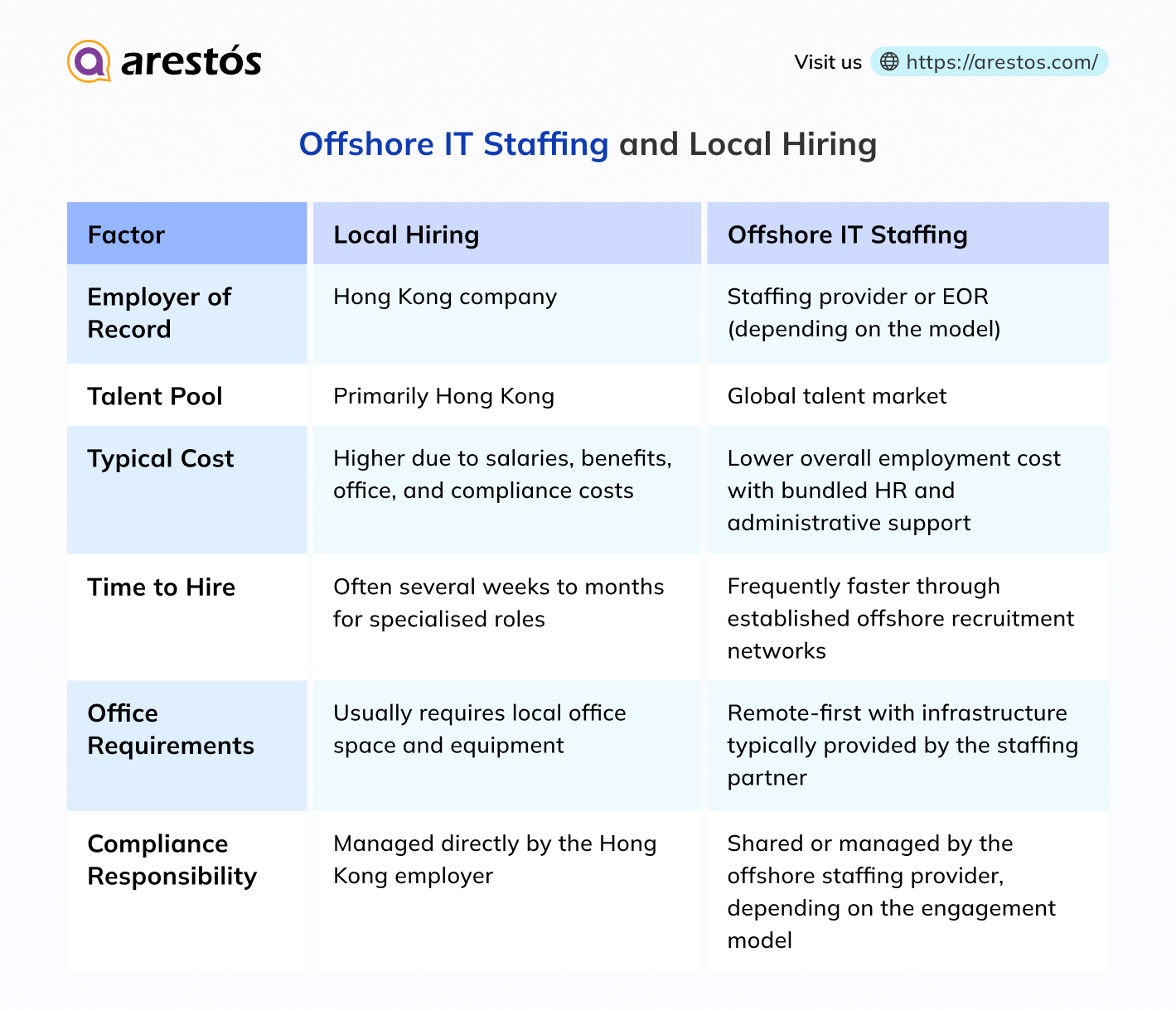
For a more detailed overview, explore our guide to Offshore IT Staffing: Benefits, Costs & Challenges for Hong Kong Companies.
Why Hong Kong Businesses Are Rethinking Their Hiring Strategy
Hong Kong businesses face growing pressure from talent shortages, rising employment costs, and increasingly complex labour regulations. As hiring becomes more expensive and time-consuming, companies are re-evaluating whether traditional local hiring remains the most efficient way to build their teams.
The Hong Kong Tech Talent Shortage, By the Numbers
Demand for technology professionals continues to exceed supply. According to TEKsystems’ Hong Kong SAR IT Market Trends, 97% of organisations report skills gaps and hiring challenges. The report also cites findings from the Hong Kong General Chamber of Commerce (HKGCC), showing that 74% of business leaders need more talent, while 60% identify IT talent shortages as the biggest barrier to adopting new technologies.
The skills gap is especially evident in specialised roles. According to Robert Walters, 67% of Hong Kong tech employers still struggle to find candidates with the right technical and soft skills. Meanwhile, the Hong Kong Productivity Council (HKPC) estimates that more than 3,000 cybersecurity positions remain unfilled, and Technavio projects Hong Kong’s IT market to grow by 7.8% year over year, with an expected 8.2% CAGR.
Rising Salaries & Wage Inflation
Higher demand has pushed salaries upward. According to salary guides from Morgan McKinley, Hays, and Robert Walters, a mid-level software engineer typically earns HK$400,000–600,000 per year (HK$33,000–50,000 per month). Beyond salaries, employers must also cover recruitment, MPF, benefits, office space, and HR administration. Hong Kong also remains one of the world’s most expensive cities for business operations, according to Mercer and the Economist Intelligence Unit (EIU).
Regulatory Complexity: MPF, the Employment Ordinance & the 2025 Offset Abolition
Local hiring also means complying with the Employment Ordinance and managing MPF obligations. Since 1 May 2025, employers can no longer use mandatory MPF contributions to offset statutory severance or long service payments for post-transition service, increasing long-term employment liabilities, according to the Hong Kong Labour and Welfare Bureau.
The Real Cost of a Slow Time-to-Hire
A slow hiring process creates costs beyond recruitment. Vacant technical roles can delay product launches, increase workloads for existing teams, and cause businesses to miss revenue opportunities. For many Hong Kong companies, reducing time-to-hire is now as important as reducing hiring costs.
Offshore IT Staffing: The Full Cost Breakdown
Unlike local hiring, offshore staffing follows an all-inclusive pricing model rather than a standardized market rate. Businesses pay a fixed monthly service fee that covers most employment-related costs, making budgeting simpler and more predictable.
For example, some offshore staffing providers publicly list software development services from approximately US$1,330 to US$3,840 per month for a full-time developer, depending on the role and service scope. These fees commonly include recruitment, HR administration, payroll, office infrastructure, and ongoing operational support.
Total Offshore Staffing Cost = Monthly Service Fee + Optional Business Expenses (if applicable)
Because most administrative and operational expenses are bundled into the monthly fee, offshore staffing involves fewer hidden costs than local hiring.
What Determines the Cost of Offshore Staffing?
Although offshore staffing is often perceived as a lower-cost hiring model, pricing varies considerably between providers. Businesses should evaluate the overall service package rather than comparing monthly fees alone.
The most common pricing factors include:
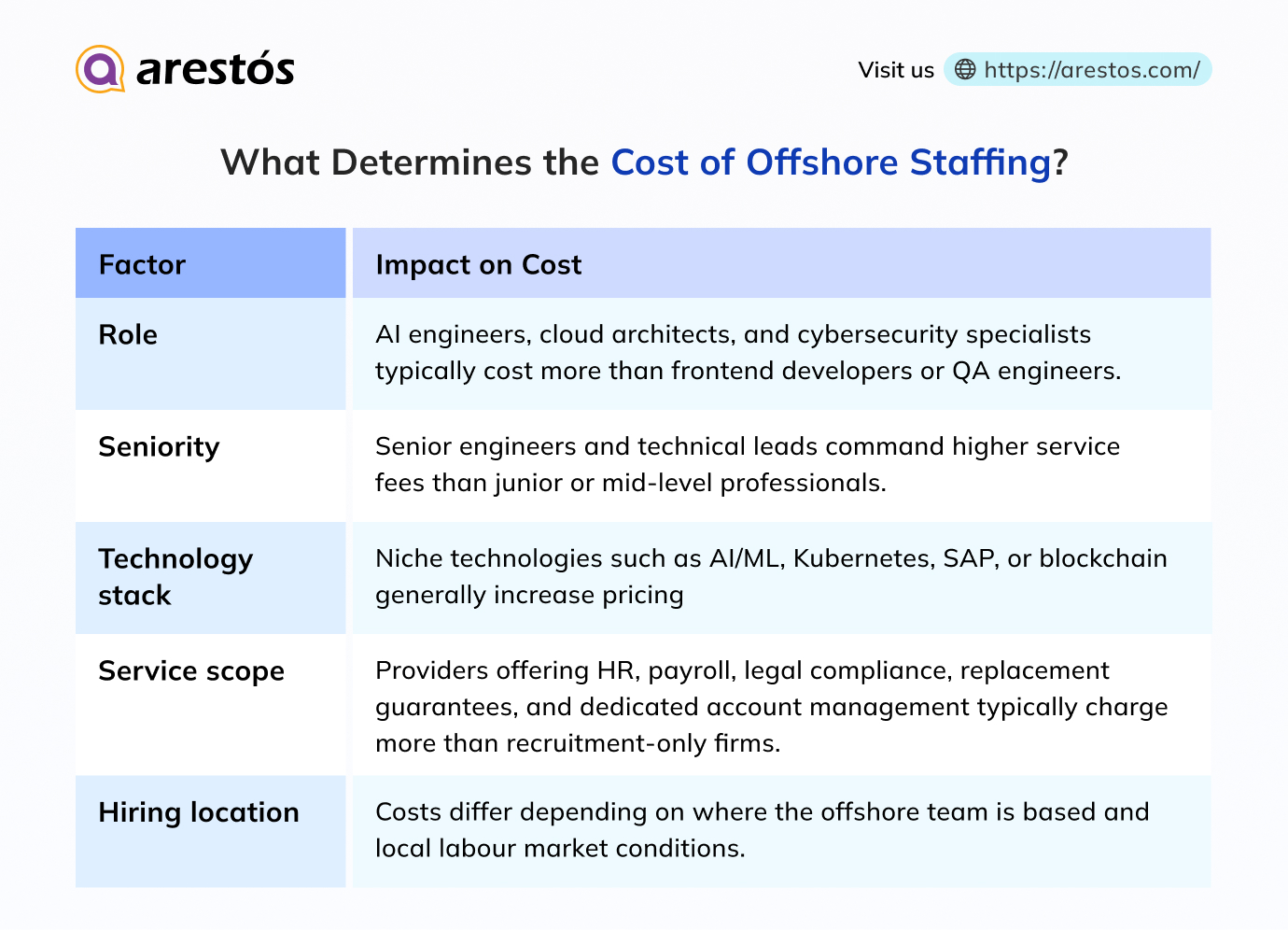
Businesses should therefore compare total value, including service quality, retention support, recruitment speed, and ongoing management—not just the headline monthly price.
What Does the Monthly Service Fee Include?
Most offshore staffing providers bundle the core employment costs into a single monthly fee. While inclusions vary by provider, the table below shows what is typically included and what may incur additional costs.
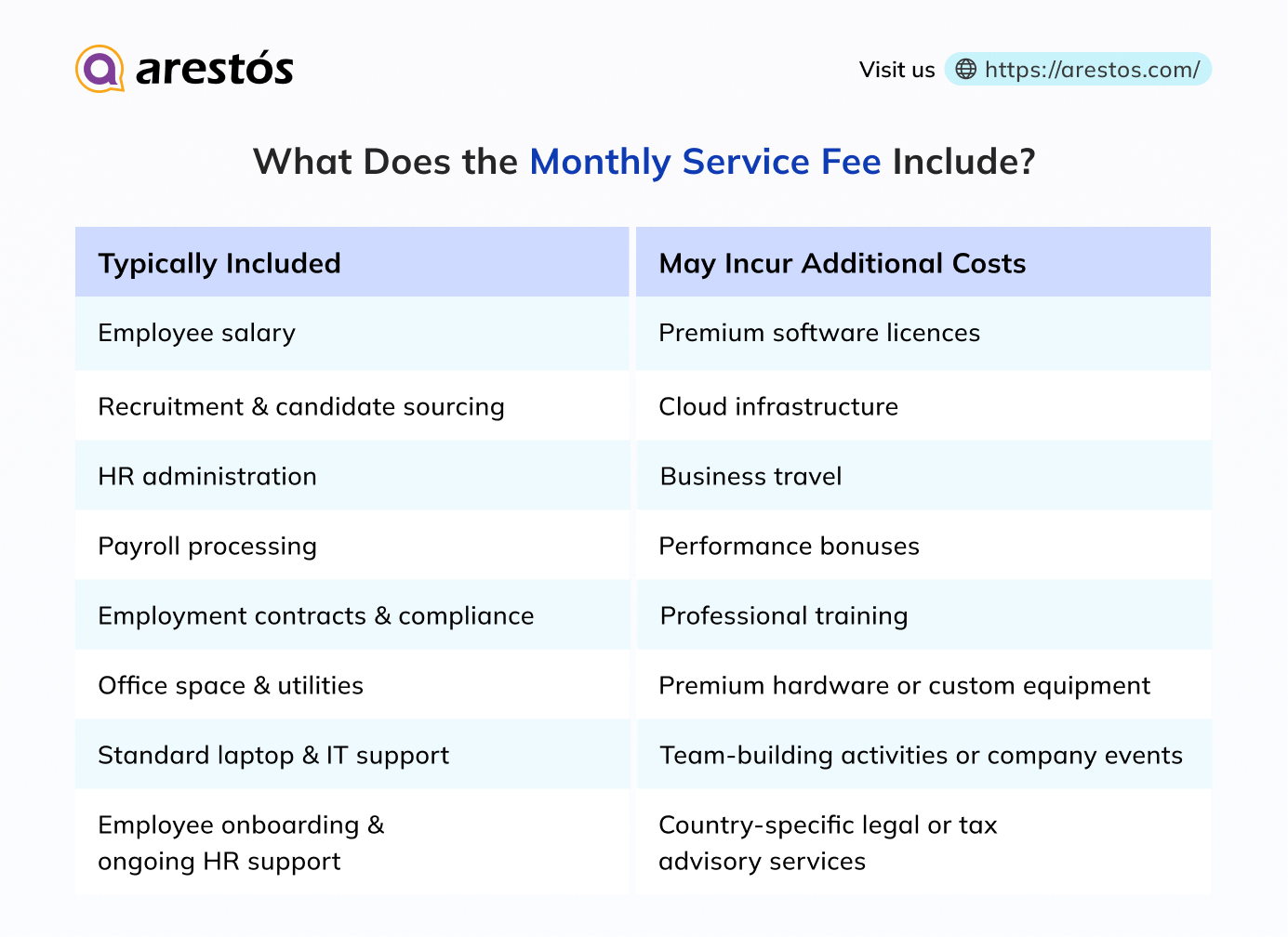
Most providers include the core employment and operational costs in the monthly fee, while project-specific or business-specific expenses are typically billed separately.
Illustrative Annual Cost Example
To better understand how offshore staffing costs are structured, consider the following illustrative example. This example is provided for comparison purposes only and does not represent a standard market price.
Assume an offshore staffing provider charges HK$28,000 per month for a dedicated mid-level backend developer, with recruitment, HR, payroll, office space, equipment, and operational support included.
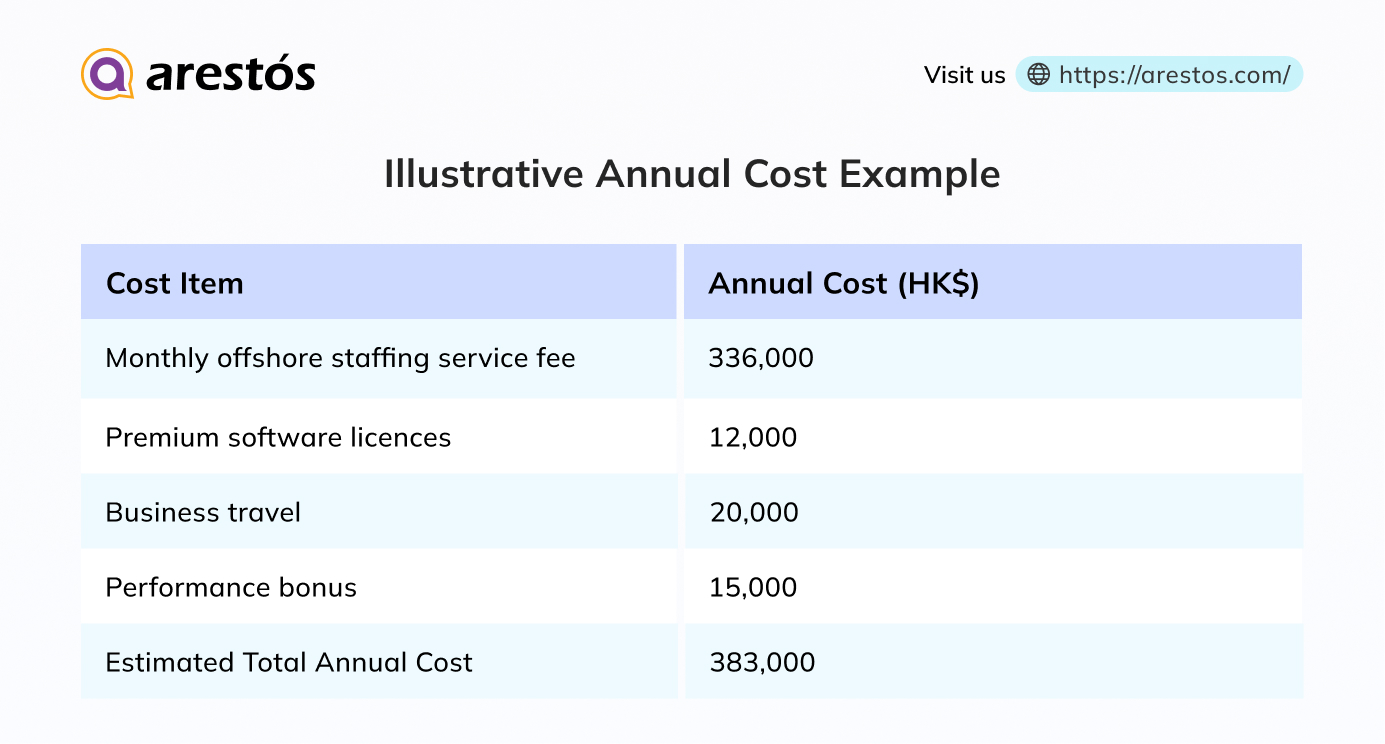
Even after adding optional business expenses, offshore staffing remains significantly more cost-effective than local hiring because many indirect employment costs are already included in the service fee.
Note: This example is for illustration only. Actual pricing varies by provider, location, seniority, and service scope.
Local Hiring in Hong Kong: The Full Cost Breakdown
The true cost of hiring locally extends well beyond an employee’s salary. The total cost of a Hong Kong hire includes base salary, MPF contributions, statutory leave, employee benefits, recruitment expenses, and office and equipment overhead. Understanding each cost component helps businesses estimate the real investment required before making a hiring decision.
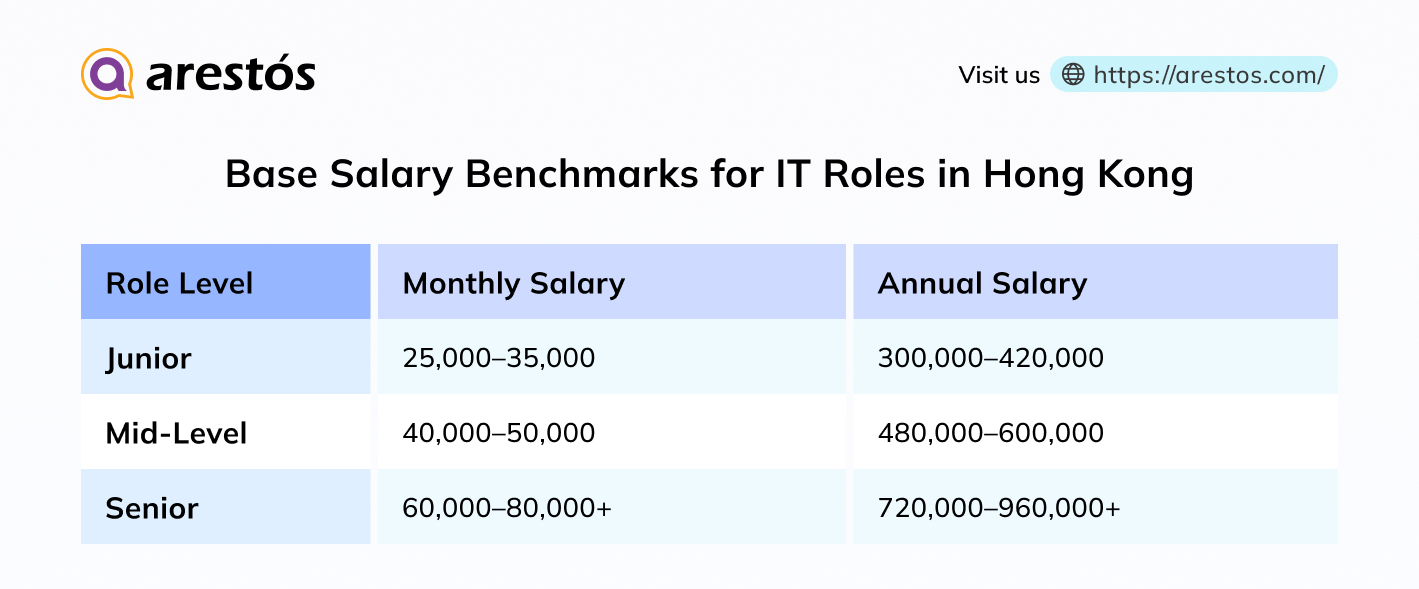
Base Salary Benchmarks for IT Roles in Hong Kong
Base salary is the largest component of local hiring costs and varies by role, experience, and technical expertise. According to the 2026 Hong Kong Salary Guides from Robert Half, Randstad, Michael Page, and other recruitment firms, software engineering salaries remain highly competitive due to ongoing talent shortages.
Mandatory Statutory Costs
Beyond salary, employers must cover several statutory employment costs.
- MPF contribution: Employers must contribute 5% of an employee’s relevant income, capped at HK$1,500 per month for employees earning HK$30,000 or more.
According to Hong Kong’s Employment Ordinance, published by the Hong Kong Labour Department.
- Annual leave: Employees are entitled to 7 days of paid annual leave after 12 months of service, increasing gradually to 14 days after nine years under the Employment Ordinance.
- Statutory holidays: Hong Kong is progressively increasing statutory holidays from 12 to 17 days by 2030. Employers should confirm the current entitlement for the publication year via the Labour Department.
- Minimum wage: The statutory minimum wage increased to HK$43.10 per hour on 1 May 2026, although most technology professionals earn significantly above this level.
Recruitment & Onboarding Costs
Hiring costs begin long before an employee’s first working day. Recruitment agencies in Hong Kong typically charge 20–25% of a candidate’s first-year salary for professional and technology roles, with some agencies charging 15–30% depending on seniority and hiring complexity.
For a backend developer earning HK$480,000 per year, this represents a one-time recruitment cost of approximately HK$96,000–120,000, excluding onboarding, training, and productivity ramp-up.
Office Space & Equipment Overhead
Local hiring also requires physical workspace and equipment. According to market reports from JLL and Savills, Grade A office rents in Central can exceed HK$110–140 per sq. ft. per month, while decentralised business districts generally range from HK$27–75 per sq. ft., excluding management fees.
Assuming 80–100 sq. ft. per employee, office rent alone can add thousands of Hong Kong dollars per employee each month, before factoring in laptops, software licences, utilities, and IT support.
Worked Example: True Annual Cost of One Mid-Level Developer in Hong Kong
Worked Example: True Annual Cost of One Mid-Level Developer in Hong Kong
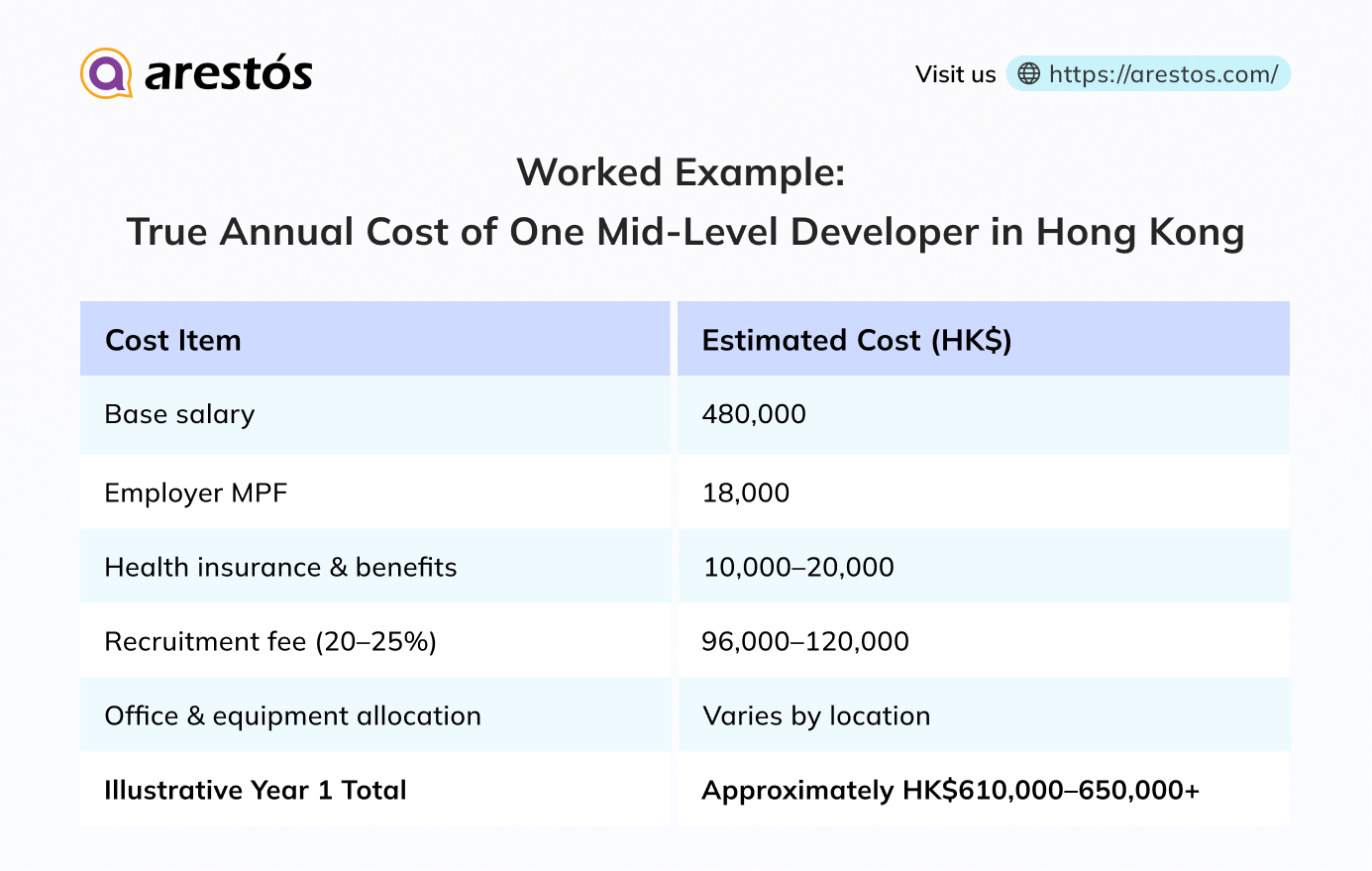
Note: This example is intended to illustrate the major cost components of local hiring. Actual costs vary depending on salary level, office location, benefits, and recruitment arrangements.
Offshore IT Staffing vs Local Hiring: Side-by-Side Cost Comparison
While salary is an important factor, it does not reflect the total cost of hiring. The comparison below highlights the key cost differences between local hiring in Hong Kong and offshore staffing, helping businesses evaluate the overall financial impact of each model.
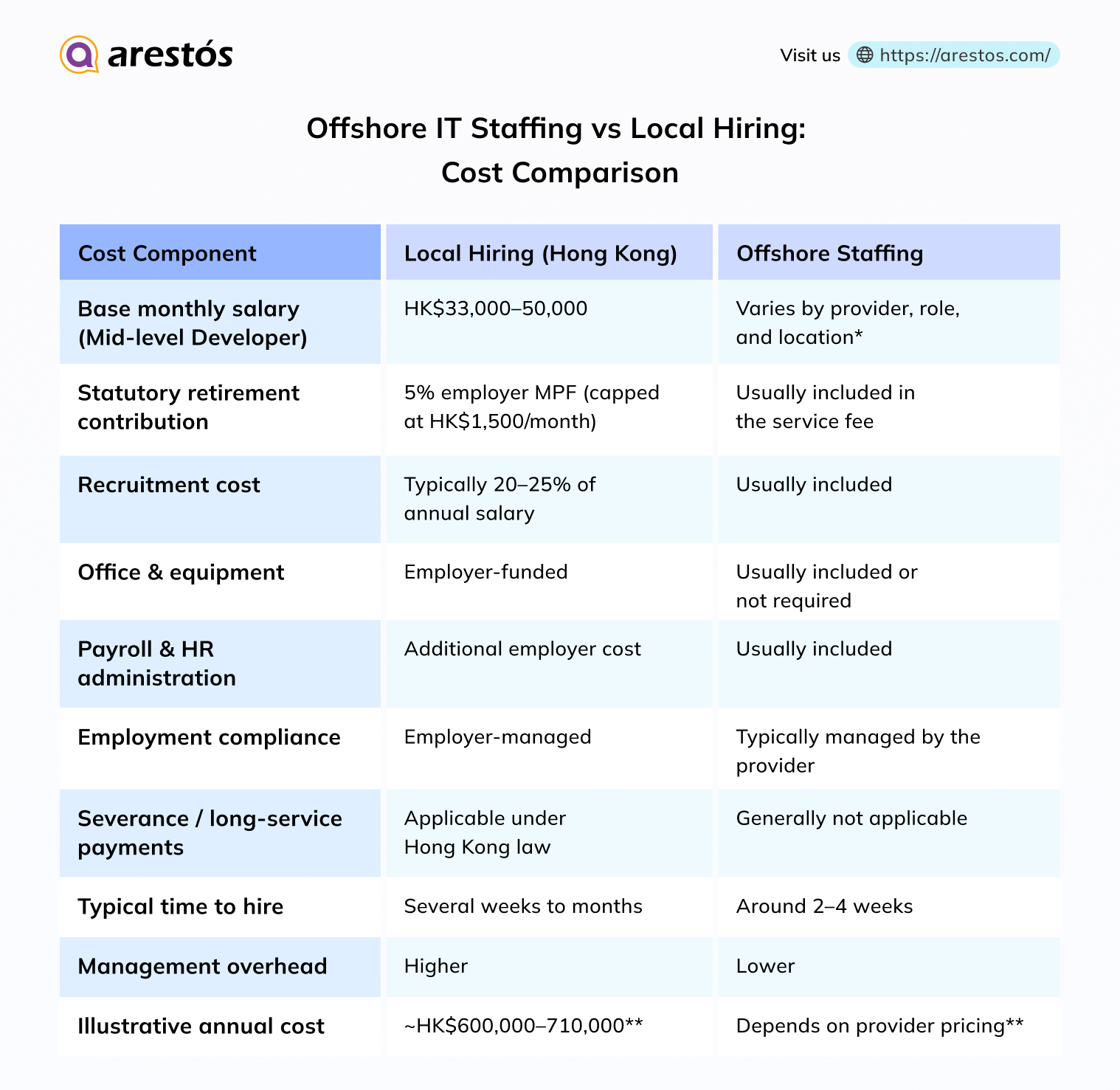
Offshore staffing rates vary by provider, role, seniority, location, and service scope.
Illustrative comparison only. Actual costs vary and should be confirmed with the service provider before budgeting.
Offshore vs. Local Hiring: A Decision-Making Framework for Hong Kong Businesses
There is no one-size-fits-all hiring model. In practice, the businesses should decide role by role, rather than applying the same approach across the entire organization. The best choice depends on the role’s responsibilities, hiring urgency, budget, collaboration needs, and access to local talent.
When Local Hiring Makes More Sense
Local hiring is the better option when a role requires close collaboration, local market expertise, or long-term strategic involvement. Examples include:
- Client-facing or relationship management roles requiring regular in-person meetings.
- Positions that require deep knowledge of Hong Kong regulations, business practices, or the local market.
- Small teams that rely on frequent face-to-face collaboration.
- Leadership, management, or other long-term strategic roles.
When Offshore Staffing Makes More Sense
Offshore staffing is a practical solution for roles where work can be delivered remotely and standardized processes are in place. It is particularly suitable for:
- Software development, QA, IT support, DevOps, data, and other technical execution roles.
- Startups and SMEs looking to scale while managing costs.
- Projects requiring rapid team expansion or downsizing.
- Roles where recruiting qualified talent locally is difficult or time-consuming.
The Hybrid Model
For many Hong Kong businesses, the most effective approach is neither fully local nor fully offshore. Instead, companies adopt a hybrid model, where the local team focuses on strategy, client relationships, and business decisions, while the offshore team handles technical execution and day-to-day delivery.
This approach combines local market knowledge with access to a broader talent pool, allowing businesses to improve scalability without sacrificing quality or customer engagement.
Looking for a provider? Explore our guide to the Top 10 Offshore IT Staffing Companies in Hong Kong to compare leading offshore staffing partners.
Frequently Asked Questions
1. Is offshore staffing cheaper than local hiring in Hong Kong?
Often, yes. Offshore staffing can lower total hiring costs by bundling recruitment, HR, payroll, and operational expenses into a single service fee.
2. What hidden costs should businesses consider when hiring locally?
Besides salary, businesses should consider recruitment fees, MPF contributions, employee benefits, office costs, equipment, payroll administration, and severance obligations.
3. How long does it take to hire through an offshore staffing provider?
Many offshore staffing providers can present qualified candidates within 2–4 weeks, depending on the role and hiring requirements.
4. Is offshore staffing suitable for startups and SMEs?
Yes. It enables startups and SMEs to access skilled talent, scale faster, and manage hiring costs more effectively.
5. How much can Hong Kong companies save with offshore staffing?
Savings vary by role and provider, but offshore staffing often reduces overall employment costs compared with local hiring.
Conclusion
Choosing between offshore IT staffing and local hiring is about more than comparing salaries. By considering the fully-loaded cost, hiring speed, scalability, and long-term business needs, Hong Kong companies can make more informed hiring decisions and build teams that support sustainable growth.
At Arestós, we help Hong Kong businesses build dedicated offshore IT teams tailored to their goals. From talent sourcing and recruitment to HR management, payroll, and ongoing support, our Offshore IT Staffing service simplifies the hiring process so you can focus on growing your business with confidence.
Contact us today to find the right offshore talent for your business.
Subscribe to our newsletter!
Get updated to
the lastest IT trends
Related Posts
Update the latest technology trends for your business