Back to featured insights
How to Reduce Website Development Costs for Enterprises In HK
Website development costs can quickly increase as projects become more complex. Learn how businesses can reduce unnecessary spending while maintaining the quality, scalability, and long-term value of their digital investment.

Table of Content
Share
Website Development Costs can quickly increase as project scope, technical complexity, and business requirements grow. A strategic approach to planning and delivery can help reduce unnecessary spending while protecting quality, performance, and long-term value.
This guide is designed for businesses in Hong Kong looking to make smarter decisions about website development investment. In this blog, we explore practical ways to reduce costs without compromising quality or long-term value.
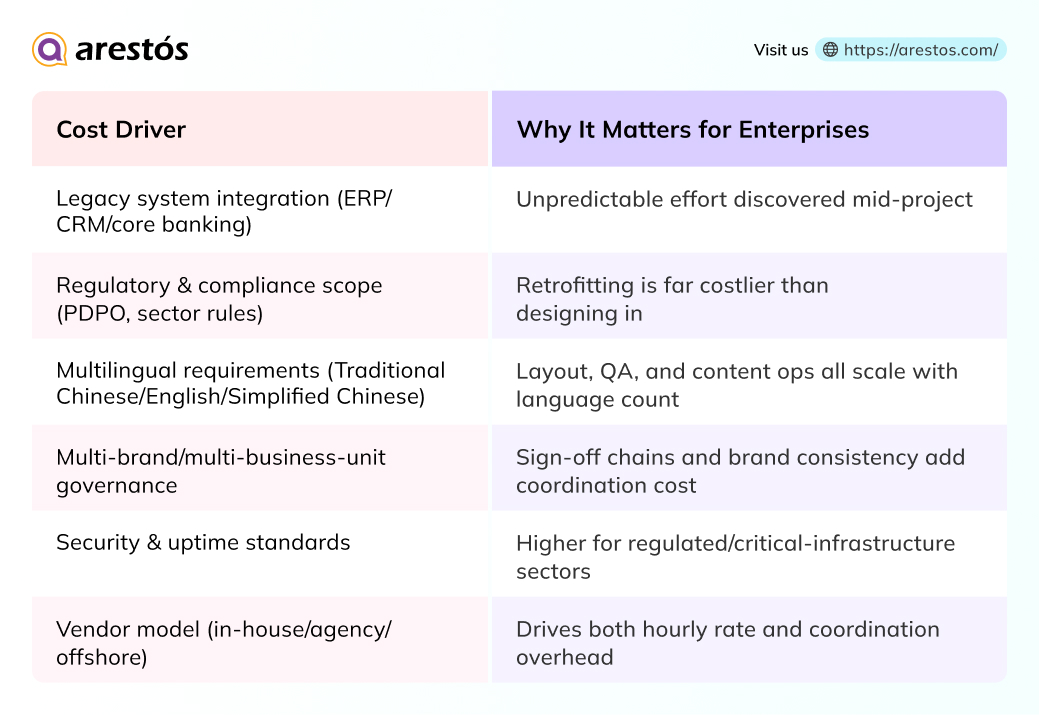
What Drives Website Development Costs for Enterprises in Hong Kong?
Website development costs are not determined by design and coding alone. For complex projects, factors such as existing systems, compliance requirements, internal governance, and delivery models can significantly influence the final budget.
Understanding these cost drivers early makes it easier to identify unnecessary complexity and control costs before they escalate.
What Does an Enterprise Website Cost in Hong Kong?
Enterprise website development costs in Hong Kong can vary significantly depending on scope, integrations, and technical requirements.
The ranges below are indicative only and should be verified against current agency quotes before making budget decisions.
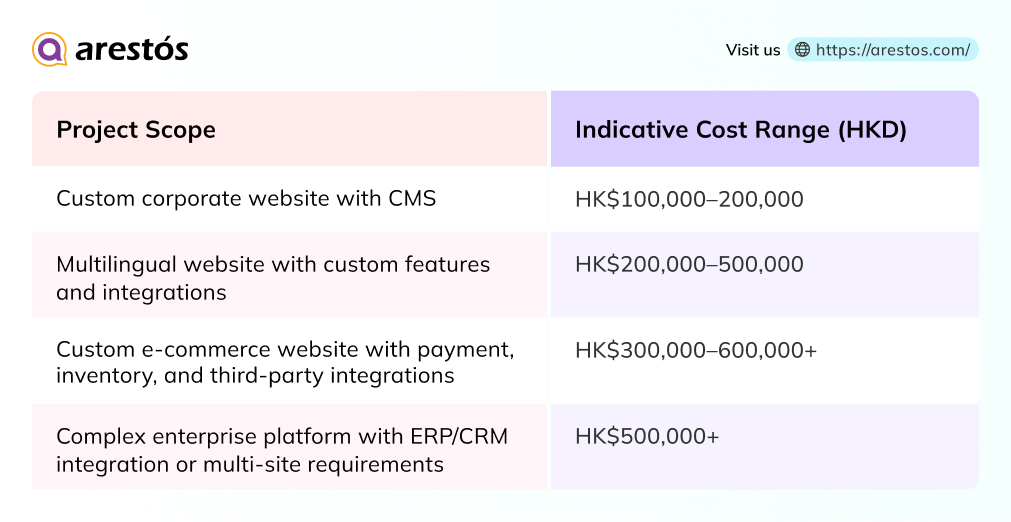
The wide range is largely a scope problem: two projects described as an “enterprise website” can involve very different levels of customization, integration, content migration, security, and governance. A clear scope is therefore essential not only for accurate budgeting, but also for controlling development costs.
For a more detailed breakdown, read our guide: How Much Does the Cost of a Corporate Website Change in HK
5 Strategic Ways to Reduce Website Development Costs Without Compromising Quality
Reducing website development costs does not mean choosing the cheapest solution or cutting essential features. The most effective approach is to reduce unnecessary complexity, prevent rework, and make decisions based on long-term value rather than the initial project price.
Fix Scope and Governance Before a Line of Code Is Written
One of the biggest causes of cost overruns is discovering new requirements after development has started. A structured discovery and requirements process before issuing an RFP can help identify technical dependencies, stakeholder needs, and potential risks early.
Key actions include:
- Consolidating fragmented websites onto shared platforms or design systems where appropriate.
- Prioritizing requirements using an MVP approach and frameworks such as MoSCoW.
- Phasing lower-priority features instead of building every requirement into version one.
- Assigning a clear project owner and sign-off process to prevent uncontrolled scope changes.
Cost-saving principle: Preventing unnecessary work is usually cheaper than removing it after development begins.
Choose Architecture That Reduces Cost Over 5 Years, Not Just at Launch
The cheapest architecture at launch is not always the most cost-effective over time. Technology decisions should be evaluated based on total cost of ownership, including upgrades, maintenance, integrations, security, and future expansion.
Consider:
- Using composable or headless architecture where flexibility and reuse justify the additional upfront investment.
- Building a reusable design system and component library across brands, business units, or markets.
- Making deliberate build-vs-buy decisions based on actual business and technical requirements.
- Designing for compliance, accessibility, and multilingual support from the beginning instead of retrofitting them later.
Cost-saving principle: Optimize for lifecycle cost, not just the launch invoice.
Change How You Buy, Not Just What You Buy
Vendor selection can significantly affect both project costs and long-term overhead. Instead of focusing only on hourly rates, evaluate the total cost of each delivery model.
A structured approach includes:
- Comparing in-house, agency, specialist, and blended delivery models based on cost, expertise, scalability, IP ownership, and security requirements.
- Using milestone-based or outcome-based pricing where appropriate to improve cost predictability.
- Issuing structured RFPs with clear evaluation criteria and requesting itemized pricing.
Cost-saving principle: A cheaper quote is not necessarily a lower-cost project.
Engineer for Efficiency, Not Just Speed
Speed can reduce time to launch, but efficiency reduces the cost of operating and improving the website over time. Investing in quality engineering practices can prevent expensive rework later.
Focus on:
- Automating testing, QA, and CI/CD to identify issues earlier.
- Maintaining clean, documented code to reduce technical debt and future maintenance effort.
- Right-sizing cloud infrastructure to avoid paying for unused capacity or suffering performance issues during peak demand.
Cost-saving principle: The cost of preventing defects is often lower than the cost of fixing them in production.
Manage Total Cost of Ownership, Not Just the Launch Invoice
The initial development quote represents only part of the website’s total cost. Before choosing a solution, model the expected cost over three to five years, including licensing, hosting, maintenance, security, content operations, and future enhancements.
To reduce long-term costs:
- Centralize governance where possible to avoid duplicated tools, licenses, and development work.
- Reuse platforms and capabilities across business units.
- Validate new features against real user and business data before investing in development.
Cost-saving principle: The best investment is not always the one with the lowest upfront price, but the one that delivers the required value at the lowest sustainable cost over time.
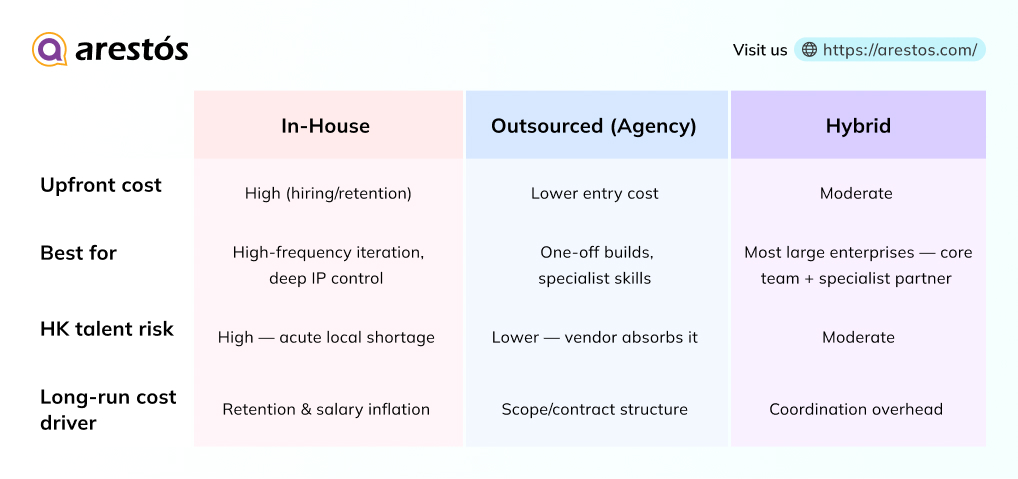
In-House vs. Outsourced vs. Hybrid: Which Actually Costs Less?
There is no single lowest-cost model for every website project. The real cost depends on how often development work is needed, the level of specialist expertise required, and how much internal control the organization needs.
How to Choose a Web Development Partner Without Overpaying
Choosing an enterprise web development agency in Hong Kong should not come down to the lowest quote. A cheaper proposal can become more expensive when the scope is unclear, security requirements are overlooked, or post-launch support is not included. The right partner should demonstrate the capability to manage both the technical and operational complexity of the project.
Before making a decision, evaluate the following:
- Enterprise-scale experience: Look for relevant projects involving complex integrations, multiple markets, or large-scale digital operations—not just a portfolio of SME websites.
- Compliance knowledge: The partner should understand the PDPO and any sector-specific regulatory requirements relevant to the project.
- Transparent pricing: Request itemized pricing and clear assumptions. Be cautious of lump-sum quotes that do not explain what is included or excluded.
- Security capability: Assess relevant security certifications, such as ISO 27001 or SOC 2 where applicable, and confirm who is responsible for security throughout the project.
- Post-launch support: Review the SLA, support scope, response times, and escalation process—not just the delivery timeline.
- Multilingual capability: For Hong Kong projects, bilingual or trilingual production should be an established capability rather than an afterthought.
The goal is not simply to find the lowest-cost vendor, but to choose a partner that provides clear scope, predictable costs, and the capabilities needed to avoid expensive rework later.
Why Choose Arestós for Web development
The right technology partner can help reduce unnecessary complexity, improve delivery efficiency, and create better long-term value from your technology investment.
- Comprehensive digital capabilities: Support across web, software, e-commerce, data, and mobile solutions.
- One trusted technology partner: Reduce the cost and complexity of managing multiple vendors.
- Flexible and scalable support: Access the right technical capabilities as business and project needs evolve.
- Built for long-term value: Focus on solutions that balance cost, performance, scalability, and ongoing development needs.
Explore how Arestós’ Web Development services can support your digital initiatives.
Frequently Asked Questions
1. Why does an enterprise website cost so much?
Enterprise websites cost more because they often require complex integrations, stronger security, compliance, and greater scalability.
2. How much should an enterprise website cost in Hong Kong?
Enterprise website development in Hong Kong typically ranges from around HK$100,000 to HK$500,000+, depending on scope and complexity.
3. Is it cheaper to build a website in-house or outsource development?
Outsourcing usually reduces upfront hiring costs, while in-house development may be more cost-effective for continuous, long-term needs.
4. What should I look for when choosing a web development agency in Hong Kong?
Look for relevant experience, transparent pricing, technical expertise, security capabilities, and reliable post-launch support.
5. How can I avoid going over budget on a website development project?
Define the scope early, prioritize essential features, identify technical risks, and control scope changes throughout the project.
Conclusion
Reducing website development costs is not about choosing the cheapest option. It starts with defining the right scope, selecting an architecture and delivery model that fit long-term needs, improving development efficiency, and managing total cost of ownership beyond the initial launch.
Arestós provides Web Development services to help businesses build, improve, and scale their digital solutions while balancing cost efficiency, performance, and long-term needs.
Looking to reduce unnecessary costs in your next web development project? Contact us to explore the right approach for your business.
Related Posts
Update the latest technology trends for your business