Back to featured insights
How to Optimize Content for AI Search: The Complete Guide
Discover how to optimize content for AI search and stay ahead in the future of SEO. Learn practical strategies to improve visibility, strengthen brand authority, attract more qualified traffic, and increase your chances of appearing in AI-generated answers across modern search platforms.

Table of Content
Share
Optimize content for AI search is becoming essential as more users rely on AI-powered platforms like ChatGPT, Gemini, and Google AI Overviews to find information online. A strong AI content optimization strategy can help improve search visibility, increase brand authority, and boost the chances of appearing in AI-generated answers.
This guide is designed for marketers, SEO professionals, content creators, and businesses that want to stay competitive in the evolving search landscape. In this guide, you’ll learn how to optimize content for AI search, use AI tools effectively, avoid common mistakes, and improve your overall AI search visibility.
What is Optimize Content for AI Search?
Optimize content for AI search is the process of creating content that AI systems can easily understand, extract, and cite in AI-generated answers. Unlike traditional SEO, which focuses mainly on search rankings, AI search optimization focuses on semantic relevance, content structure, entity recognition, and user intent.
The goal is to help your content appear in platforms like ChatGPT, Google AI Overviews, Gemini, and Perplexity by making information clear, trustworthy, and machine-readable.
To better understand how AI-focused optimization strategies work, you can also read our guide on AEO vs GEO
What are the benefits of Optimize Content for AI Search?
As AI-powered search platforms continue to change how users discover information, optimizing content for AI search helps businesses improve visibility, authority, and long-term organic growth.
- Increase visibility in AI-generated answers: Your content has a higher chance of appearing in platforms like ChatGPT, Google AI Overviews, Gemini, and Perplexity.
- Improve brand authority: AI systems are more likely to reference brands with clear, trustworthy, and well-structured content.
- Capture more organic traffic: Optimizing for AI search helps you reach users beyond traditional Google rankings.
- Better match user intent: AI-focused content is designed around real questions and conversational search behavior.
- Strengthen topical authority: Comprehensive and semantically related content helps AI understand your expertise in a specific field.
- Future-proof your SEO strategy: As AI search continues to grow, AI optimization helps businesses stay competitive in the evolving search landscape.
6 Ways to Use AI for Content Optimization
Let’s explore six effective strategies to optimize content for AI search, along with useful AI-powered optimization tools.
Find on-page SEO opportunities
Improving on-page SEO helps search engines and AI systems better understand your content, increasing your chances of appearing in both traditional search results and AI-generated answers.
AI tools can simplify this process by helping you:
- Identify missing content opportunities
- Create cleaner and more user-friendly URL structures
- Optimize content for SERP features like featured snippets
ChatGPT is particularly useful for content gap analysis. By comparing your article with competitor pages, it can highlight missing topics, questions, or insights that should be added to improve topical coverage.
For example, you can use a prompt like:
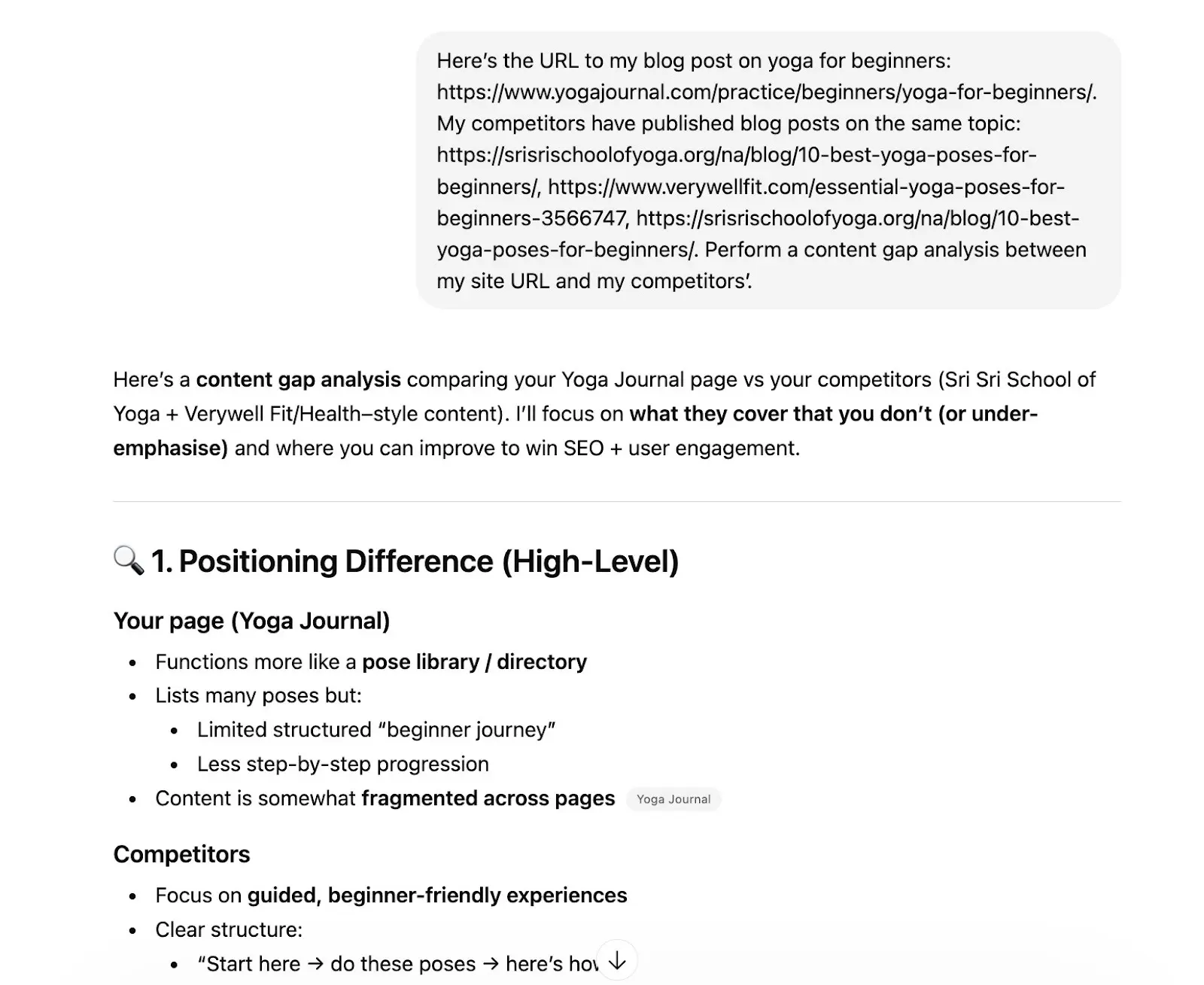
“Here’s the URL to my blog post on [topic]: [your URL]. My competitors have published blog posts on the same topic: [competing URL 1], [competing URL 2], [competing URL 3]. Perform a content gap analysis between my site URL and my competitors’.”
Below is an example of how ChatGPT might respond.
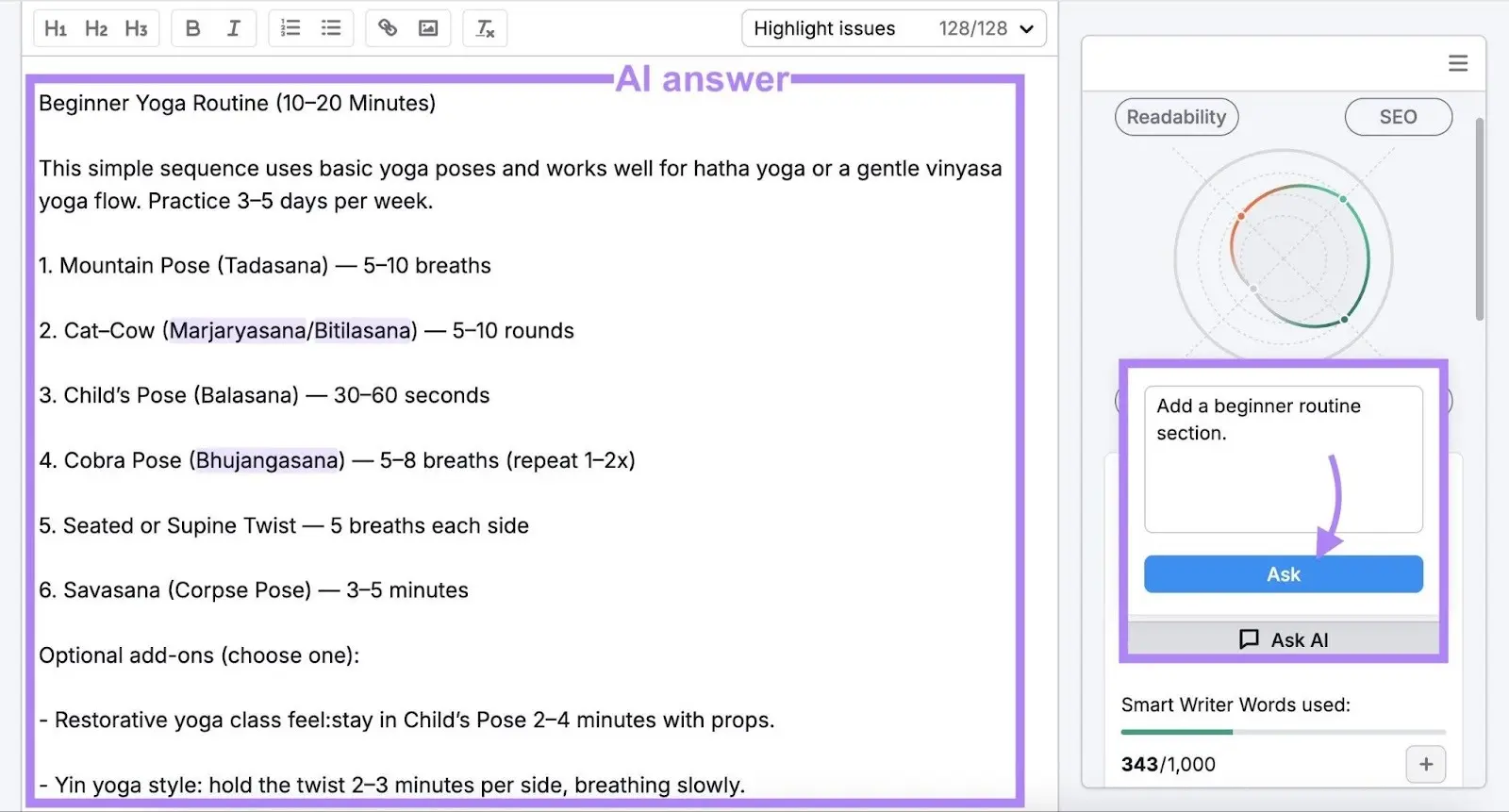
You can then use tools like ChatGPT or Semrush’s SEO Writing Assistant to generate new sections that address those content gaps and improve topical coverage.
Simply provide the tool with the type of content or topic you want to add, and it can generate relevant suggestions or draft content. Here’s an example of how this works in SEO Writing Assistant.
Optimize title tags and meta descriptions
Optimizing title tags and meta descriptions can help improve click-through rates in both traditional and AI-powered search results.
Title tags and meta descriptions are HTML elements that define a page’s title and summary. Search engines and AI systems may use these elements to understand your content and generate search result snippets.
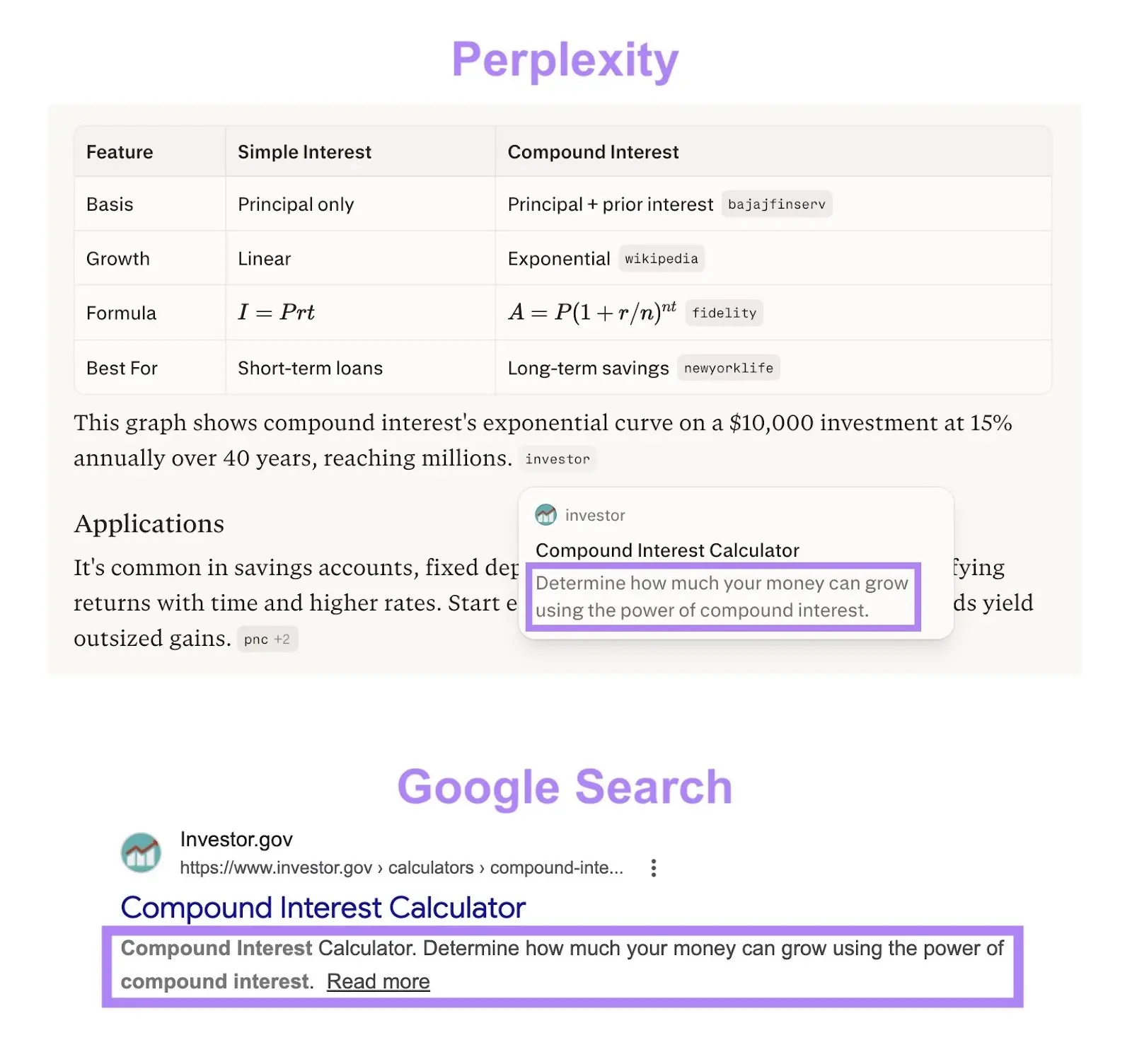
To perform well in both AI and traditional search results, your title tags and meta descriptions should:
- Encourage users to click
- Include your target keyword naturally
- Stay concise to avoid truncation
- Title tags: under 60 characters
- Meta descriptions: under 105 characters
You can use ChatGPT to quickly generate optimized title tags and meta descriptions with prompts like:
“Generate title tags and meta descriptions for this article. The title tags and meta descriptions should entice readers to click and must include the ‘[keyword]’ keyword. The title tags should not exceed 60 characters, and the meta descriptions should not exceed 105 characters. Article: [text]”
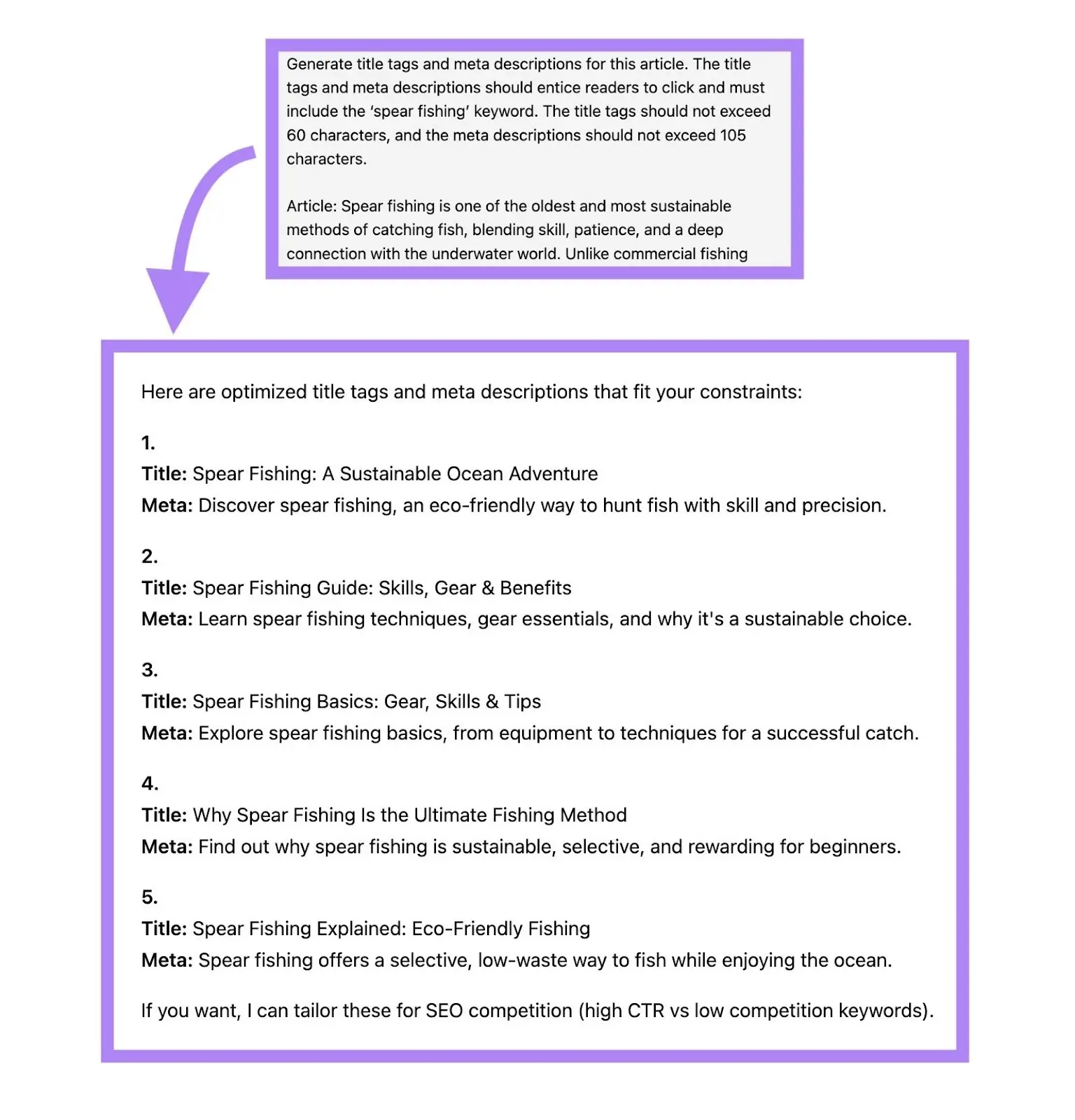
Alternatively, you can use the Content Toolkit’s AI Article Generator to automatically create optimized title tags and meta descriptions while generating your article.
Simply enter your article topic, customize the settings, and click “Generate article” to receive AI-generated content along with SEO-friendly metadata.
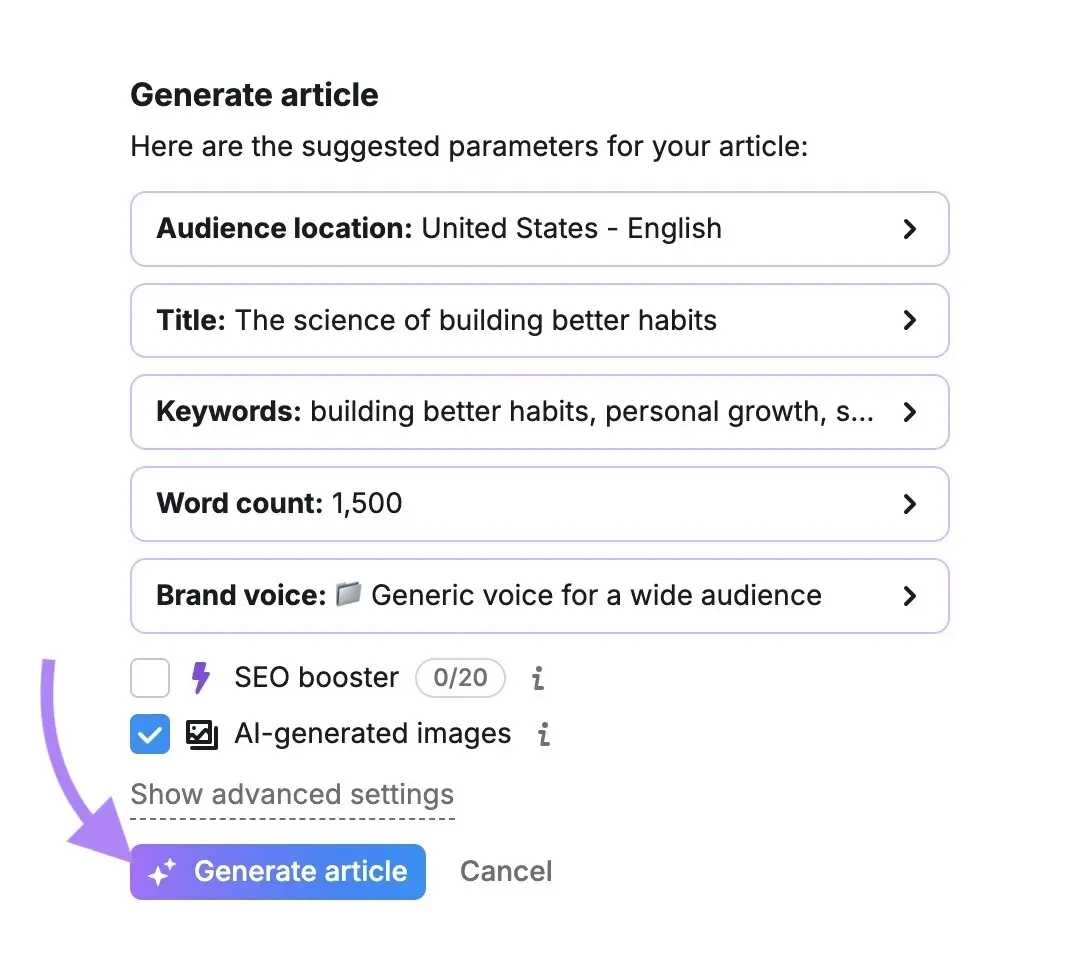
The AI Article Generator will create a search-optimized article that includes a suggested title tag and meta description at the top of the page.
If you’re not satisfied with the generated results, you can either regenerate them using AI or manually refine them to better match your SEO goals and brand voice.
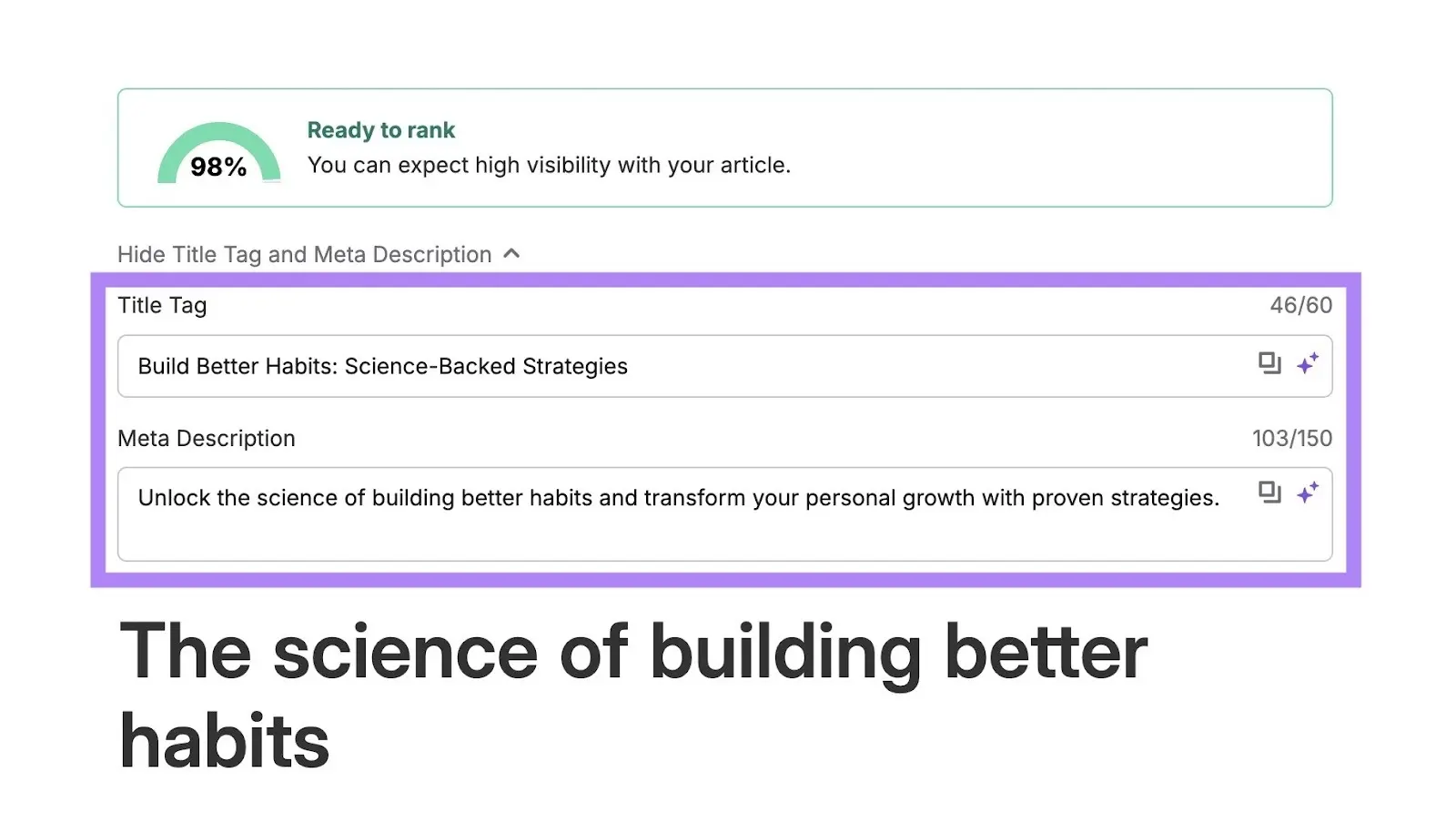
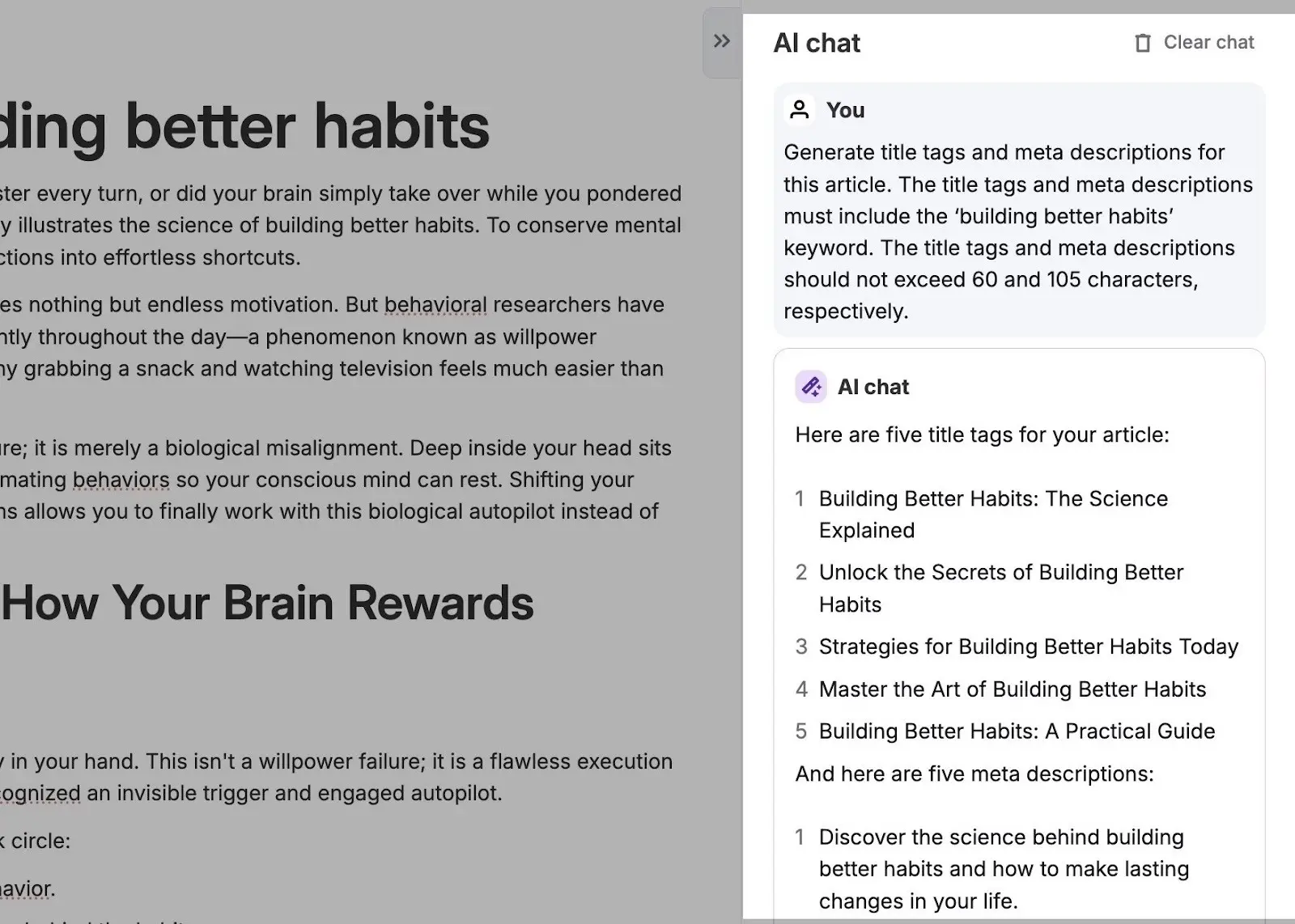
If you need optimized title tags and meta descriptions for existing content drafts, you can use the Content Toolkit’s AI Search Optimizer.
Simply enter a prompt describing your article and optimization goals, and the tool will generate SEO-friendly title tags and meta descriptions tailored for both traditional and AI search results.
“Generate title tags and meta descriptions for this article. The title tags and meta descriptions must include the ‘[keyword]’ keyword. The title tags and meta descriptions should not exceed 60 and 105 characters, respectively.”
Identify related queries and keyword clusters
Identify related search queries that can be grouped into keyword clusters to help a single page rank for a broader range of searches and improve overall visibility.
Keyword clusters consist of a primary keyword along with closely related queries that support the same topic and search intent.
AI tools make it much easier to discover related queries and organize them into effective keyword clusters. Here’s how it works:
Find related queries
You can use ChatGPT to discover related search queries by entering a prompt like this:
“Generate 30 related search queries for ‘[primary topic]’.”
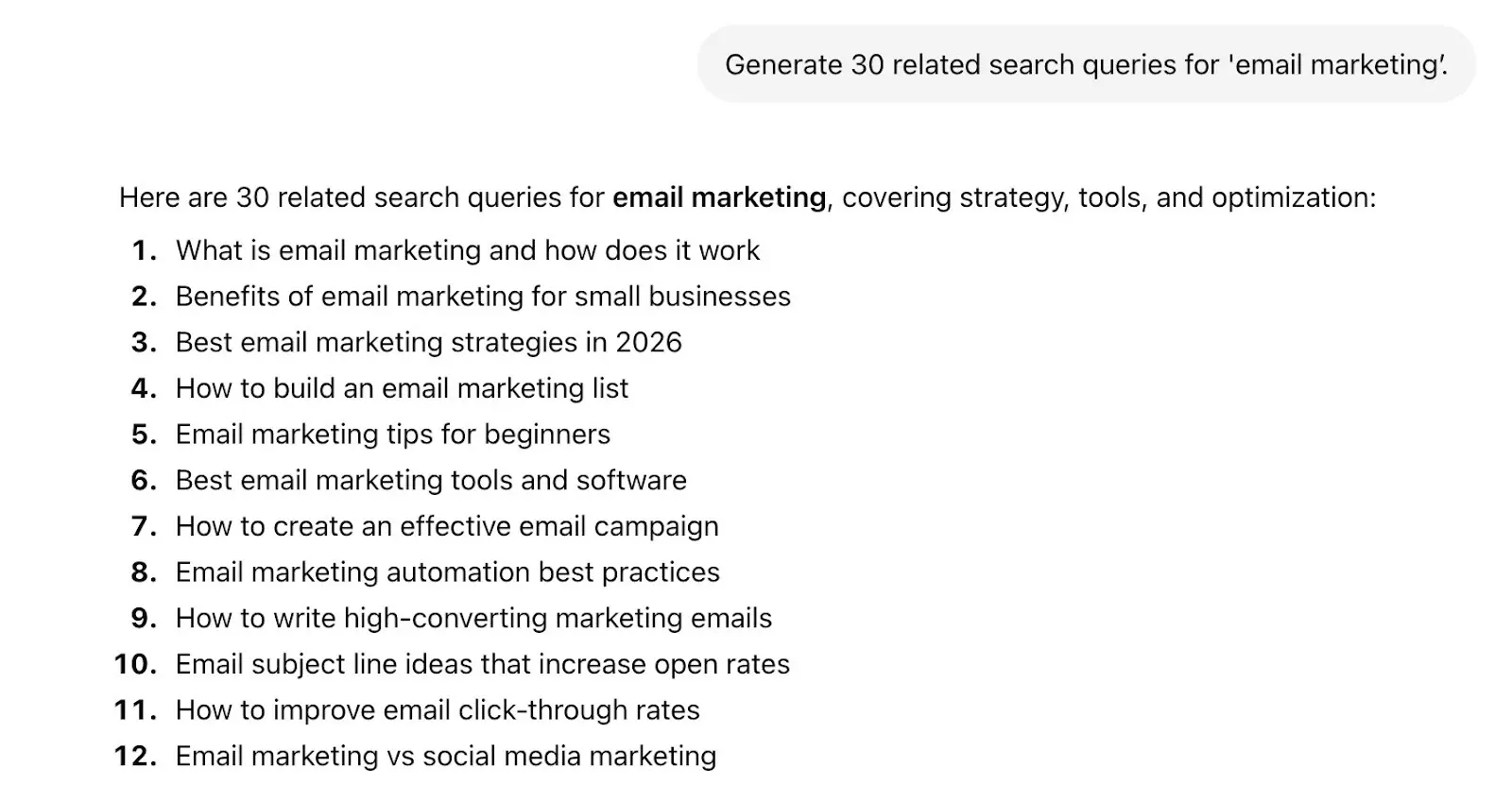
ChatGPT is useful for brainstorming related search queries and content ideas. However, if you want to discover real prompts that users enter into AI tools, you can use the Prompt Research feature in Semrush’s AI Visibility Toolkit.
Prompt Research analyzes your main topic and identifies actual user prompts related to that subject. It also allows you to customize which AI platforms you want to collect data from.
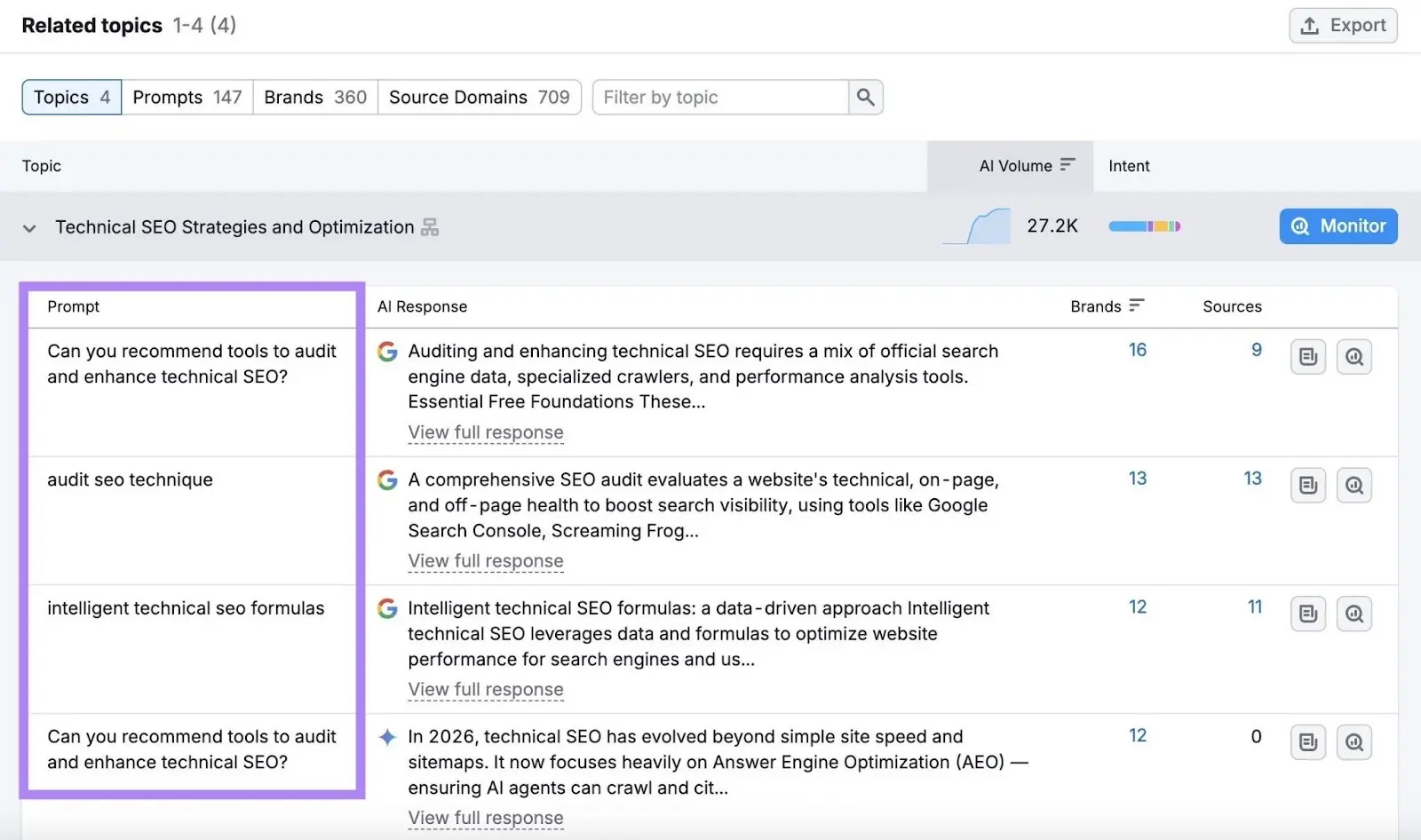
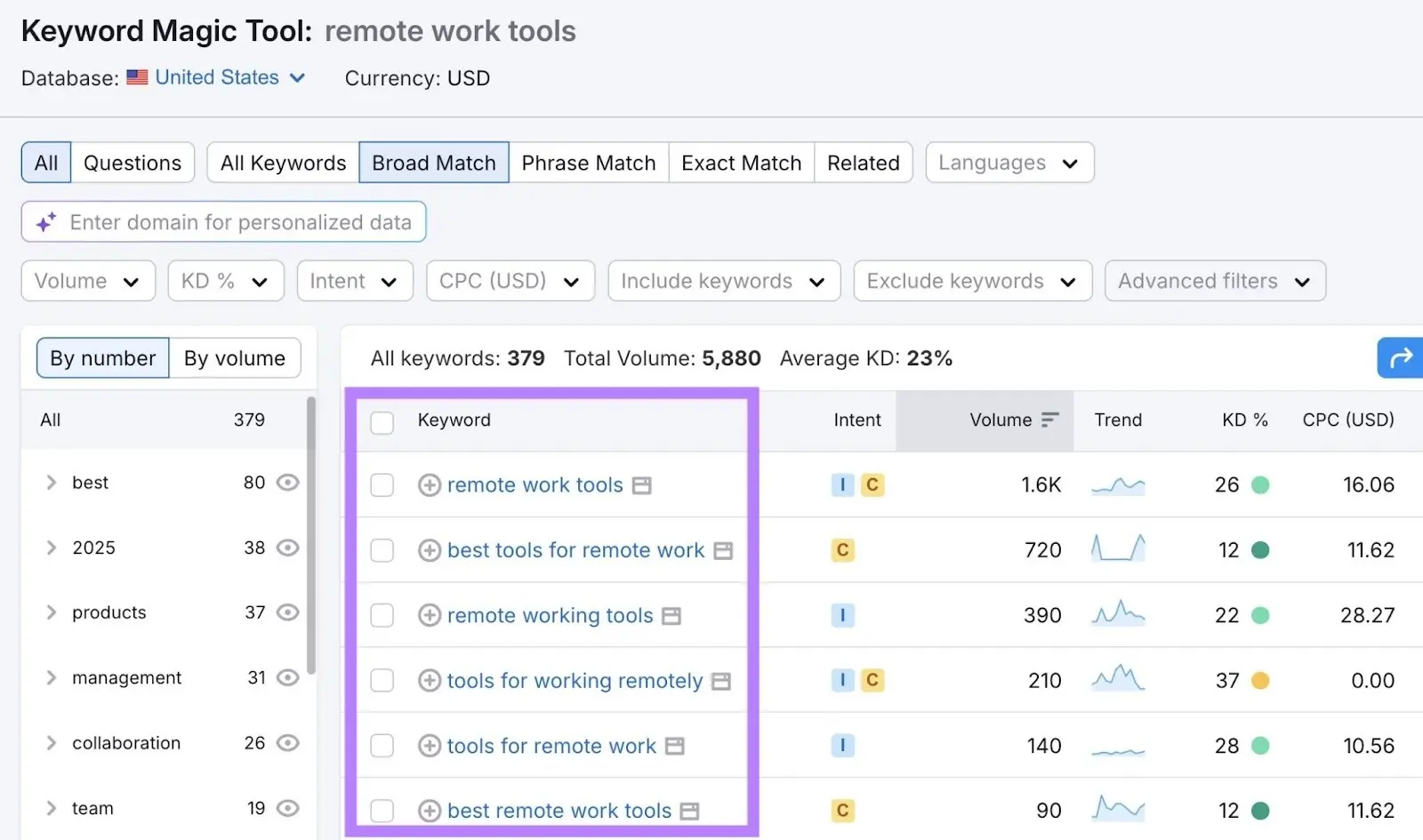
You can also expand your keyword clusters by combining the related queries found in Prompt Research with additional keyword suggestions from a keyword generator tool.
This helps you build more comprehensive content that targets a wider range of search intents and AI search queries.
Create keyword clusters
Create keyword clusters by giving ChatGPT your primary topic along with related search queries using a prompt like this:
“My primary topic is ‘[primary topic]’ and my related queries are ‘[related queries]’. Group the related queries into logical keyword clusters based on topic similarity and search intent.”
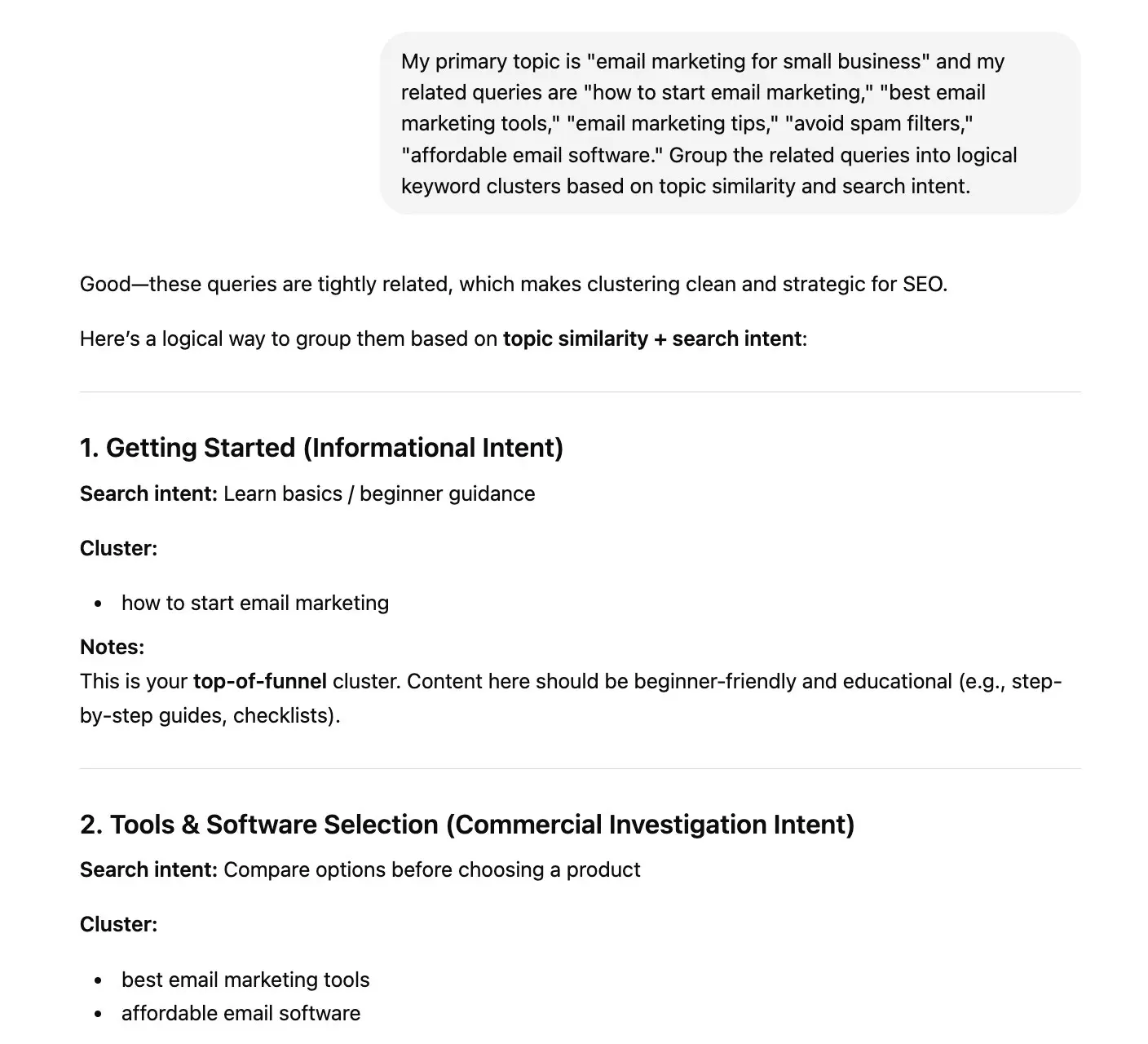
You can also use a dedicated keyword clustering tool such as Semrush’s Keyword Strategy Builder. Simply add your related queries into a list and click “Cluster this list” to automatically organize them into keyword groups.
This helps streamline content planning and improves topical relevance for both traditional and AI search.
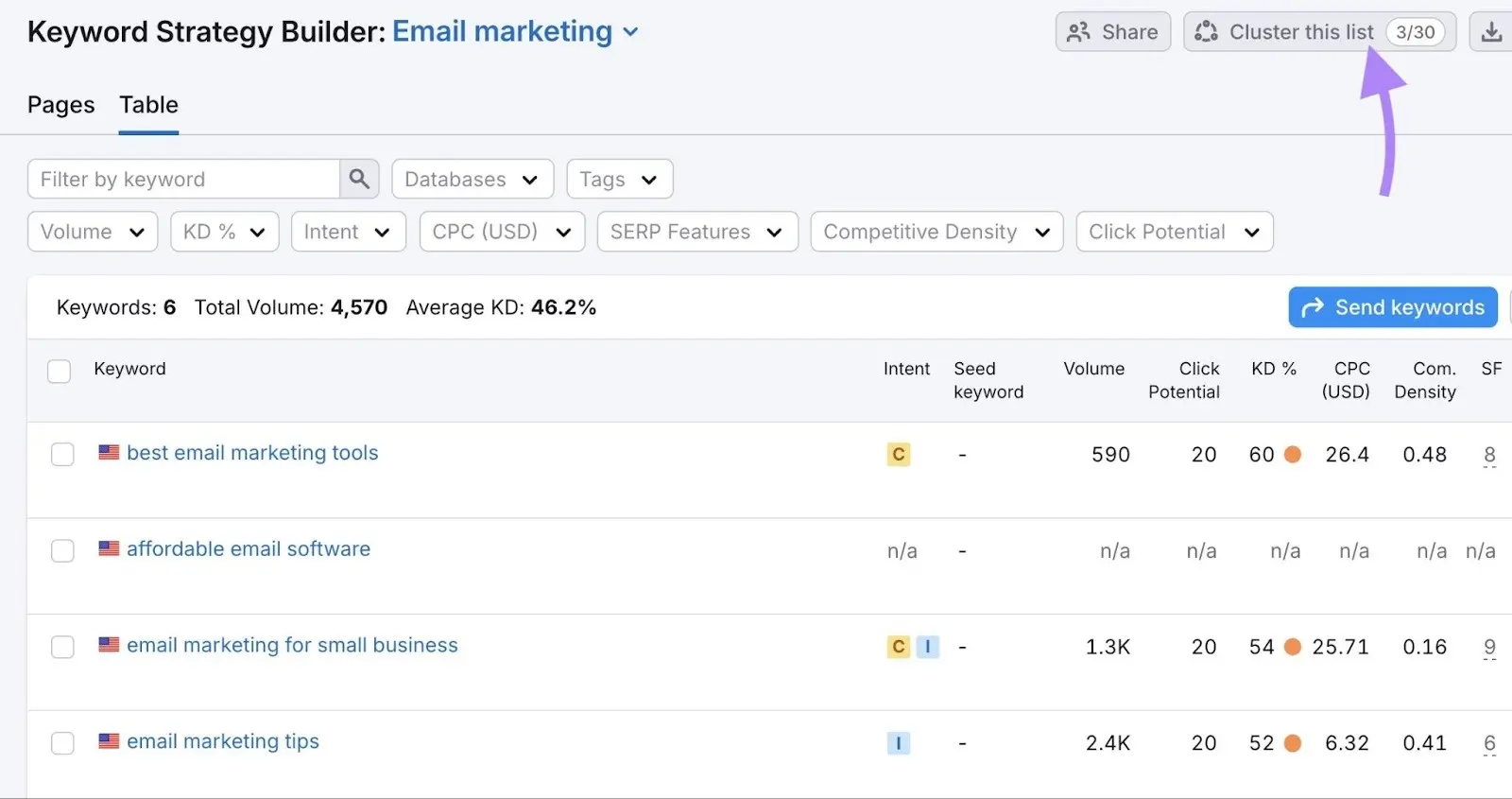
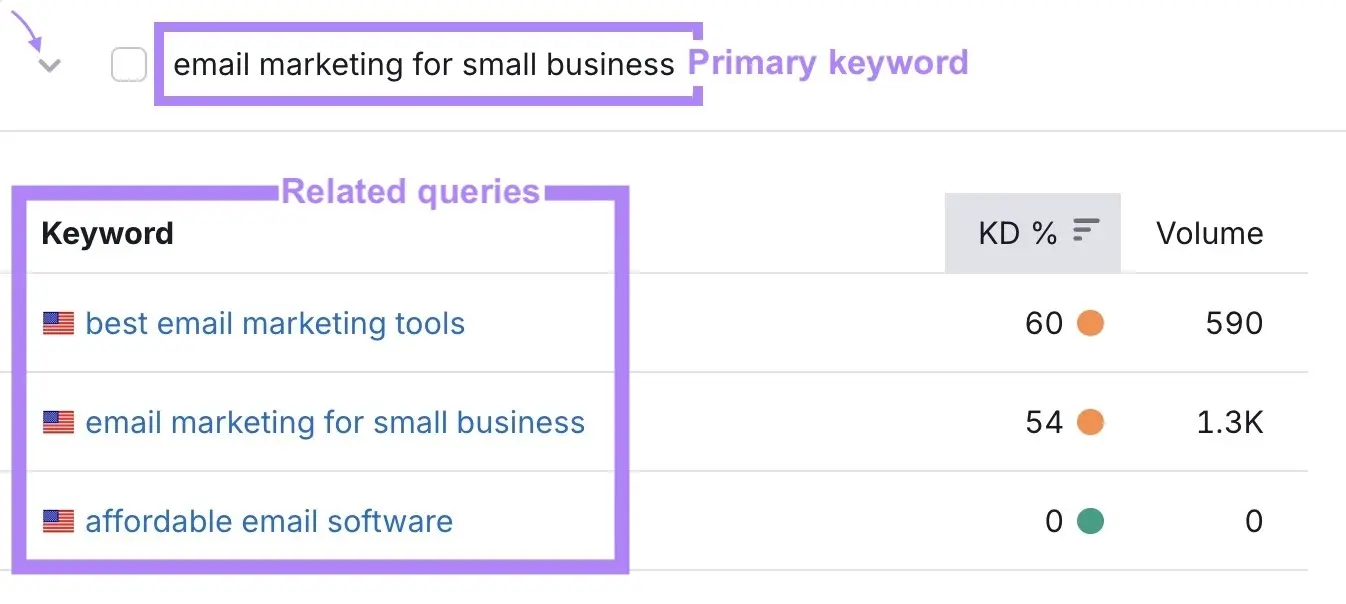
Keyword Strategy Builder automatically groups closely related queries into keyword clusters that can be targeted within the same page.
In this example, the tool generated three different clusters. You can click on any cluster to view the related queries included within that group.
Find internal linking opportunities
AI tools can help identify internal linking opportunities between your website pages, making it easier for users and search engines to discover your content while also distributing page authority more effectively.
For example, you can use ChatGPT to analyze a list of important pages on your website and suggest relevant internal links between them. Generally, the more pages you provide, the more linking opportunities the AI can identify.
Here’s an example prompt:
“Here are three key articles on my fitness website: ‘[article title 1],’ ‘[article title 2],’ and ‘[article title 3].’ Please suggest how I might link these articles internally.”
And here’s the type of response you can expect:
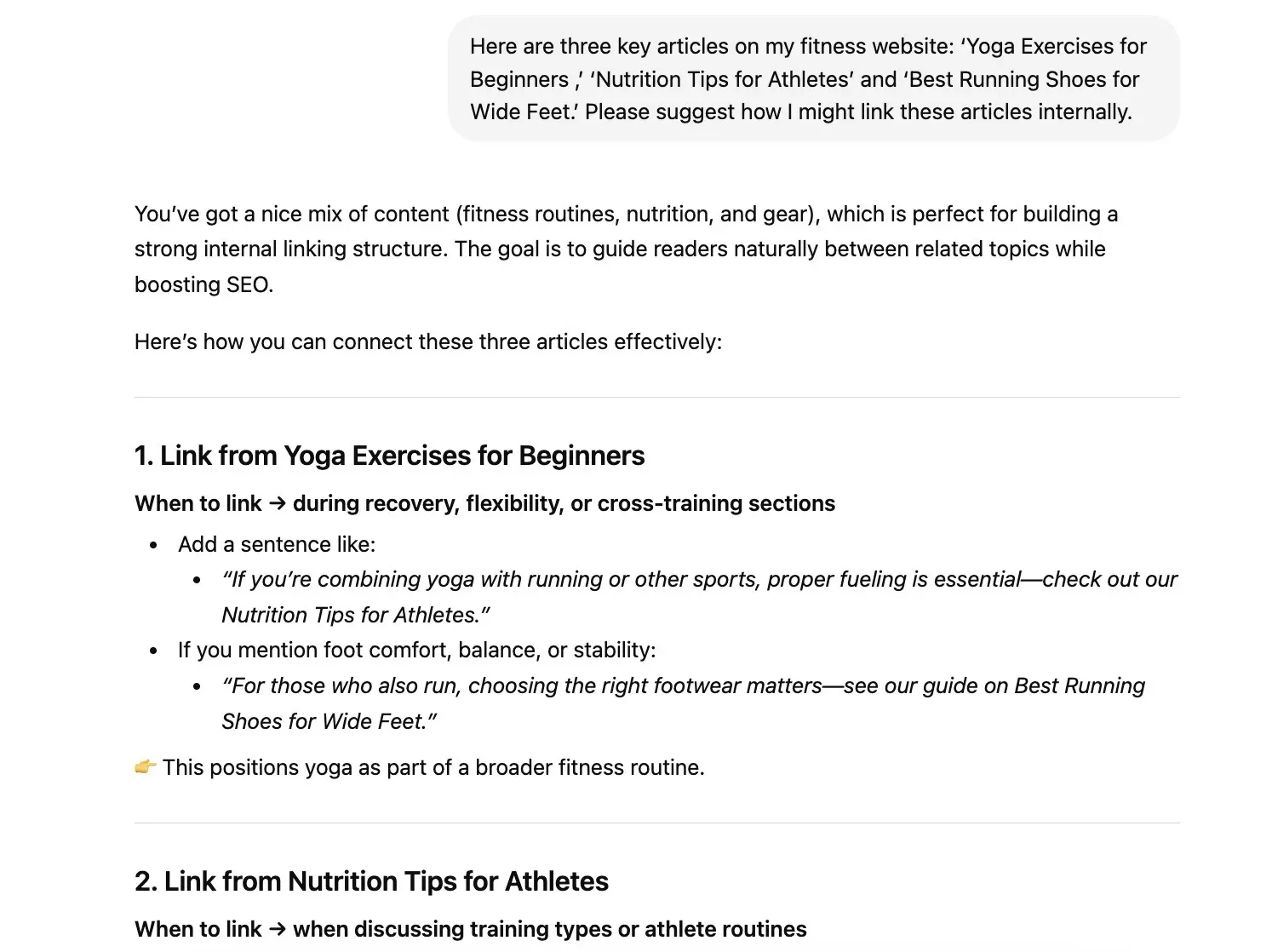
Review the internal link suggestions provided by the tool and implement the ones that are most relevant to your content and SEO strategy.
Carefully choosing useful internal links can improve site structure, user navigation, and content discoverability for both search engines and AI systems.
Analyze search intent
Analyze the search intent behind your target keyword or prompt to better understand what users are actually looking for, allowing you to create content that directly matches their needs.
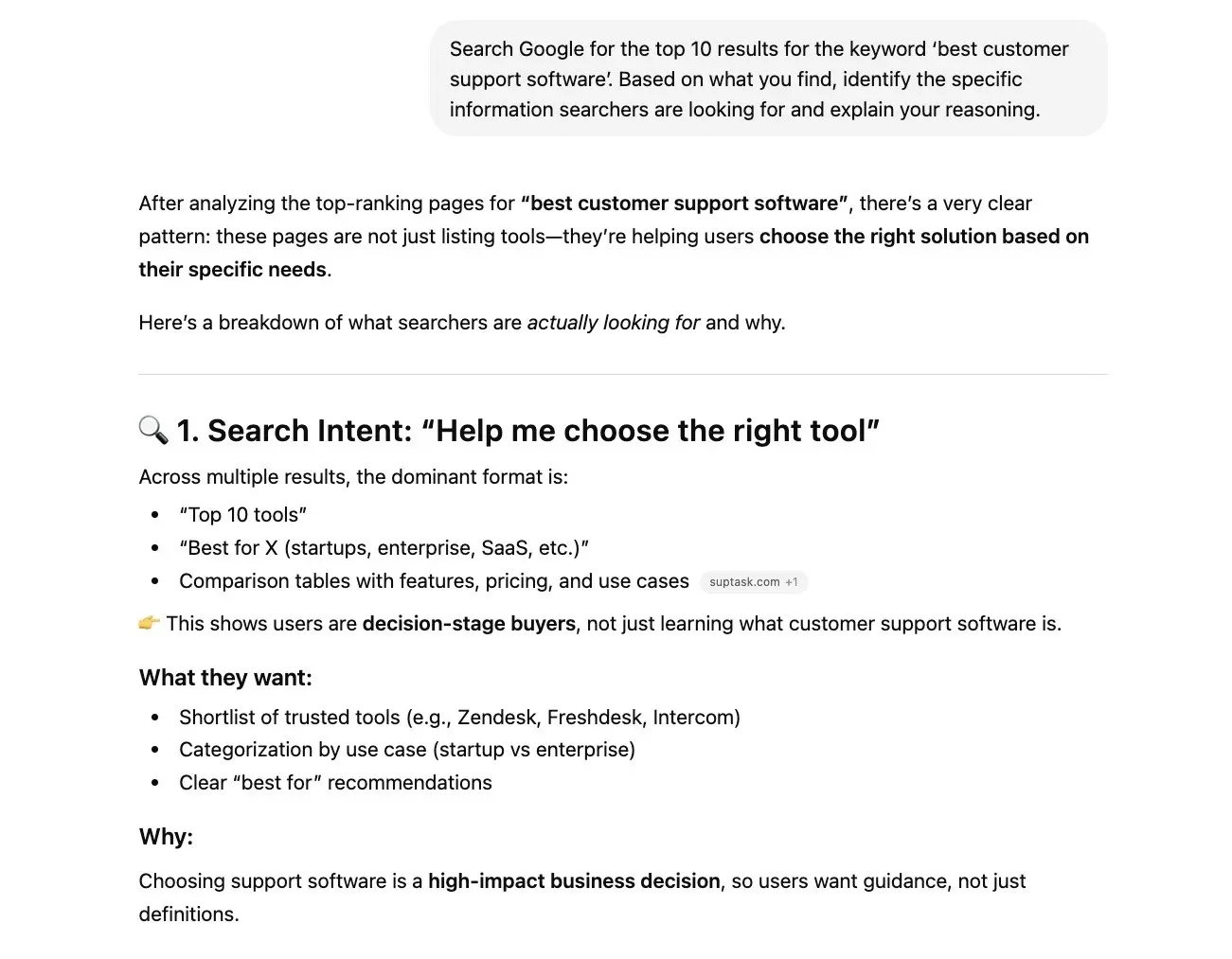
You can use ChatGPT to analyze search intent by enabling its web search feature and entering a prompt like this:
“Search Google for the top 10 results for the keyword ‘[keyword].’ Based on what you find, identify the specific information searchers are looking for and explain your reasoning.”
ChatGPT may then generate a response that explains the likely search intent behind the query, along with content recommendations that better match what users are looking for.
This can help you create more relevant, user-focused content for both traditional and AI search results.
Enhance your writing’s readability
Using AI tools to improve readability can make your content easier for both users and search systems to understand.
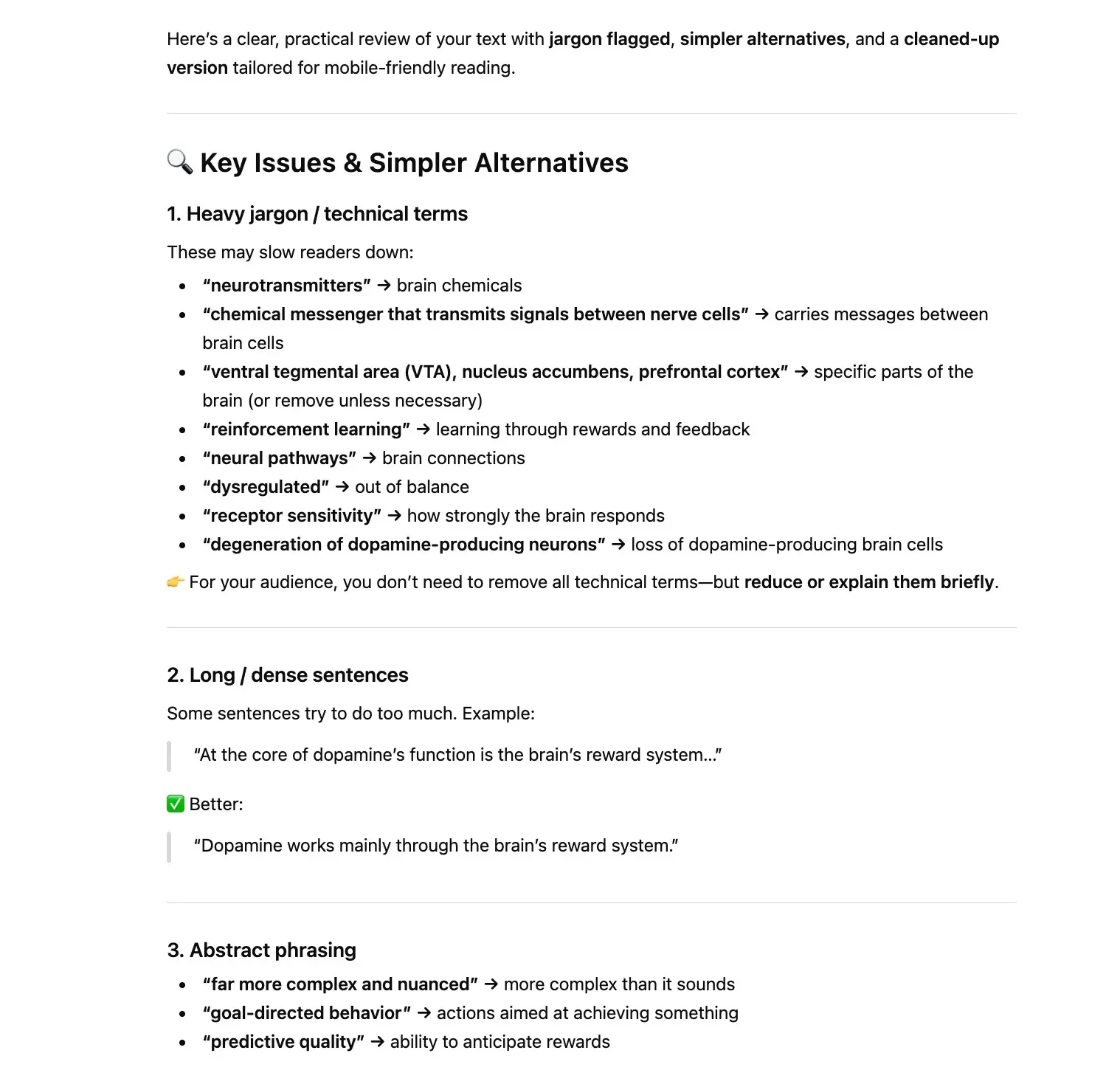
For example, ChatGPT can review your writing and suggest improvements related to clarity, sentence structure, flow, and readability when you use a prompt like this:
“Please review this text for any jargon or complex sentences that my target audience might struggle to understand. Suggest simpler alternatives to improve clarity and readability. My target audience is [describe your target audience here]. Text: [full text].”
Common AI content optimization mistakes to avoid
As AI search continues to evolve, many businesses are adopting AI content optimization strategies. However, common mistakes can reduce content quality, search visibility, and AI trustworthiness.
- Overusing AI-generated content without human editing: Publishing raw AI-generated text can lead to generic, repetitive, or inaccurate content.
- Focusing only on keywords instead of search intent: AI systems prioritize context and user intent, not just exact-match keywords.
- Creating thin or low-value content: Short, shallow content often lacks the depth and authority needed for AI search visibility.
- Ignoring content structure and readability: Poor formatting, unclear headings, and long paragraphs make content harder for AI and users to understand.
- Neglecting entity optimization: Failing to establish clear entities and semantic relationships can reduce topical relevance.
- Publishing outdated information: AI systems favor fresh, accurate, and trustworthy content.
- Forgetting internal linking opportunities: Weak internal linking makes it harder for search engines and AI systems to discover related content.
- Relying entirely on AI without original insights: Content without unique expertise, research, or perspectives is less likely to be cited by AI platforms.
Frequently Asked Questions
1. Why is AI content optimization important?
As AI-powered search platforms become more popular, optimizing content for AI helps increase visibility, improve topical authority, and boost the chances of being cited in AI-generated responses.
2. How is AI content optimization different from traditional SEO?
Traditional SEO mainly focuses on rankings and keywords, while AI content optimization focuses more on search intent, semantic relevance, entities, readability, and machine-readable content structure.
3. Can ChatGPT help optimize content for AI search?
Yes. ChatGPT can help with content gap analysis, keyword clustering, search intent analysis, readability improvements, title tag generation, and internal linking suggestions.
4. What are keyword clusters?
Keyword clusters are groups of related search queries built around one primary keyword. They help improve topical coverage and increase visibility across multiple search intents.
5. Does AI-generated content help SEO?
AI-generated content can support SEO when it is high-quality, accurate, and edited by humans. Low-quality or unedited AI content may negatively impact trust and search performance.
Conclusion
As AI-powered search continues to evolve, businesses need to move beyond traditional SEO and start optimizing content for AI search. From improving content structure and readability to building keyword clusters, analyzing search intent, and strengthening topical authority, AI content optimization helps brands increase visibility across both traditional and AI-driven search platforms.
Arestós provides AEO and GEO services that help businesses improve AI search visibility and appear more effectively in AI-generated answers.
Contact us today to build a customized AEO and GEO strategy for your business.
Subscribe to our newsletter!
Get updated to
the lastest IT trends
Related Posts
Update the latest technology trends for your business