Back to featured insights
Top 10 AI Search Ranking Factors That Influence AI Citations
AI Search Ranking Factors determine how AI systems evaluate, select, and cite content. Learn the key factors that influence AI citations, improve visibility in AI-generated answers, and help your business build authority in the future of search.
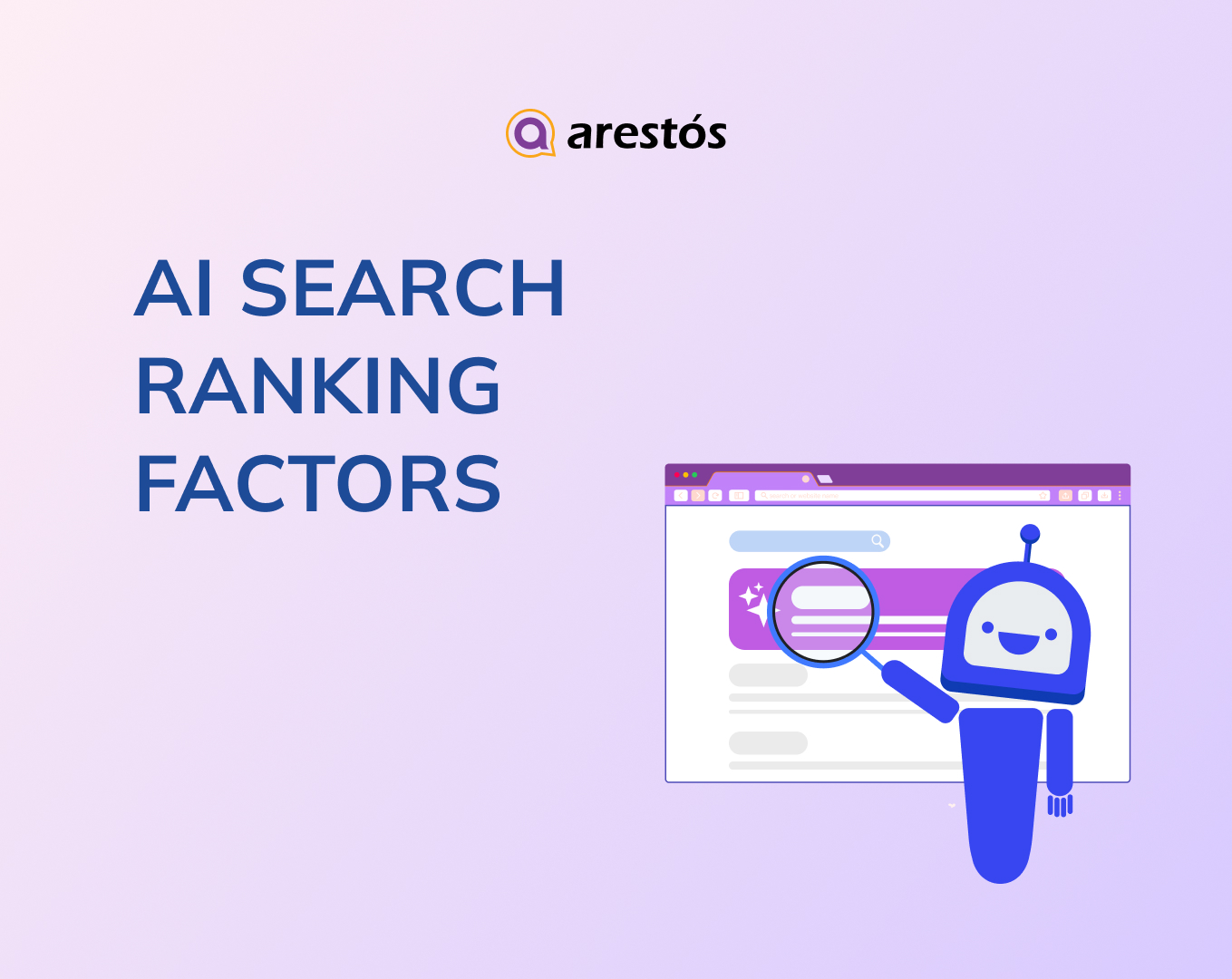

Table of Content
Share
AI Search Ranking Factors determine how AI-powered search platforms evaluate, select, and cite content in generated answers. Understanding these factors can help businesses improve visibility, earn more AI citations, and strengthen their online authority.
Whether you are a marketer, business owner, SEO professional, or content strategist, knowing how AI search works is becoming increasingly important. In this guide, you’ll learn the 10 most important AI Search Ranking Factors and how to optimize your content to increase visibility and earn more AI citations.
What Are AI Search Ranking Factors?
AI Search Ranking Factors are the signals that AI-powered search systems use to evaluate and select sources when generating answers. These factors help determine which websites, brands, and content are most trustworthy, relevant, and useful for a user’s query.
Unlike traditional SEO ranking factors that focus on webpage rankings, AI Search Ranking Factors influence whether content gets cited, referenced, or included in AI-generated responses. They play a key role in improving visibility across platforms such as ChatGPT, Google AI Overviews, Gemini, and Perplexity.
Why AI Search Ranking Factors Matter for Businesses
Understanding AI Search Ranking Factors is essential for improving visibility in AI-powered search.
- Increase visibility in AI-generated answers: Strong AI search signals improve the likelihood of being cited and mentioned by platforms such as ChatGPT, Google AI Overviews, Gemini, and Perplexity.
- Build brand authority and trust: Being referenced by AI systems can reinforce your brand’s credibility and position your business as a trusted source of information.
- Capture high-intent audiences: Users who rely on AI-generated answers are often looking for immediate solutions, making them valuable prospects for businesses.
- Stay competitive as search evolves: As more users adopt AI-powered search experiences, optimizing for AI visibility becomes increasingly important alongside traditional SEO.
- Expand visibility beyond search rankings: Even if a webpage is not ranked first in traditional search results, it can still gain exposure through AI citations and recommendations.
- Support long-term GEO and AEO strategies: Understanding AI Search Ranking Factors helps businesses optimize content for both AI-powered answer engines and generative search platforms.
How AI Search Is Different from Traditional Search
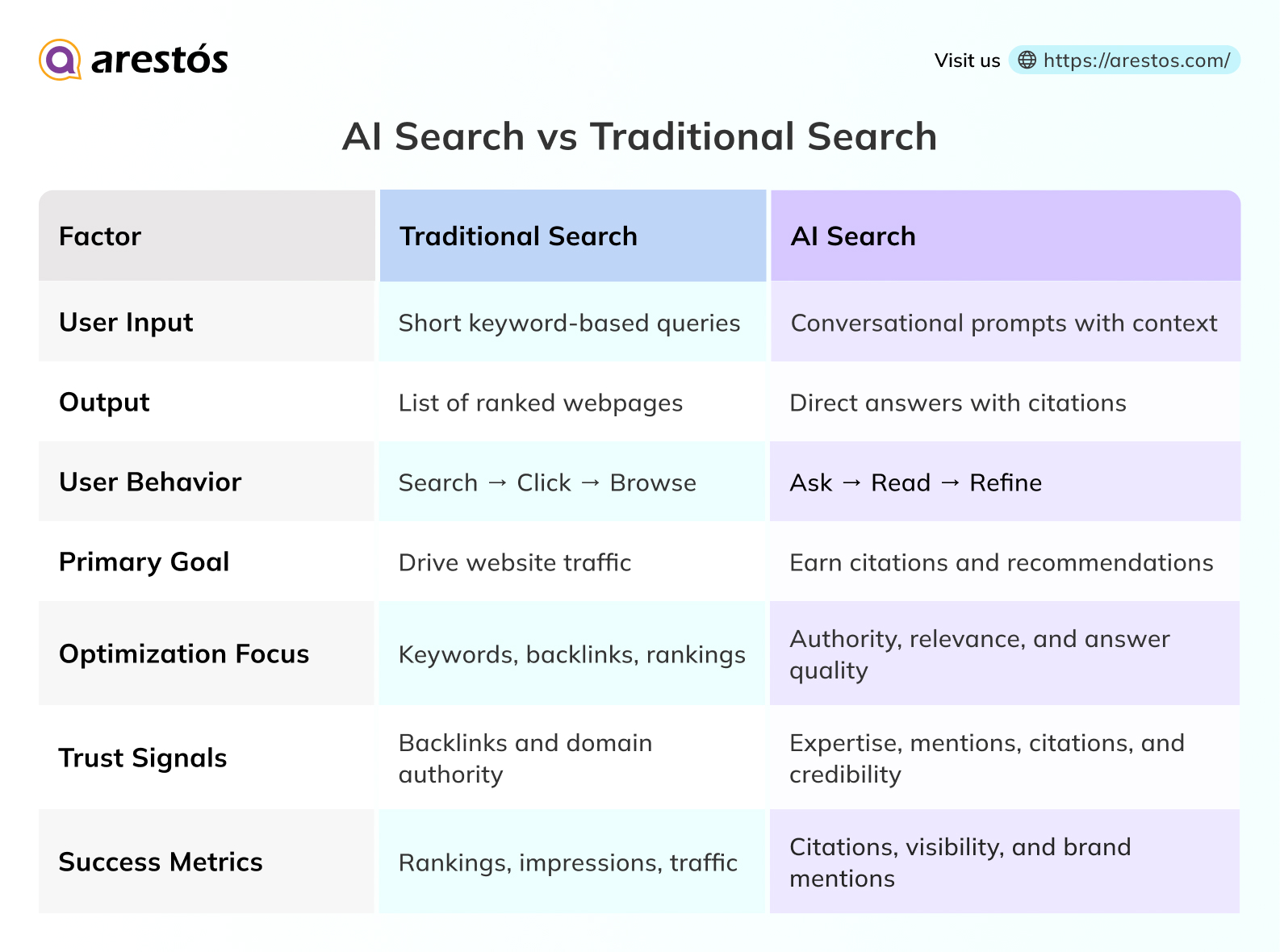
If you’re looking for practical strategies to improve your chances of being referenced by AI systems, read our guide on How To Get Cited By AI: 8 Optimization Tips.
Top 10 AI Search Ranking Factors That Influence AI Citations
Below are ten of the most important AI Search Ranking Factors that influence AI citations.
Content Relevance and Search Intent
Content relevance is one of the strongest signals AI systems use when deciding whether to cite a source. Before evaluating authority or credibility, AI first needs to determine whether a piece of content provides a useful and relevant response to the user’s query.
Rather than simply matching keywords, modern AI search platforms analyze the context and intent behind a search. They look for content that addresses the user’s needs clearly, thoroughly, and in a way that is easy to understand.
To improve content relevance:
- Focus on solving a specific user problem or question
- Align content with the intent behind the search
- Use clear and descriptive headings
- Provide complete and accurate explanations
- Include supporting information that adds context and value
- Remove content that does not contribute to the main topic
When content closely aligns with what users are looking for, AI systems can more confidently identify it as a valuable source and incorporate it into generated answers.
Learn more in our guide on How to Optimize Content for AI Search
Entity Recognition
Entity recognition is a critical AI Search Ranking Factor because it helps AI systems understand who or what a piece of content is about. An entity can be a person, brand, company, product, service, location, or concept that can be uniquely identified and connected to other entities and topics.
Rather than relying solely on keywords, AI search engines use entities to build relationships and context. When a brand is consistently associated with specific topics across its website and other online sources, AI can more accurately understand its expertise and relevance.
Entity recognition helps AI answer questions such as:
- Who is this brand or organization?
- What products or services does it offer?
- What topics is it associated with?
- Where does it operate?
- Is it relevant to the user’s query?
- Can it be considered a trustworthy source?
To strengthen entity recognition, businesses should:
- Maintain consistent brand information across all platforms
- Clearly describe products, services, and areas of expertise
- Create content around core industry topics
- Build strong internal links between related pages
- Implement structured data where appropriate
- Earn mentions from reputable third-party sources
The more clearly AI can identify and connect an entity to specific topics, the more likely it is to recognize that entity as a relevant and authoritative source within AI-generated search results.
Topical Authority
Topical authority refers to how thoroughly and consistently a website covers a specific subject. AI systems tend to favor sources that demonstrate deep expertise across an entire topic rather than websites that only publish occasional or unrelated content.
When a website regularly publishes valuable content around a core area of expertise, AI can better understand its knowledge, credibility, and relevance. This makes it easier for AI systems to identify the website as a reliable source when generating answers.
Topical authority is strengthened by:
- Comprehensive coverage of a topic
- Supporting content that explores related subtopics
- Strong internal linking between relevant pages
- Consistent use of industry terminology
- Clear and informative explanations
- Alignment between content and service offerings
- Regular content updates and improvements
Building topical authority takes time, but it helps establish long-term credibility and increases the likelihood of being cited in AI-generated search results.
Structured Content and Clear Formatting
Content structure plays an important role in how AI systems interpret and extract information. Even high-quality content may be overlooked if it is poorly organized, difficult to navigate, or lacks clear signals that help AI understand the information being presented.
Well-structured content makes it easier for AI systems to identify key information, understand relationships between sections, and extract answers for user queries. It also improves readability, allowing users to find relevant information more quickly.
Strong content structure includes:
- A clear hierarchy of H1, H2, and H3 headings
- Short and easy-to-read paragraphs
- Bullet points and numbered lists
- Clear definitions and explanations
- Question-based sections that reflect user intent
- Descriptive anchor text for internal links
- A logical flow from one section to the next
When content is organized in a way that both users and AI can easily understand, it becomes more accessible, more useful, and more likely to be cited in AI-generated answers.
Content Depth and Semantic Coverage
AI search systems evaluate topics based on meaning and context, not just keywords. As a result, content that covers a subject from multiple relevant angles is often viewed as more valuable and authoritative than content that focuses on a narrow set of terms.
Semantic coverage helps AI understand the full scope of a topic and how different concepts relate to one another. The more complete the context, the easier it is for AI systems to interpret, summarize, and reference the content when generating answers.
Strong semantic coverage includes:
- Related concepts and supporting topics
- Industry-specific terminology
- Common user questions and concerns
- Relevant entities and subtopics
- Contextual explanations and examples
- Connections between closely related subjects
- Comprehensive coverage of the topic ecosystem
Rather than repeating keywords, the goal is to provide a complete understanding of a topic. Content that offers depth, context, and meaningful connections is more likely to be recognized as a valuable resource in AI search results.
To learn how comprehensive content contributes to AI Overviews rankings, read our guide on How to Rank in Google’s AI Overviews.
Trust Signals and Credibility
Trust is a critical factor in AI search because AI systems aim to provide accurate and reliable information. Before citing a source, they evaluate various signals that indicate whether a website, brand, or business can be considered credible and trustworthy.
Strong trust signals help AI understand that the information is backed by real expertise, transparent business practices, and a genuine online presence. They also help reduce uncertainty when AI systems decide which sources to include in generated answers.
Common trust signals include:
- Clear company and business information
- Accurate descriptions of products or services
- Demonstrated expertise and industry knowledge
- Regularly updated content
- Client testimonials, reviews, or case studies
- Consistent contact and location details
- Professional website design and structure
- Helpful internal linking
- Transparent service and information pages
Trust is not built through claims alone. Both users and AI systems need clear evidence that a business is legitimate, knowledgeable, and relevant to the topic being discussed. The stronger these signals are, the more likely a website is to be recognized as a reliable source in AI-generated search results.
Internal Linking and Topic Relationships
Internal linking helps search engines and AI systems understand how pages and topics relate to one another. A strong internal linking structure connects key content across a website, creating a clear framework that supports both content discovery and topic understanding.
Internal linking supports:
- Entity understanding
- Topic clustering
- Page discovery
- Authority distribution
- Improved user experience
- Semantic relationships between content
When related pages are connected naturally, AI systems can better understand the website’s expertise and the relationships between different topics. This helps reinforce topical authority and improve visibility in AI-generated search results.
Technical SEO and Crawlability
Technical SEO remains an important foundation for AI search visibility. Before AI systems can evaluate content, they need to be able to discover, crawl, and understand the pages where that content exists.
Important technical SEO factors include:
- Clean URL structure
- Indexable pages
- Accurate XML sitemaps
- Proper robots.txt configuration
- Fast page speed
- Mobile-friendly design
- Relevant schema markup
- Canonical tags
- Fixed broken links
- Secure HTTPS connection
While technical SEO alone will not guarantee AI citations, poor technical performance can limit how effectively AI systems access and interpret your content.
Freshness and Content Updates
Content freshness is an important ranking factor because AI search systems prefer information that reflects current trends, terminology, and user behavior. As industries evolve, outdated content may become less useful and less likely to be referenced in AI-generated answers.
Maintaining content freshness may include:
- Adding new sections and insights
- Updating outdated information
- Refreshing internal links
- Expanding FAQs
- Improving examples and use cases
- Aligning content with current services
- Strengthening entity associations
Content does not need constant changes, but it should be reviewed regularly to ensure it remains accurate, relevant, and valuable. Fresh content helps reinforce topical authority and improves the likelihood of being cited by AI search systems over time.
Clear Answers to Specific Questions
AI search systems are designed to answer questions. Content that provides clear, direct answers is often easier for AI to understand, summarize, and reference in generated responses.
Answer-focused content may include:
- Definitions of key concepts
- Question-based headings
- Direct answers to common user queries
- FAQs
- Step-by-step explanations
- Comparisons and summaries
By addressing specific questions and presenting information clearly, businesses can make their content more useful for both users and AI systems. This improves the chances of being featured in AI-generated answers, AI Overviews, and other answer-driven search experiences.
Answer-focused content is also important for voice search, where users often ask questions in a conversational format. Learn more in our guide, on Voice Search Optimization
Frequently Asked Questions
1. What factors influence AI citations the most?
Content relevance, entity authority, topical authority, trust signals, and answer-focused content are among the most important factors influencing AI citations.
2. How can I improve my website’s visibility in AI search results?
Focus on creating helpful content, building topical authority, strengthening entity signals, and maintaining strong technical SEO.
3. Does traditional SEO still matter for AI search?
Yes. Technical SEO, content quality, and website authority remain essential foundations for AI search visibility.
4. Why is entity recognition important for AI search?
Entity recognition helps AI understand who you are, what you do, and whether your brand is relevant to a specific query.
5. How often should content be updated for AI search?
Review important content regularly and update it whenever information becomes outdated or user search behavior changes.
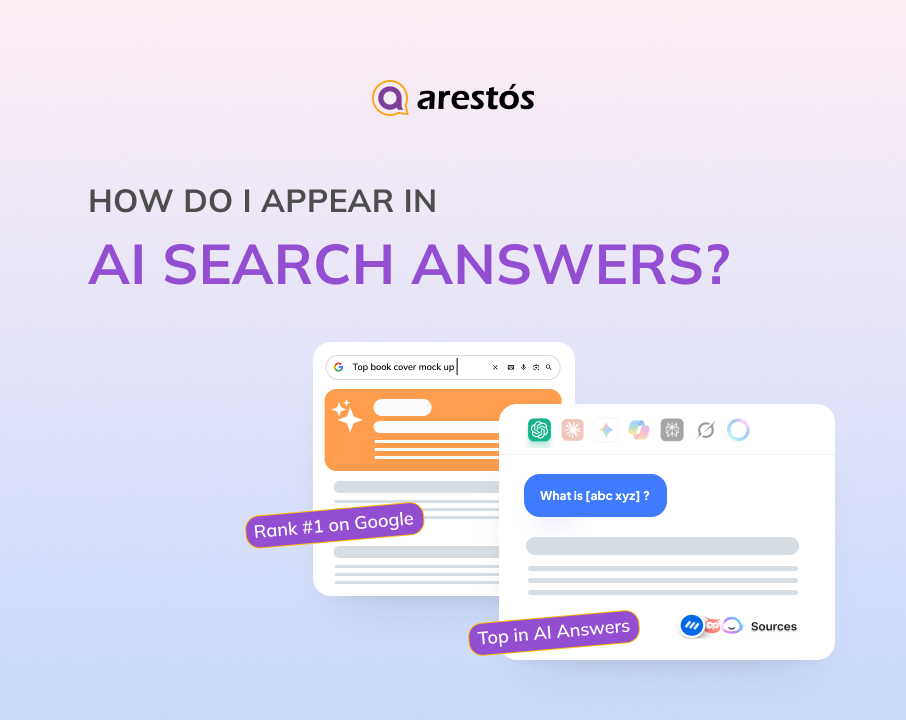
6. Can a website be cited by AI without ranking #1 on Google?
Yes. AI systems can cite content that provides the most relevant and trustworthy answer, even if it is not the top organic result.
Conclusion
As AI search continues to evolve, earning visibility is no longer just about ranking pages—it is about becoming a trusted source that AI systems choose to reference. Businesses that invest in building authority, creating valuable content, and improving their digital presence will be better positioned to succeed in the future of search.
Arestós helps businesses grow their presence across SEO, AEO, and GEO through technical optimization, authority-driven content, entity development, and AI search strategies designed for long-term visibility.
Contact us today to start building a stronger digital presence today.
Subscribe to our newsletter!
Get updated to
the lastest IT trends
Related Posts
Update the latest technology trends for your business